listicle
Affordable Concrete Floor Finish Options: 7 Budget Solutions
Table of Contents
- 7 Affordable Concrete Floor Finish Options That Actually Work
- 1. Concrete Paint vs. Stain: Which Budget Option Wins?
- 2. DIY Concrete Floor Finishes on a Budget
- 3. Best Budget Concrete Floor Sealers for Protection
- 4. Concrete Floor Resurfacing Budget Options for Damaged Surfaces
- 5. Epoxy Coatings: Balancing Cost and Durability
- 6. Alternative Budget Finishes: Rubber Tiles and Vinyl Overlays
- How to Choose Your Affordable Concrete Floor Finish Option
Affordable Concrete Floor Finish Options: 7 Budget Solutions
Last Updated: July 31, 2026
When your concrete floor looks worn, stained, or drab, replacement feels prohibitive. Yet affordable concrete floor finish options exist that transform spaces for a fraction of new flooring costs. At Concrete-Enhancements, we've spent over 20 years helping property owners across the Raleigh-Durham Triangle, NC Triad, and Coastal South Carolina discover budget-friendly finishes that deliver durability and aesthetic appeal without breaking the bank.
The challenge is knowing which finish delivers value for your situation. Some budget solutions fail within months; others require constant maintenance that erodes savings. This guide shows you which affordable concrete floor finish options work, which to avoid, and how much time and money each approach really requires.
Quick Comparison: Cost, Durability, and DIY Feasibility
| Finish Option | Typical Cost Range | Durability (Years) | DIY-Friendly | Best For |
|---|---|---|---|---|
| Concrete Paint | $0.40-$1.50/sq ft | 2-4 | Yes | Quick refresh on low-traffic areas |
| Acid Stain | $2-$6/sq ft | 10+ | Moderate | Unique, natural-looking finishes |
| Water-Based Stain | $2-$5/sq ft | 8-12 | Moderate | Predictable colors, interior spaces |
| Concrete Sealer | $0.40-$0.90/sq ft | 3-5 | Yes | Protecting existing finishes |
| Polished Concrete (DIY) | $1-$4/sq ft + rental | 10-15 | Challenging | Durable, low-maintenance look |
| Microtopping | $3-$8/sq ft | 5-10 | No | Resurfacing damaged concrete |
| Epoxy Coating (DIY) | $1.75-$2.50/sq ft | 5-10 | Difficult | Garages, workshops, high-traffic |
1. Concrete Paint vs. Stain: Which Budget Option Wins?
Concrete paint and stain represent two fundamentally different approaches to finishing concrete, each with distinct cost and longevity implications.
Concrete Paint: Pros, Cons, and Application Steps
Concrete paint sits on the surface, creating an opaque, uniform color finish. Products like Kilz Concrete & Garage Floor Paint cost less than $40 per gallon and cover approximately 400 square feet per gallon, making this one of the cheapest affordable concrete floor finish options available.
Paint is easy to apply, a homeowner with basic skills can roll it on in a weekend. Color is immediately visible with no surprises. The serious limitation: paint chips and peels. Unlike stains that chemically bond with concrete, paint sits on the surface. Heavy foot traffic, moisture, and freeze-thaw cycles cause failure. Most painted concrete floors need repainting every 2-4 years.
Application steps for concrete paint:
- Clean thoroughly. Pressure wash the concrete and let dry completely (24-48 hours).
- Repair cracks. Fill cracks wider than 1/8 inch with concrete caulk and sand smooth.
- Prime if necessary. Check product instructions; primer improves adhesion on slick or previously sealed concrete.
- Apply paint. Use a roller for large areas, brush for edges. Apply thin, even coats (typically 2 coats).
- Cure time. Do not walk on the floor for at least 24 hours; full cure takes 7 days.
Water-Based and Acid Stains: Durability and Color Variety
Stains chemically react with or penetrate concrete, becoming part of the surface rather than sitting on top. This explains why stains last 8-12 years or longer, while paint fails in 2-4 years.
Acid stains create translucent, variegated finishes with earthy tones, tans, browns, terra cottas, greens, and blue-blacks. Color is unpredictable because it reacts with minerals in your concrete, making each finish unique.
Water-based stains offer a wider color palette and predictable results. They deposit pigment into concrete pores without chemical reaction, ideal for matching a specific aesthetic. Water-based stains are also safer for indoor application.
Both stain types require excellent surface preparation. Concrete must be clean, free of sealers, and ideally ground to open pores. If your concrete is sealed or waxed, stain won't penetrate properly.
2. DIY Concrete Floor Finishes on a Budget
DIY finishes save labor costs, but not all affordable concrete floor finish options are equally suitable for DIYers.
Polished Concrete: Renting Equipment vs. Hiring Professionals
Polished concrete delivers a smooth, reflective, high-gloss finish lasting 10-15 years with minimal maintenance. DIY polishing costs $1-$4 per square foot with equipment rental at $200-$400 per day. For a 500-square-foot basement, you might spend $500-$800 total, versus $2,500-$4,000 for professional installation.
Polishing requires skill. You must maintain consistent pressure, work in overlapping passes, and progress through multiple grit levels (80, 120, 200, 400, 800, and 1500). Mistakes are costly; uneven pressure creates dull spots nearly impossible to fix without starting over.
Common Mistakes That Cost DIYers Money
Skipping surface preparation. Many DIYers apply stain or sealer to concrete that hasn't been properly cleaned or ground. Always clean aggressively and lightly grind the surface to open pores.
Not accounting for moisture. Concrete wicks moisture from below, especially in basements. Applying sealer, paint, or epoxy over damp concrete causes blistering and peeling within weeks. Test for moisture using a calcium chloride test or plastic sheet test (tape a sheet to concrete for 24 hours; condensation underneath indicates moisture). Address moisture before finishing.
Applying finishes in wrong conditions. Most coatings require application between 50°F and 85°F with relative humidity below 85%. Cold, damp weather causes slow cure, poor adhesion, and premature failure. Check product specifications and plan projects for favorable weather.
Underestimating prep time. Surface preparation typically accounts for 40-60% of total project time. Budget 2-3 days for prep on medium-sized floors.
3. Best Budget Concrete Floor Sealers for Protection
A sealer alone won't transform your concrete's appearance, but it protects whatever finish you've applied and extends its life significantly.
Penetrating vs. Topcoat Sealers: What Budget Allows
Penetrating sealers sink into concrete and harden the surface without creating a visible coating. They resist moisture, salt, and stains while maintaining natural appearance. Penetrating sealers cost $0.40-$0.60 per square foot and last 3-5 years before reapplication. They preserve the concrete's natural gray appearance or stain color and are less slippery than topcoat sealers.
Topcoat sealers (acrylic or polyurethane) sit on the surface and create a glossy, protective layer. They enhance color and create a wet-look appearance. Topcoat sealers cost $0.60-$0.90 per square foot and last 4-5 years. They're easier for DIYers to apply but become slippery when wet and may yellow over time.
Maintenance Lifecycle Costs: Sealing Frequency and Reapplication
A penetrating sealer on a 500-square-foot basement costs roughly $100-$150 in materials and lasts 3-5 years, or $20-$50 annually. Over 15 years, that's $300-$750 total.
A topcoat sealer costs $150-$225 upfront and lasts 4-5 years, roughly $30-$56 annually, or $450-$840 over 15 years. High-traffic areas require more frequent resealing.
4. Concrete Floor Resurfacing Budget Options for Damaged Surfaces
If your concrete is cracked, spalling, or severely stained, finishing with paint or stain won't solve underlying problems. Resurfacing is the answer.
Microtopping and Thin Overlays: Cost-Effective Repair
A microtopping is a thin layer of polymer-modified cement applied over damaged concrete, typically 1/8 inch to 1/4 inch thick. It covers cracks, spalls, and discoloration without removing old concrete. Microtopping costs $3-$8 per square foot and lasts 5-10 years. It can be stained, sealed, or polished to match your desired aesthetic.
The process:
- Clean and profile existing concrete
- Apply a bonding agent
- Trowel on microtopping in thin passes
- Smooth and finish the surface
- Cure for 24-48 hours before sealing
Microtopping requires skill to apply smoothly. DIY application is possible but risky; troweling technique directly affects final appearance. For large areas or visible spaces, professional installation is worth the cost.
When to Resurface vs. Paint or Seal
Resurface your concrete if cracks are wider than 1/4 inch, spalling covers more than 10% of the floor, the surface is severely uneven, or you want a completely fresh appearance. Paint or seal if the concrete is structurally sound with only minor surface issues, you want the quickest, cheapest solution, or you're comfortable with reapplication every 2-4 years.
5. Epoxy Coatings: Balancing Cost and Durability
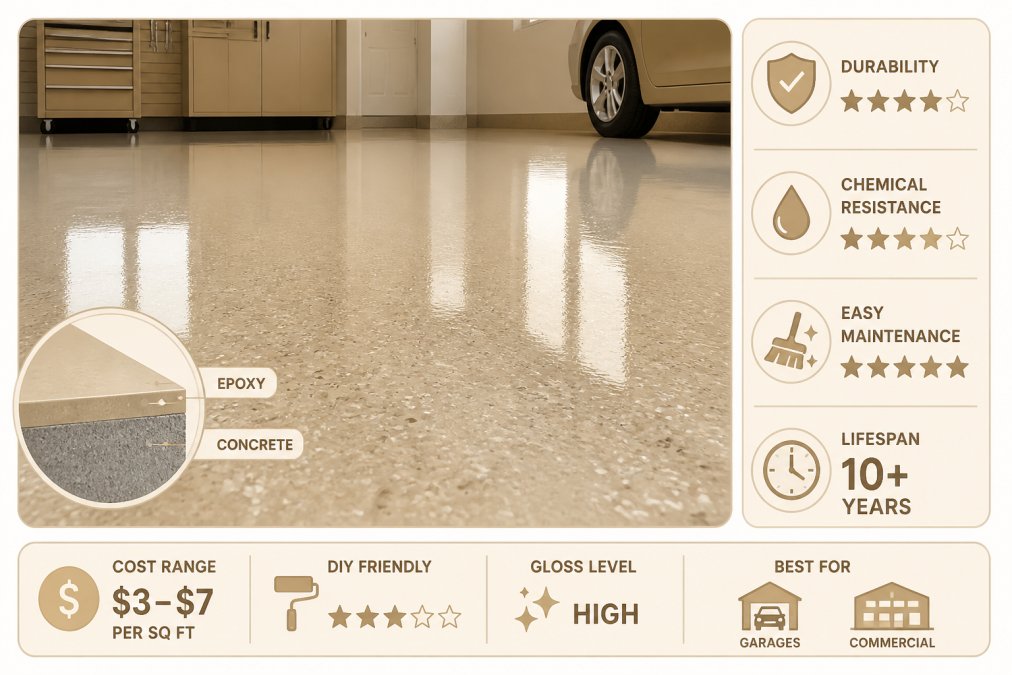
Epoxy is the gold standard for durable, attractive concrete finishes. It resists chemicals, stains, and abrasion far better than paint or sealer. The trade-off is higher cost and demanding application.
DIY Epoxy Application and Why Professional Installation Matters
DIY epoxy materials cost $1.75-$2.50 per square foot. For a 500-square-foot garage, that's $875-$1,250 in materials. Professional installation runs $5-$9 per square foot, or $2,500-$4,500 for the same space.
Epoxy is unforgiving. It's a two-part system requiring exact mixing ratios and application within a narrow window before curing. Temperature and humidity must be within specific ranges. Many homeowners apply DIY epoxy, see it fail within 1-2 years, then hire professionals to strip and redo it, ultimately spending more than if they'd hired professionals initially.
Environmental Impact and VOC Levels in Budget Epoxies
Volatile organic compounds (VOCs) in epoxy coatings are a health and environmental concern. Traditional epoxies release significant VOCs during application and curing, requiring excellent ventilation and personal protective equipment.
Water-based epoxies have lower VOC content but are less durable and more expensive. For indoor application, choose low-VOC or water-based options and ensure good ventilation during application and curing (24-72 hours).
6. Alternative Budget Finishes: Rubber Tiles and Vinyl Overlays
Not every concrete floor finish needs direct application to concrete. Overlays and tiles offer temporary or semi-permanent solutions that are easy to install and remove.
Peel-and-Stick Vinyl vs. Interlocking Rubber: Temporary vs. Permanent
Peel-and-stick vinyl floor tiles cost $1.50-$4 per square foot and require no tools, adhesive, or installation skill. They come in hundreds of styles and colors, ideal for renters or anyone hesitant to commit to a permanent finish. Adhesive degrades over time, especially in warm basements or high-traffic areas. Tiles may curl at edges or lift within 2-3 years.
Interlocking rubber floor tiles offer more durability and comfort. They're naturally moisture-resistant, provide cushioning underfoot, and lock together without adhesive. They cost $2-$5 per square foot but last 10+ years. Rubber tiles are ideal for basements, home gyms, and playrooms. The trade-off is rubber smell (though low-odor options exist) and heavier installation than vinyl tiles.
How to Choose Your Affordable Concrete Floor Finish Option
Decision Framework: Budget, Durability, and Application Method
Start by answering three questions:
1. What's your total budget?
- Under $500: Concrete paint or penetrating sealer
- $500-$1,500: Water-based stain or acid stain
- $1,500-$3,000: Polished concrete (DIY) or professional sealer
- $3,000+: Microtopping, epoxy (DIY), or professional polishing
2. How long do you want the finish to last?
- 2-4 years: Paint (accept reapplication)
- 5-8 years: Sealer, water-based stain, DIY epoxy
- 10+ years: Acid stain, polished concrete, professional epoxy, microtopping
3. Are you DIY-capable, or do you need professionals?
- DIY-friendly: Paint, water-based stain, sealer, peel-and-stick vinyl, rubber tiles
- Moderate DIY: Acid stain, polished concrete
- Professional-recommended: Epoxy, microtopping, complex polishing
Choose the option satisfying all three constraints. If your budget is $800 and you need a 10-year finish, stain is your answer. If you want to DIY with $2,000, polished concrete with rented equipment is feasible.
Surface Preparation: The Hidden Cost That Determines Success
Surface preparation determines whether your finish succeeds or fails.
For paint or sealer: Pressure wash the concrete (2,500-3,000 PSI) and remove all dirt, oil, loose material, and old coatings. Allow 24-48 hours drying time. Repair cracks and spalls with concrete caulk or patching compound.
For stain: In addition to cleaning, lightly grind the concrete surface to open pores. A concrete grinder rental costs $50-$100 per day. This step is non-negotiable for stain adhesion.
For epoxy: Clean aggressively, then etch the concrete with a concrete etching solution. Etching opens pores and improves adhesion.
For polished concrete: Professional-grade preparation involves grinding with progressively finer grits, requiring equipment and skill.
Budget 30-50% of your total timeline for preparation. A 500-square-foot floor might take 2-3 days to prepare properly. Rushing this phase guarantees poor results.
Choosing the right affordable concrete floor finish option means matching your budget, durability expectations, and skill level to a realistic solution. Concrete-Enhancements has helped property owners across the Raleigh-Durham Triangle, NC Triad, and Coastal South Carolina transform worn concrete into durable, attractive surfaces. Whether you're resurfacing a residential patio, driveway, or pool deck, or you need high-performance epoxy flooring for a commercial warehouse, our CTi Certified team can guide you toward the best finish for your specific situation. Contact us at (919) 824-5403 or craigrfear@gmail.com for a free estimate and professional assessment of your concrete's condition and your project goals.
Frequently Asked Questions
What is the cheapest way to finish a concrete floor?
Concrete paint is typically the most budget-friendly affordable concrete floor finish option, costing less than $40 per gallon for products like Kilz Concrete & Garage Floor Paint. Water-based concrete stains ($35-$60 per gallon) and penetrating sealers ($30-$80 per gallon) are also affordable choices. However, the cheapest option upfront may require more frequent reapplication, affecting long-term lifecycle costs. Surface preparation is critical, skipping this step leads to premature peeling and failure.
Is it cheaper to paint or stain a concrete floor?
Concrete paint is generally cheaper initially ($2-$5 per square foot for DIY materials), but staining offers better durability and aesthetic appeal. Water-based stains cost $2-$5 per square foot, while acid stains run $2-$6 per square foot. Paint may require recoating every 1-3 years, whereas stains penetrate the concrete and last longer. For long-term value, staining is often the more cost-effective choice despite higher upfront costs, especially in high-traffic areas.
Can you DIY an affordable concrete floor finish?
Yes, many affordable options are DIY-friendly, including concrete paint, water-based stains, and polished concrete with rented equipment ($200-$400 per day). However, DIY success depends on proper surface preparation and application technique. Common mistakes, like inadequate grinding, poor moisture barriers, or improper sealing, often result in peeling or failure within a year. Professional installation guarantees durability but increases cost. For best results on a budget, consider hiring professionals for surface prep and DIY the finish application.
What are the best sealers for concrete floors on a budget?
Penetrating sealers ($0.40-$0.90 per square foot) offer excellent budget value, protecting concrete from moisture and stains without altering appearance. Acrylic sealers are affordable and easy to apply but require reapplication every 1-3 years. For longer-lasting protection, polyurethane sealers cost slightly more but extend reapplication intervals. Budget-conscious homeowners should factor in maintenance frequency: cheaper sealers may save money upfront but cost more over time due to repeated applications.
How much does concrete floor resurfacing cost compared to other finishes?
Concrete floor resurfacing with microtopping or thin overlays provides a cost-effective alternative to full replacement, though pricing depends on substrate condition and square footage. Resurfacing works best for damaged or heavily worn concrete, offering better results than paint or sealers alone. For minor wear, concrete paint ($2-$5/sq ft) or stains ($2-$6/sq ft) are cheaper alternatives. Resurfacing is ideal when existing concrete has structural damage, spalling, or significant aesthetic issues that cheaper finishes cannot address.
This article was written using GrandRanker
Frequently Asked Questions
Concrete paint is typically the most budget-friendly affordable concrete floor finish option, costing less than $40 per gallon for products like Kilz Concrete & Garage Floor Paint. Water-based concrete stains ($35–$60 per gallon) and penetrating sealers ($30–$80 per gallon) are also affordable choices. However, the cheapest option upfront may require more frequent reapplication, affecting long-term lifecycle costs. Surface preparation is critical—skipping this step leads to premature peeling and failure.
Concrete paint is generally cheaper initially ($2–$5 per square foot for DIY materials), but staining offers better durability and aesthetic appeal. Water-based stains cost $2–$5 per square foot, while acid stains run $2–$6 per square foot. Paint may require recoating every 1–3 years, whereas stains penetrate the concrete and last longer. For long-term value, staining is often the more cost-effective choice despite higher upfront costs, especially in high-traffic areas.
Yes, many affordable options are DIY-friendly, including concrete paint, water-based stains, and polished concrete with rented equipment ($200–$400 per day). However, DIY success depends on proper surface preparation and application technique. Common mistakes—like inadequate grinding, poor moisture barriers, or improper sealing—often result in peeling or failure within a year. Professional installation guarantees durability but increases cost. For best results on a budget, consider hiring professionals for surface prep and DIY the finish application.
Penetrating sealers ($0.40–$0.90 per square foot) offer excellent budget value, protecting concrete from moisture and stains without altering appearance. Acrylic sealers are affordable and easy to apply but require reapplication every 1–3 years. For longer-lasting protection, polyurethane sealers cost slightly more but extend reapplication intervals. Budget-conscious homeowners should factor in maintenance frequency: cheaper sealers may save money upfront but cost more over time due to repeated applications.
Concrete floor resurfacing with microtopping or thin overlays provides a cost-effective alternative to full replacement, though pricing depends on substrate condition and square footage. Resurfacing works best for damaged or heavily worn concrete, offering better results than paint or sealers alone. For minor wear, concrete paint ($2–$5/sq ft) or stains ($2–$6/sq ft) are cheaper alternatives. Resurfacing is ideal when existing concrete has structural damage, spalling, or significant aesthetic issues that cheaper finishes cannot address.