ultimate-guide
Benefits of Epoxy Floor Coatings 2026
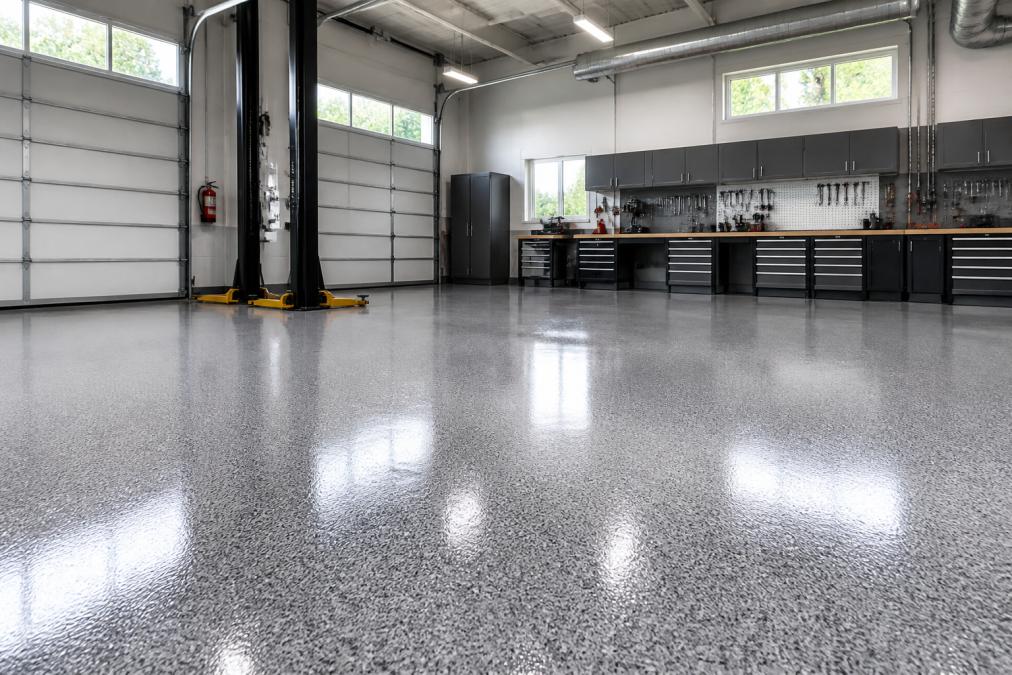
Table of Contents
- Why Epoxy Floor Coatings Deliver Superior Protection
- Durability and Structural Resilience
- Epoxy Floor Cost Per Square Foot 2026
- Epoxy Floor Maintenance Tips and Long-Term Care
- Pros and Cons of Epoxy Garage Floors
- Commercial and Residential Applications
- Return on Investment and Long-Term Value
- Conclusion
Last Updated: August 12, 2026
Why Epoxy Floor Coatings Deliver Superior Protection
Epoxy floor coatings have become the gold standard for protecting concrete surfaces across residential and commercial spaces. Unlike paint or sealers that sit on top of concrete, epoxy bonds to the substrate, creating a seamless flooring system that resists peeling, cracking, and failure.
A properly installed epoxy coating system reduces maintenance costs, extends concrete life by decades, and maintains appearance far longer than uncoated surfaces. For commercial facilities, this means lower downtime and fewer disruptions. For residential spaces, the investment continues paying dividends year after year.
The distinction between basic epoxy and industrial-grade epoxy matters significantly. Basic coatings work for light-duty residential applications. Industrial-grade systems, engineered for warehouses, manufacturing floors, and high-traffic commercial environments, deliver performance where it's non-negotiable.
Durability and Structural Resilience
Epoxy floor coatings deliver exceptional durability because they bond chemically to the concrete substrate, creating a monolithic protective layer that prevents peeling even under extreme conditions.
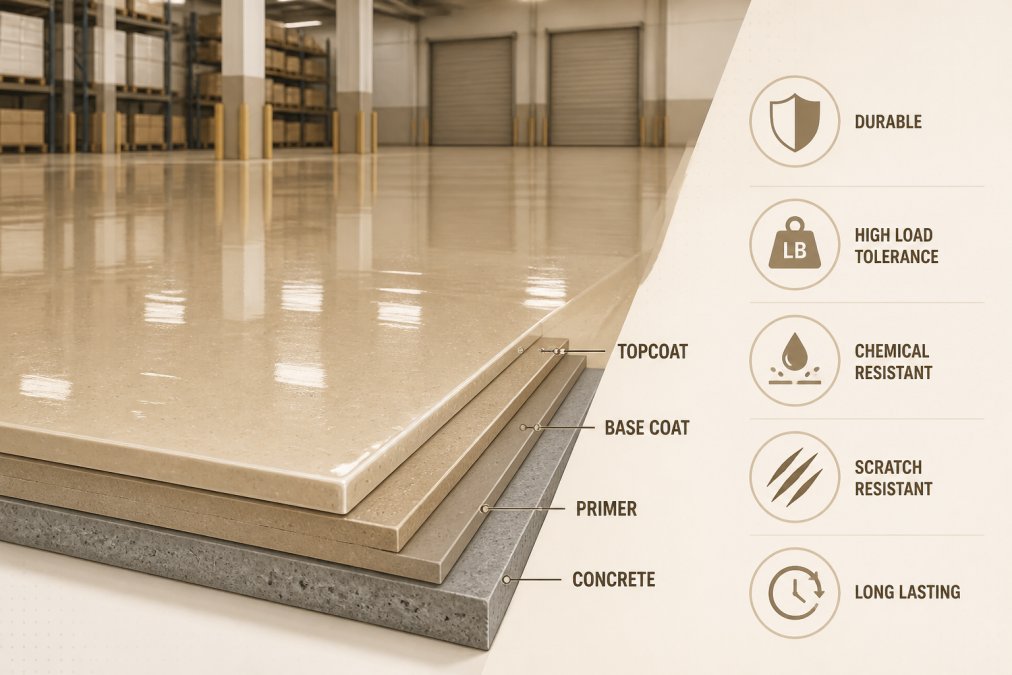
Epoxy's tensile strength and impact resistance allow it to flex slightly under thermal shock without cracking or delaminating. This is critical in climates with significant seasonal temperature swings, where concrete expands and contracts throughout the year.
Abrasion resistance is another defining characteristic. High-traffic areas experience constant wear from foot traffic, rolling equipment, and sliding objects. Epoxy's hard, smooth surface resists this wear far more effectively than bare concrete, which deteriorates visibly within months under heavy use.
Chemical resistance is equally important. Epoxy floor coatings repel spills from oils, solvents, cleaning agents, and industrial chemicals that would otherwise penetrate bare concrete and cause permanent staining or degradation. The seamless nature means there are no pores for chemicals to seep into.
Properly formulated epoxy systems allow controlled moisture vapor transmission, preventing the bubbling and failure that occurs when poor-quality coatings trap moisture beneath the surface.
Epoxy Floor Cost Per Square Foot 2026
Pricing for epoxy floor coatings varies based on substrate condition, coating thickness, finish type, and whether the project is residential or commercial.
Substrate preparation typically represents 30-40% of total project cost. If your concrete is in good condition, preparation costs are lower. If it has cracks, spalling, moisture issues, or existing coatings requiring removal, preparation becomes more extensive and expensive. Inadequate surface preparation is where many DIY attempts fail, leading to poor adhesion and premature failure.
The epoxy system itself comes in different grades. Basic systems cost less but offer lower performance and durability. Industrial-grade polyaspartic and epoxy systems cost more upfront but deliver superior UV stability, faster curing times, and longer service life. For commercial applications, the investment in higher-quality systems pays back quickly through reduced maintenance and extended floor longevity.
Rather than guessing at generic per-square-foot averages, contact Concrete-Enhancements for a detailed estimate. We provide free assessments that break down substrate preparation, material costs, and labor for your specific situation, accounting for real-world variables.
Epoxy Floor Maintenance Tips and Long-Term Care
Proper maintenance separates epoxy floors that last 15-20 years from those that fail within 5-7 years. The good news is that epoxy requires far less maintenance than bare concrete.
Regular cleaning is foundational. Sweep or vacuum frequently to remove dirt and debris that can scratch the surface. For routine cleaning, use pH-neutral cleaners rather than acidic or alkaline solutions that can damage the coating. A mop with warm water and mild detergent is sufficient for most situations.
Address spills immediately. While epoxy resists chemical penetration, sitting spills can stain the surface or affect the coating's finish over extended periods.
Avoid dragging heavy objects across the floor. Use furniture pads under equipment and machinery to prevent scratching and gouging. In warehouses and commercial spaces, this practice significantly extends the coating's lifespan.
Inspect the coating periodically for signs of wear or damage. Small areas of peeling or chipping should be addressed before they expand. Catching problems early prevents minor issues from becoming major failures.
Moisture management is critical, especially in basements or high-humidity areas. If moisture is seeping through concrete, it must be addressed before coating application. If moisture problems develop after installation, they need immediate attention to prevent coating failure.
The maintenance cycle typically involves annual inspections and spot cleaning. Commercial facilities with heavy traffic may benefit from periodic deep cleaning or burnishing. High-traffic areas might require recoating every 10-15 years, while lighter-use areas can go 15-20 years before needing attention.
Pros and Cons of Epoxy Garage Floors
Epoxy garage floors offer distinct advantages for homeowners, but they're not universally ideal for every situation.
The primary advantage is durability. A garage floor experiences constant wear from vehicle weight, oil and fluid spills, temperature changes, and impact. Epoxy handles all of this far better than bare concrete, preventing staining from automotive fluids and resisting tire marks.
Aesthetic appeal is significant. Epoxy comes in numerous colors and finishes, solid colors, metallic effects, flaked designs, and high-gloss or matte options. Homeowners can customize their garage floor to match their home's design or create a showroom-quality appearance.
Call (919) 824-5403 or email craigrfear@gmail.com for a free estimate →
Ease of cleaning is transformative. Epoxy's seamless, non-porous surface means spills don't soak into concrete. A quick sweep and mop keeps the floor pristine, compared to bare concrete which absorbs oils and stains permanently.
The main drawback is surface preparation. Epoxy requires thorough concrete preparation, grinding, cleaning, and sometimes repairing damaged areas. This labor-intensive process represents a significant portion of project cost. Inadequate preparation is the leading cause of epoxy failure in DIY projects.
Curing time is another consideration. Epoxy requires 5-7 days of cure time before normal use, with full hardness developing over several weeks. During this period, you cannot park vehicles in the garage. For homeowners with only one garage, this disruption can be inconvenient.
Slip resistance can be a concern in wet conditions. High-gloss epoxy becomes slippery when wet. Concrete-Enhancements addresses this by incorporating slip-resistant additives into the coating, creating a textured surface that maintains traction even when moisture is present.
Commercial and Residential Applications
Epoxy floor coatings perform exceptionally well in both residential and commercial settings, though specific applications and performance requirements differ significantly.
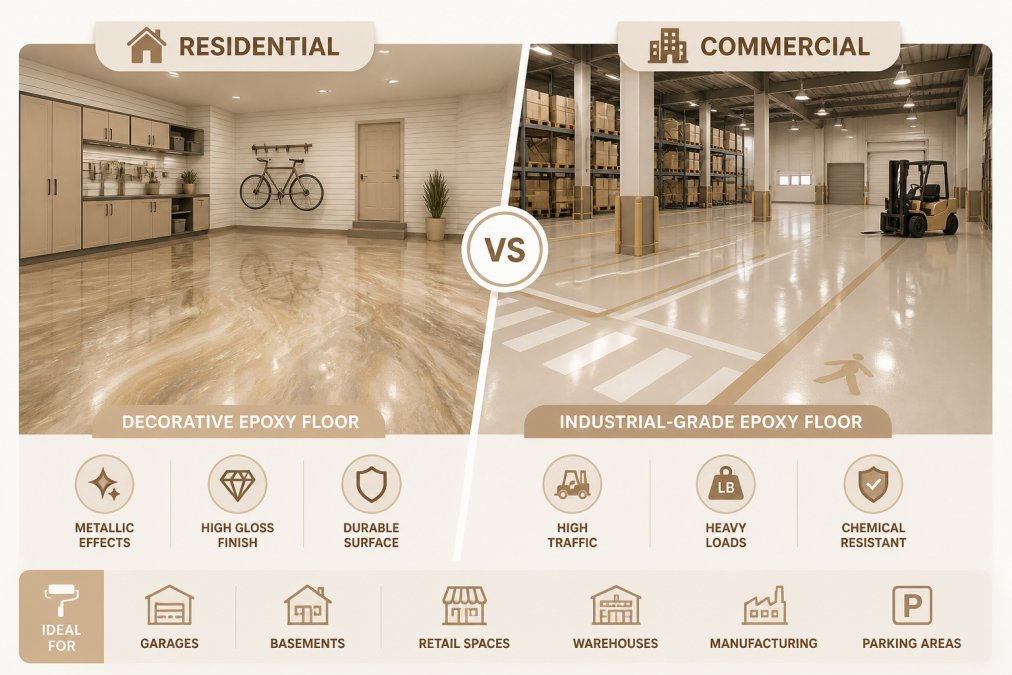
Residential applications typically include garages, basements, laundry rooms, and occasionally kitchens or entryways. Homeowners choose epoxy primarily for protection and aesthetics. Decorative options allow homeowners to express personal style while gaining functional protection.
Residential projects generally use standard epoxy systems with aesthetic finishes. Curing time and application disruption matter more because homeowners need access to their spaces quickly.
Commercial applications are far more demanding. Warehouses, manufacturing facilities, retail showrooms, food processing plants, and healthcare facilities depend on epoxy coatings for operational performance. These environments feature heavy equipment, chemical exposure, high foot traffic, and stringent cleanliness standards.
Industrial-grade epoxy systems are engineered for these conditions, offering superior chemical resistance, higher abrasion resistance, and faster curing times to minimize facility downtime. In pharmaceutical or food production facilities, epoxy coatings meet strict hygiene requirements because their seamless, non-porous surface prevents bacterial growth and contamination.
Commercial facilities benefit from reduced maintenance cycles. Bare concrete requires constant cleaning and sealing. Epoxy-coated floors stay cleaner, require less frequent maintenance, and reduce labor costs associated with floor care.
Church facilities and high-traffic institutional spaces represent a growing application area. Fellowship halls and common areas experience constant foot traffic and require durable, low-maintenance flooring. Epoxy coatings reduce cleaning labor and maintain appearance far longer than vinyl or tile.
Return on Investment and Long-Term Value
The true value of epoxy floor coatings emerges when calculating long-term costs rather than focusing solely on installation price. A properly installed epoxy system generates measurable returns through extended concrete life, reduced maintenance, and improved facility functionality.
Concrete without protection deteriorates predictably. Freeze-thaw cycles crack the surface, moisture causes spalling, and chemical exposure creates permanent damage. Within 10-15 years, uncoated concrete in high-traffic areas becomes unsafe and requires expensive repair or replacement. Epoxy coatings prevent this deterioration, extending concrete life by 15-20 years or more.
The maintenance cost differential is substantial. Bare concrete requires regular sealing, aggressive cleaning, and frequent repairs. Epoxy-coated floors require basic cleaning and occasional inspection. The labor savings alone justify the initial investment within 5-7 years for most commercial applications.
Facility downtime represents a hidden cost. When concrete deteriorates and requires repair, facilities must close or operate with restricted access. Epoxy coatings prevent the deterioration that causes this downtime, protecting facility operations and revenue.
Property value increases when you invest in durable, attractive flooring. A residential garage with professional epoxy coating appeals to buyers and justifies higher property valuations. Commercial facilities with well-maintained epoxy floors present better to clients and tenants, supporting higher lease rates or sale prices.
Calculating ROI requires comparing total cost of ownership, installation plus maintenance over the coating's lifespan, against alternatives. For most applications, epoxy delivers the lowest total cost of ownership while providing superior performance and aesthetics.
Epoxy floor coatings represent a strategic investment in concrete protection and property value. Whether you're protecting a residential garage, warehouse, retail showroom, or institutional facility, the durability, chemical resistance, and aesthetic benefits deliver measurable returns. Concrete-Enhancements has spent over two decades installing epoxy systems that continue performing reliably across residential and commercial properties throughout the region. The difference between amateur installation and professional application becomes evident within the first year, proper substrate preparation, correct material selection, and expert installation determine whether your epoxy floor lasts 5 years or 20 years. Call (919) 824-5403 or email craigrfear@gmail.com for a free estimate. Our CTi Certified team will assess your concrete, recommend the right epoxy system for your specific application, and deliver the professional installation that transforms your surface into a durable, attractive asset.
Frequently Asked Questions
What are the downsides of epoxy floor coating?
Epoxy coatings require proper substrate preparation and professional application, poor installation leads to peeling or adhesion failure. The initial cost is significant, and UV exposure can cause yellowing in some formulations. High-gloss finishes become slippery when wet unless slip-resistant additives are included. Curing time extends facility downtime, and certain epoxy systems are sensitive to moisture during application. Thermal shock from temperature swings can create stress on the coating. Despite these limitations, professional installation and proper maintenance minimize these issues.
What happens to an epoxy floor after 5 years?
A properly installed epoxy floor coating maintains its integrity for 5-10 years or longer in residential settings, and up to 15+ years in commercial spaces with regular maintenance. After 5 years, high-traffic areas may show minor wear or slight dulling of the finish, but the protective barrier remains intact. Chemical spills and abrasion resistance hold up well if the floor receives routine cleaning. Professional topcoat applications extend durability. The key factor is maintenance, floors neglected during this period degrade faster than those cleaned regularly.
Are epoxy floors really worth it?
Epoxy floors deliver strong ROI for both residential and commercial properties. They protect concrete from moisture vapor transmission, chemical damage, and surface wear, eliminating costly concrete repair down the road. Residential homeowners see increased property value and aesthetic appeal. Commercial facility operators reduce maintenance cycles and downtime. The investment depends on your space's use: high-traffic warehouses and commercial showrooms see faster returns, while residential patios and driveways benefit from enhanced durability and appearance. Long-term maintenance cost savings often justify the upfront expense.
How does epoxy compare to polyaspartic coatings in 2026?
Epoxy and polyaspartic coatings both provide industrial-grade protection, but they differ in application and performance. Epoxy offers superior bond strength and tensile strength, making it ideal for heavy-traffic commercial spaces. Polyaspartic coatings cure faster, reducing facility downtime, and provide better UV stability for outdoor applications. Epoxy typically costs less upfront, while polyaspartic commands a premium for faster installation. Both resist chemical spills and abrasion. The choice depends on your timeline, budget, and exposure to UV light, commercial warehouses often favor epoxy for cost-effectiveness, while outdoor pool decks benefit from polyaspartic's UV resistance.
This article was written using GrandRanker
Frequently Asked Questions
Epoxy coatings require proper substrate preparation and professional application—poor installation leads to peeling or adhesion failure. The initial cost is significant, and UV exposure can cause yellowing in some formulations. High-gloss finishes become slippery when wet unless slip-resistant additives are included. Curing time extends facility downtime, and certain epoxy systems are sensitive to moisture during application. Thermal shock from temperature swings can create stress on the coating. Despite these limitations, professional installation and proper maintenance minimize these issues.
A properly installed epoxy floor coating maintains its integrity for 5-10 years or longer in residential settings, and up to 15+ years in commercial spaces with regular maintenance. After 5 years, high-traffic areas may show minor wear or slight dulling of the finish, but the protective barrier remains intact. Chemical spills and abrasion resistance hold up well if the floor receives routine cleaning. Professional topcoat applications extend durability. The key factor is maintenance—floors neglected during this period degrade faster than those cleaned regularly.
Epoxy floors deliver strong ROI for both residential and commercial properties. They protect concrete from moisture vapor transmission, chemical damage, and surface wear—eliminating costly concrete repair down the road. Residential homeowners see increased property value and aesthetic appeal. Commercial facility operators reduce maintenance cycles and downtime. The investment depends on your space's use: high-traffic warehouses and commercial showrooms see faster returns, while residential patios and driveways benefit from enhanced durability and appearance. Long-term maintenance cost savings often justify the upfront expense.
Epoxy and polyaspartic coatings both provide industrial-grade protection, but they differ in application and performance. Epoxy offers superior bond strength and tensile strength, making it ideal for heavy-traffic commercial spaces. Polyaspartic coatings cure faster, reducing facility downtime, and provide better UV stability for outdoor applications. Epoxy typically costs less upfront, while polyaspartic commands a premium for faster installation. Both resist chemical spills and abrasion. The choice depends on your timeline, budget, and exposure to UV light—commercial warehouses often favor epoxy for cost-effectiveness, while outdoor pool decks benefit from polyaspartic's UV resistance.