ultimate-guide
Best Garage Floor Epoxy for Hot Climates: 2026 Guide
Table of Contents
- Why Standard Garage Floor Epoxy Fails in Hot Climates
- Best Garage Floor Epoxy for Hot Climates: Quick Comparison
- Polyaspartic vs Epoxy for Garage Floors: Which Handles Heat Better?
- How to Prepare Concrete for Epoxy in Hot Weather
- Epoxy Floor Curing Time in Summer: What to Expect
- Top Epoxy and Polyaspartic Systems for Hot Garages
- Frequently Asked Questions
Last Updated: September 12, 2026
Why Standard Garage Floor Epoxy Fails in Hot Climates
Heat breaks epoxy in ways most product labels never mention. Standard solvent-based and water-based kits cure too fast as ambient temperature climbs, trapping stress inside the film before it bonds to the concrete. That stress shows up months later as peeling, bubbling, or a chalky surface that never quite hardens.
We've watched this play out across hundreds of garage floors. The problem isn't the epoxy itself, most epoxy is formulated for moderate conditions, and a garage in full summer sun is anything but moderate.
Hot Tire Pickup and Thermal Shock
Hot tire pickup is the most common failure mode for garage floor epoxy in hot climates. A tire that's been baking on asphalt transfers heat fast, softening the topcoat until the tire lifts the coating off the concrete.
Thermal shock compounds the problem. Concrete and epoxy expand and contract at different rates, and in a garage that swings from cool nights to triple-digit afternoons, that mismatch pulls the coating away from the slab, de-lamination.
UV Yellowing and Moisture Vapor Transmission
Sunlight through an open garage door degrades epoxy over time. Most standard epoxy resins yellow under UV, turning a clean gray floor amber within a couple of seasons. Polyaspartic topcoats solve this because they're UV-stable.
Moisture vapor transmission, or MVT, is the invisible culprit. Concrete is porous, and ground moisture rises through the slab continuously. When that vapor hits a sealed epoxy layer, hydrostatic pressure builds until the coating blisters.
Best Garage Floor Epoxy for Hot Climates: Quick Comparison
If you want the short answer: high-solids epoxy paired with a polyaspartic topcoat handles heat best, and professional installation beats DIY kits every time in hot, humid conditions.
| System Type | Heat Resistance | UV Stability | Cure Speed | Best For |
|---|---|---|---|---|
| Standard water-based epoxy | Low | Poor | Slow | Mild climates only |
| High-solids epoxy | High | Moderate | Moderate | Hot garages with topcoat |
| Polyaspartic coating | Very high | Excellent | Very fast | Extreme heat, sun exposure |
| Epoxy + polyaspartic topcoat | Very high | Excellent | Fast | Best overall for hot climates |
Pure epoxy struggles on its own in high heat. Add a polyaspartic topcoat and you get the chemical resistance of epoxy with the UV and heat tolerance of polyaspartic.
Polyaspartic vs Epoxy for Garage Floors: Which Handles Heat Better?
Polyaspartic wins on heat and UV performance; epoxy wins on cost and chemical resistance to certain solvents. The best systems combine both rather than choosing one.
Here's the trade-off in practice:
- Polyaspartic cures in a fraction of the time, stays flexible through thermal cycling, and resists yellowing. It costs more and demands fast, skilled application because the pot life is short.
- Epoxy bonds aggressively to prepared concrete and handles abrasion and impact well. It yellows under UV and softens in extreme heat without a protective topcoat.
A common mistake is treating this as either-or. A high-solids epoxy base coat plus a polyaspartic topcoat gives you the bond strength of epoxy and the weather resistance of polyaspartic. That's the combination we specify most often for garages that see direct summer sun.
How to Prepare Concrete for Epoxy in Hot Weather
Surface preparation decides whether your coating lasts five years or fifteen. In hot weather, concrete dries faster, dust control matters more, and the window before the slab gets too warm for adhesion is narrower. But the biggest variable in a hot, humid climate isn't the surface profile, it's what's happening underneath the slab.
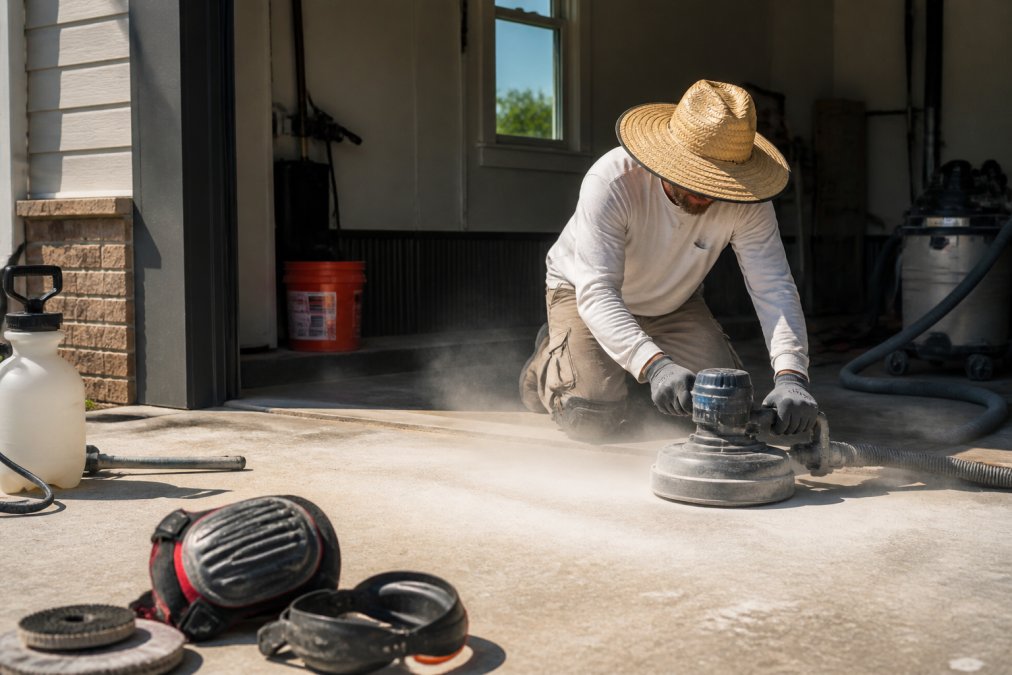
Here's the sequence that works:
- Test for moisture first. This step, which most DIY guides bury, determines whether your coating survives year two. See the MVT section below.
- Profile the surface. Diamond grinding creates the profile epoxy needs to grip, typically CSP 2 to CSP 3 for garage floors. Acid etching is unreliable on hot, dry concrete because the reaction is uneven, leaving some areas too smooth and others too aggressive.
- Repair cracks and spalls. Fill them before coating, not after. Thermal movement widens existing cracks, so a crack that's cosmetic in spring can telegraph through a coating by August.
- Clean and degrease. Any oil residue kills bond strength, and in a hot garage oils and tire dressings bake into the slab and are harder to lift.
- Check slab temperature. If the concrete is too warm to touch comfortably, wait for morning. Most manufacturers specify roughly 60°F to 85°F slab temperature; above that, pot life collapses and the coating can skin over before it bonds.
Moisture Vapor Transmission Testing: The Step That Decides Everything
MVT testing measures how much moisture rises through your slab, usually in pounds per 1,000 square feet over 24 hours. In hot, humid regions, it's the most common reason a coating that looked perfect on day one blisters from below six months later.
The standard field methods:
Call (919) 824-5403 or email craigrfear@gmail.com for a free estimate →
- Calcium chloride test (ASTM F1869). A measured dish of calcium chloride is sealed under a plastic dome on the slab for 60 to 72 hours (astm.org). The weight gain converts to a pounds-per-1,000-square-feet-per-24-hours number. It's the traditional field method, still widely used.
- In-situ relative humidity probe (ASTM F2170). Holes are drilled into the slab, sleeves inserted, and probes measure internal relative humidity once it equilibrates, typically 24 hours per hole (astm.org). Many manufacturers prefer this method because it measures the slab's internal condition rather than surface emission rate.
What the numbers mean. Most manufacturers publish a maximum allowable MVT rate, often around 3 pounds per 1,000 square feet per 24 hours for standard epoxy, with high-performance systems rated higher (PubMed). If your slab tests above the limit, either apply a moisture-mitigating primer or epoxy system rated for higher MVT, or choose a different floor covering. Coating over a high-MVT slab without mitigation is the top reason coatings blister from below in humid, hot regions.
Why This Matters More in Hot Climates
Hot air holds more moisture, and in humid regions vapor pressure under a slab is higher in summer than winter. A slab that behaves in a moderate climate can push enough vapor in July to lift a coating that would have been fine elsewhere. Combined with the thermal expansion stress described earlier, that's two forces working against the bond line at once. Testing for MVT before you coat isn't optional in a hot, humid climate, it's the difference between a floor and a redo.
Epoxy Floor Curing Time in Summer: What to Expect
Cure time shrinks dramatically in summer heat, and that cuts both ways. A floor that takes 24 hours to cure at 70°F might be walkable in 8 to 12 hours at 90°F, but the recoat window also closes faster, sometimes within 30 to 60 minutes for polyaspartic.
The practical implications:
- Work in small sections so you can maintain a wet edge
- Mix only what you can apply within the pot life
- Avoid applying in direct afternoon sun when slab temperature peaks
- Plan your recoat window before you start, not mid-project
Ambient temperature above 90°F shortens pot life and cure time for nearly every two-part system. If the forecast is extreme, start at dawn.
VOC Compliance and Ventilation During Application
VOC regulations vary by state and region, and high-heat areas often have stricter air quality rules. Before you buy any solvent-based product, check your local air quality management district requirements. Some regions restrict solvent-based coatings entirely during summer ozone season.
Ventilation matters for two reasons: your safety and the coating's cure. A garage with the door cracked isn't enough. Use box fans to push fresh air through, and never apply solvent-based products in an enclosed space without respiratory protection. Low-VOC and water-based options exist, but they trade some chemical resistance for easier compliance.
Top Epoxy and Polyaspartic Systems for Hot Garages
The right system depends on your slab, sun exposure, and whether you want a DIY kit or turnkey installation. In hot climates, three variables separate a floor that lasts from one that fails: solids content by volume, the glass transition temperature (Tg) of the cured film, and whether the topcoat is UV-stable. Most labels publish only the first.
What Actually Matters in a Hot-Climate System
- Solids content by volume. High-solids epoxy (typically 85-100% solids) shrinks less as it cures, which means less internal stress when slab temperature swings. Standard water-based kits often run 40-60% solids and are the most likely to fail under thermal cycling.
- Glass transition temperature (Tg). The temperature at which a cured coating softens and becomes vulnerable to hot-tire pickup. A coating with a Tg near or below your slab's peak surface temperature, which can exceed 130°F in full summer sun, will soften under a hot tire. High-solids epoxy and polyaspartic systems generally have higher Tg than economy water-based kits.
- UV stability. Standard epoxy amines yellow under UV. Polyaspartic and polyurea topcoats are UV-stable and are the standard fix for garages that see direct sun through an open door.
- Application window. Polyaspartic pot life can be as short as 5-20 minutes at 90°F. That's a real constraint on DIY work in summer.
Systems Worth Knowing
Concrete-Enhancements is our top pick for homeowners and commercial property managers who want a floor that survives a hot climate. As a CTi Certified Dealer with over 20 years of experience, we handle moisture testing, surface preparation, and system selection as one package, exactly where DIY projects fail. We serve the Raleigh-Durham Triangle, NC Triad, and Coastal SC, where summer heat and humidity punish poorly specified coatings.
The Thermal Expansion Angle Most Guides Skip
Here's the part almost no product page mentions: in a hot climate, the slab itself moves. Concrete expands and contracts with temperature, and epoxy, even high-solids epoxy, has a different coefficient of thermal expansion. Over a garage that swings from 60°F nights to 110°F afternoons, that mismatch creates shear stress at the bond line. The coating with the highest tensile bond strength and most flexible cured film wins. That's why a high-solids epoxy base coat paired with a flexible polyaspartic topcoat outperforms either product alone in extreme heat, the epoxy grips, and the polyaspartic flexes.
Frequently Asked Questions
Does heat affect garage floor epoxy?
Yes. High temperatures accelerate the curing reaction, which shortens pot life and the recoat window, so the coating can flash-cure before it bonds properly. Heat also softens standard epoxy, making it more vulnerable to hot tire pickup and thermal shock. Choose a high-solids or polyaspartic garage floor epoxy rated for high heat, and apply it during cooler morning hours.
What is the best type of floor coating for hot weather?
Polyaspartic and polyurea coatings outperform standard epoxy in hot climates. They cure faster, resist UV yellowing, and handle thermal expansion and contraction better. If you prefer epoxy, look for a high-solids, UV-stable formula with a polyaspartic topcoat. For garages that see direct sun and hot tires daily, a polyaspartic system is the most reliable long-term choice.
How do you prevent epoxy from peeling in hot garages?
Proper surface preparation is the key. Diamond grinding or acid etching opens the concrete pores, and moisture vapor transmission testing confirms the slab is dry enough. Apply a primer coat, respect the recoat window, and avoid applying in direct sun or temperatures above the product's limit. A polyaspartic topcoat adds flexibility to handle thermal movement and reduces the chance of de-lamination.
How long does garage floor epoxy last in high heat?
A standard epoxy might last 2-3 years in a hot garage before showing hot tire pickup, yellowing, or peeling. A high-solids epoxy with a polyaspartic topcoat can last 5-10 years with proper prep and maintenance. Polyaspartic systems often outlast traditional epoxy by 2-3 times in residential applications, making them a better investment for hot climates.
Tags: garage floor epoxy, best garage floor epoxy for hot climates, polyaspartic vs epoxy for garage floors, how to prepare concrete for epoxy in hot weather, epoxy floor curing time in summer
Frequently Asked Questions
Yes. High temperatures accelerate the curing reaction, which shortens pot life and the recoat window, so the coating can flash-cure before it bonds properly. Heat also softens standard epoxy, making it more vulnerable to hot tire pickup and thermal shock. Choose a high-solids or polyaspartic garage floor epoxy rated for high heat, and apply it during cooler morning hours.
Polyaspartic and polyurea coatings outperform standard epoxy in hot climates. They cure faster, resist UV yellowing, and handle thermal expansion and contraction better. If you prefer epoxy, look for a high-solids, UV-stable formula with a polyaspartic topcoat. For garages that see direct sun and hot tires daily, a polyaspartic system is the most reliable long-term choice.
Proper surface preparation is the key. Diamond grinding or acid etching opens the concrete pores, and moisture vapor transmission testing confirms the slab is dry enough. Apply a primer coat, respect the recoat window, and avoid applying in direct sun or temperatures above the product's limit. A polyaspartic topcoat adds flexibility to handle thermal movement and reduces the chance of de-lamination.
A standard epoxy might last 2-3 years in a hot garage before showing hot tire pickup, yellowing, or peeling. A high-solids epoxy with a polyaspartic topcoat can last 5-10 years with proper prep and maintenance. Polyaspartic systems often outlast traditional epoxy by 2-3 times in residential applications, making them a better investment for hot climates.