ultimate-guide
Chemical Resistant Epoxy Coatings Industrial Guide
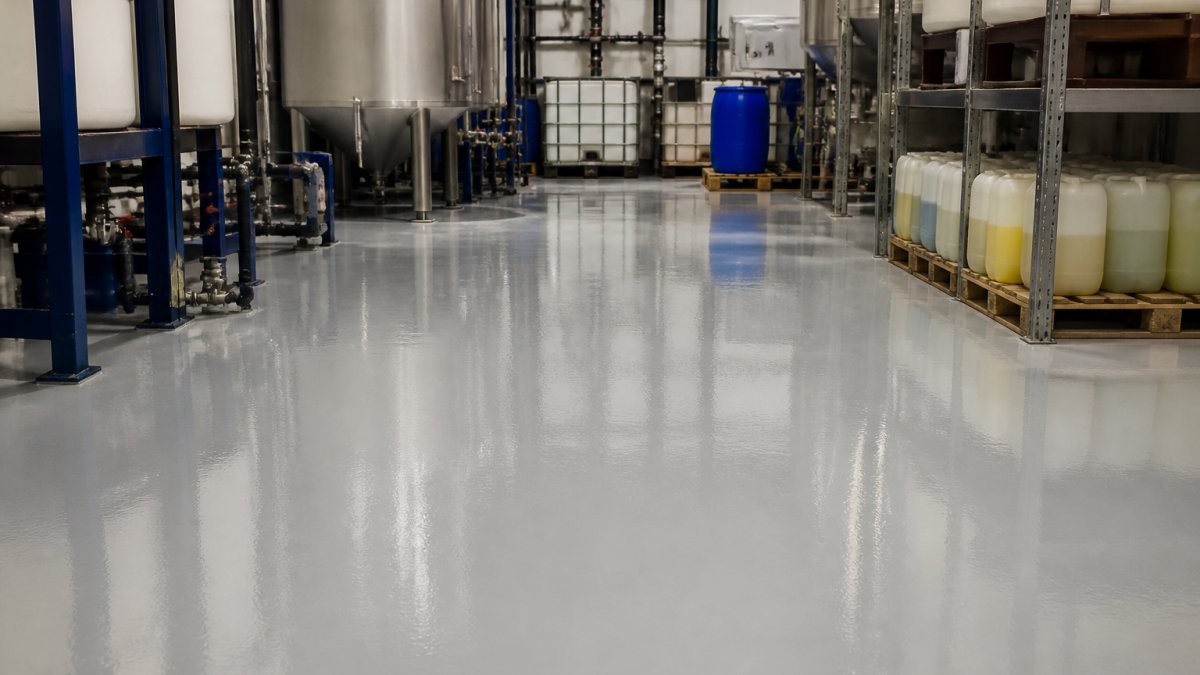
Table of Contents
- Why Chemical Resistant Epoxy Coatings Are the Standard for Industrial Floors
- Types of Chemical Resistant Epoxy Coatings and How to Choose
- Industrial Floor Coating Chemical Resistance Chart: What Each Resin Handles
- Epoxy vs Polyurethane for Chemical Exposure: Which Wins Where
- Surface Preparation and Application: What Determines Coating Performance
- Regulatory and Safety Standards for Industrial Epoxy Flooring
- Maintenance, Troubleshooting, and Lifecycle Cost of Industrial Epoxy Floors
- Conclusion
- Frequently Asked Questions
Last Updated: October 2, 2026
Why Chemical Resistant Epoxy Coatings Are the Standard for Industrial Floors
Chemical resistant epoxy coatings are two-component resin systems engineered to resist acids, solvents, and caustic spills while bonding directly to concrete. Unlike paint, a properly specified epoxy forms a moisture-impervious barrier that handles chemical exposure, abrasion, and thermal shock in one film.
A single uncontained spill can penetrate bare concrete within minutes, and once contamination reaches the substrate, no coating will bond without full removal. Chemical spill containment starts with the floor, not the berm.
At Concrete-Enhancements, we have spent over 20 years specifying and installing epoxy floor systems across warehouses, showrooms, and industrial spaces, and we are a CTi Certified Dealer.
Types of Chemical Resistant Epoxy Coatings and How to Choose
Choosing the right coating comes down to three variables: the chemicals present, the exposure temperature, and the mechanical load. Match all three and the floor lasts; miss one and it fails early.
Most industrial floor coating systems fall into four categories:
- Standard bisphenol-A epoxy: General-purpose corrosion protection for mild acids and dilute caustics. Best for light manufacturing and retail showrooms.
- Novolac epoxy: A higher-crosslink-density resin for aggressive solvents and concentrated acids. The workhorse for chemical processing areas.
- Polyurethane topcoats: UV-stable and flexible, used over epoxy for abrasion resistance and color retention.
- Solvent-free epoxy: Zero or low VOC formulations for occupied buildings and food-adjacent environments.
The most common mistake is specifying on price per square foot rather than chemical exposure. A cheaper resin that fails in eighteen months costs more than the right one installed once.
Novolac Epoxy Coating Properties: When You Need Extra Chemical Resistance
Novolac epoxy has a denser molecular crosslink than standard epoxy, which is why it resists solvent attack and concentrated acids that degrade conventional coatings.
Where it falls short: novolac is more brittle than standard epoxy and offers limited UV stability, so it typically needs a polyurethane topcoat for sun-exposed areas. It also costs more per gallon, so reserve it for chemical exposure zones.
Industrial Floor Coating Chemical Resistance Chart: What Each Resin Handles
No single coating resists everything, and "chemical resistant" on a product page means almost nothing without the chemical, concentration, temperature, and duration of exposure. The matrix below reflects typical performance for properly cured systems at ambient temperature (roughly 70°F) with splash-and-spill exposure; ratings drop fast as temperature climbs or exposure becomes continuous immersion.
| Chemical Class | Example Chemicals | Standard Bisphenol-A Epoxy | Novolac Epoxy | Polyurethane Topcoat | Solvent-Free Epoxy |
|---|---|---|---|---|---|
| Mineral acids (dilute) | 10% sulfuric, 10% hydrochloric, 10% phosphoric | Good | Excellent | Moderate | Good |
| Mineral acids (concentrated) | 50% sulfuric, 37% hydrochloric, 70% nitric | Poor | Good to Excellent | Poor | Fair |
| Organic acids | Acetic, citric, lactic, formic | Fair | Good | Fair | Good |
| Alkalis / caustics | 50% sodium hydroxide, potassium hydroxide, ammonium hydroxide | Good | Excellent | Moderate | Good |
| Aromatic solvents | Toluene, xylene, benzene, styrene | Poor | Good | Poor | Fair |
| Ketones | Acetone, MEK, MIBK | Poor | Fair | Poor | Poor |
| Chlorinated solvents | Methylene chloride, trichloroethylene | Poor | Fair | Poor | Poor |
| Alcohols | Methanol, ethanol, isopropanol | Good | Excellent | Good | Good |
| Glycols and coolants | Ethylene glycol, propylene glycol | Good | Excellent | Good | Good |
| Oils, greases, fuels | Motor oil, hydraulic fluid, diesel, gasoline | Good | Excellent | Good | Good |
| Food-grade acids and sugars | Vinegar, whey, corn syrup, brewery wash | Good | Excellent | Good | Excellent |
- Novolac wins on aggressive chemistry, not everything. Its higher crosslink density resists aromatic solvents, concentrated mineral acids, and hot caustics that degrade standard bisphenol-A epoxy, but it is more brittle and less UV-stable, so it belongs in the exposure zone, not the whole floor.
- Polyurethane is a wear surface, not a chemical barrier. It holds up to UV, thermal shock, and abrasion, but is the weakest of the four on concentrated acids and aromatic solvents. That is why the standard industrial build is a novolac or standard epoxy basecoat with a polyurethane topcoat.
- Solvent-free epoxy is a compromise, not a shortcut. Eliminating solvent improves indoor air quality and film build, but does not automatically improve chemical resistance. Match the base resin to the chemistry first, then choose solvent-free if VOC limits require it.
How to Read a Manufacturer's Chemical Resistance Table
Every reputable manufacturer publishes a chemical resistance table on the technical data sheet (TDS), and the format is consistent once you know what to look for:
- Concentration matters more than chemical name. A resin rated for 10% sulfuric acid is not necessarily rated for 50%. Check the exact percentage your process uses.
- Temperature and duration are usually listed as columns. Look for ratings at the temperature your floor actually sees, not the ambient lab condition.
- "Splash and spill" is not the same as "immersion." An "Excellent" splash rating can become "Not recommended" for continuous immersion in the same chemical.
- Cure time affects the rating. Most TDS ratings assume a full 7-day cure at 70°F. A floor put into chemical service at 48 hours will not perform to the published table.
Building a Facility-Specific Compatibility Matrix
A generic chart is a starting point, not a specification. The step that separates a floor that lasts from one that fails is building a matrix around what your facility actually handles. Walk the floor and inventory:
- Every chemical stored or used, including cleaning agents, degreasers, and process intermediates, not just the headline chemicals.
- Concentration and temperature at the point of contact, including worst-case spill scenarios.
- Exposure mode, incidental splash, regular washdown, or continuous pooling.
- Secondary exposures, forklift traffic, thermal shock from washdown, and abrasion from aggregate or metal debris.
Bring that list to your coating manufacturer or applicator and ask for a written resistance rating for each chemical at your actual concentration and temperature. A vendor who cannot produce that in writing should not be specifying your floor.
Epoxy vs Polyurethane for Chemical Exposure: Which Wins Where
Epoxy wins on chemical resistance and substrate adhesion; polyurethane wins on UV stability, flexibility, and abrasion resistance. The practical answer for most industrial floors is a hybrid system: epoxy basecoat for corrosion protection, polyurethane topcoat for the wear surface.
Here is where each fails if used alone:
- Epoxy alone outdoors: chalks and yellows under UV within a season.
- Polyurethane alone on concrete: bonds less aggressively and struggles with concentrated acids.
- Epoxy base plus polyurethane top: handles both, which is why it is the default specification for high-traffic industrial flooring.
The real difference comes down to exposure. If your floor sees chemical spills and forklift traffic but no direct sunlight, a straight epoxy system is the better value.
Surface Preparation and Application: What Determines Coating Performance
Surface preparation determines whether a coating bonds or peels. Most epoxy failures trace back to inadequate profiling, moisture in the slab, or contaminants left on the concrete substrate, not the coating itself.
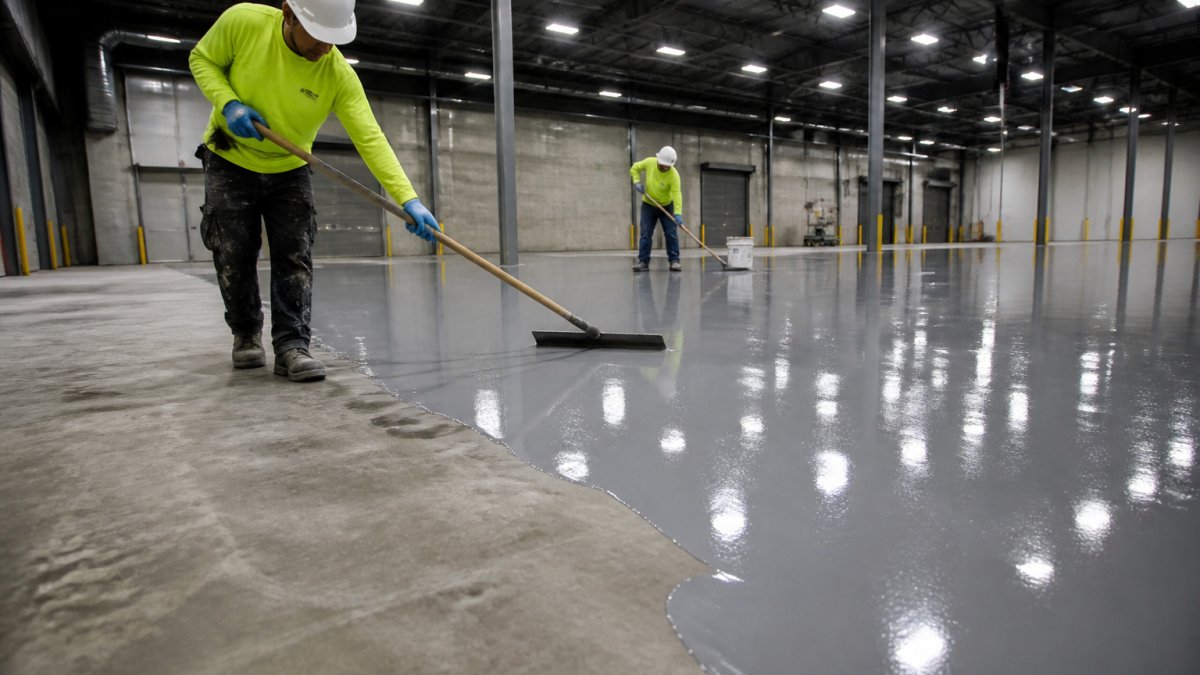
A proper specification includes:
- Mechanical profiling by diamond grinding or shot blasting to open the concrete's pore structure
- Moisture testing to confirm the slab is dry enough for the chosen system
- Contaminant removal of oils, curing compounds, and previous coatings
- Film thickness control to the manufacturer's specified mil build
The thing nobody tells you about epoxy installation is that curing time and pot life are not the same thing. Pot life is how long the mixed resin stays workable; curing time is how long before the floor accepts traffic.
Regulatory and Safety Standards for Industrial Epoxy Flooring
Regulatory requirements do not just affect how a coating is installed, they often determine which coating you can specify in the first place. The four areas below most often change a specification, and each maps to a concrete decision rather than a checkbox.
Worker Exposure and Application Safety (OSHA)
The Occupational Safety and Health Administration (OSHA) governs worker exposure to coating vapors and dust during surface preparation and application. Two standards drive most practical requirements:
Call (919) 824-5403 or email craigrfear@gmail.com for a free estimate →
- Respiratory protection, OSHA's respiratory protection standard (29 CFR 1910.134) requires a written program, medical evaluation, fit testing, and training whenever respirators are required. For solvent-based epoxies and polyurethanes applied in enclosed spaces, that is almost always the case.
- Hazard communication, OSHA's Hazard Communication Standard (29 CFR 1910.1200) requires that safety data sheets (SDS) for every coating component be on site and that workers be trained on the hazards. Amine hardeners and solvent carriers are the two most common sources of skin sensitization and inhalation complaints on epoxy jobs.
Practical effect on specification: if the facility cannot support a full respiratory protection program during application, solvent-free or low-VOC formulations become the practical choice, not just the environmentally preferred one.
VOC Limits and Air Quality Rules
VOC content is regulated under the Clean Air Act and enforced primarily through state and local air quality management districts, so the limit that applies depends on where the facility sits.
Practical effect on specification: before finalizing a resin system, confirm the VOC limit that applies to your facility's jurisdiction. A solvent-based novolac that performs beautifully in one state may be non-compliant in another.
Food, Pharmaceutical, and Potable Water Contact
Facilities handling food, beverages, pharmaceuticals, or drinking water may need coatings that meet specific federal requirements:
- Food-contact surfaces, the U.S. Food and Drug Administration (FDA) regulates substances used in coatings that may contact food. Coatings intended for incidental food contact must use components that comply with the applicable FDA food-contact regulations. Confirm with the manufacturer that the specific product carries the appropriate compliance statement.
- Potable water, coatings used in contact with drinking water must meet NSF/ANSI Standard 61, which is the health-effects standard for drinking water system components. This is a separate certification from food-contact compliance and is not interchangeable.
- Pharmaceutical and cleanroom environments, these typically require smooth, non-shedding, cleanable surfaces, which often pushes the specification toward solvent-free epoxy or epoxy with a chemical-resistant urethane topcoat.
Practical effect on specification: if your facility falls into any of these categories, the resin choice is constrained before chemical resistance is even considered. Verify the certification on the specific product, not the product family.
Slip Resistance and Accessibility
Slip resistance is a safety requirement, not an aesthetic choice, and it is the most common source of post-installation complaints on industrial floors. Two references matter:
- ADA accessibility guidance, the Americans with Disabilities Act sets advisory friction guidance for accessible walking surfaces. While ADA does not prescribe a specific coefficient of friction for industrial floors, many facility specifications reference it as a baseline for accessible routes.
- OSHA walking-working surfaces, OSHA's walking-working surfaces standard (29 CFR 1910.22) requires that floors be kept clean, dry, and in good repair, and that slip hazards be addressed. In practice, this is what drives the use of aggregate broadcast into the topcoat in wet-process areas.
Practical effect on specification: slip resistance and chemical resistance can pull in opposite directions. A heavy aggregate broadcast improves traction but creates a rougher surface that traps chemical residue and is harder to clean. The right answer is usually zone-specific, smooth, chemical-resistant finish in process areas, aggregate-enhanced finish on walkways and wet zones.
For the specific limits that apply to your facility, check the OSHA chemical exposure standards and your state air quality authority before specifying. If your facility handles food, pharmaceuticals, or drinking water, request the manufacturer's written compliance statement for the exact product, not the product line, before approving the specification.
Maintenance, Troubleshooting, and Lifecycle Cost of Industrial Epoxy Floors
Lifecycle cost, not installation price, is the number that matters. A coating that costs less up front but needs recoating every few years usually costs more over a decade than a properly specified system installed once.
Common failure modes and their causes:
| Problem | Likely Cause | Fix |
|---|---|---|
| Peeling or delamination | Poor surface prep or moisture | Full removal and re-profile |
| Blistering | Moisture vapor drive | Moisture barrier primer |
| Yellowing | UV exposure on epoxy | Polyurethane topcoat |
| Chemical staining | Wrong resin for exposure | Respecify to novolac |
Maintenance is straightforward when the system is right. Sweep or dust-mop regularly, clean spills promptly, and use neutral pH cleaners rather than aggressive solvents that degrade the film. For chemical spill containment, keep absorbent material staged near high-risk zones and address every spill within minutes, not hours.
The insider observation here: most "failed" epoxy floors did not fail because the resin was wrong. They failed because the substrate was never properly prepared or the slab was still releasing moisture when the coating went down.
Conclusion
Specifying a chemical resistant epoxy floor that lasts comes down to matching the resin to your real chemical exposure, preparing the substrate correctly, and respecting cure times.
Concrete-Enhancements brings over 20 years of experience and CTi Certified Dealer credentials to every industrial and commercial epoxy project, from warehouse floors to showrooms and high-traffic common areas.
Call (919) 824-5403 or email craigrfear@gmail.com for a free estimate and get a floor specification built around what your facility actually handles.
Frequently Asked Questions
What epoxy is chemical resistant?
Standard two-component epoxy resins resist many dilute acids, bases, and solvents, but highly aggressive chemicals like concentrated sulfuric acid or ketones require novolac epoxy or vinyl ester coatings. The resin type, cross-link density, and film thickness determine resistance. Always verify against the manufacturer's technical data sheet for your specific chemical, concentration, and temperature before specifying a system.
What is the difference between standard epoxy and Novolac epoxy?
Novolac epoxy contains a higher density of epoxy groups and a phenolic backbone, giving it greater resistance to acids, solvents, and elevated temperatures than standard epoxy. It also handles thermal shock and chemical spill containment better. Standard epoxy remains a cost-effective choice for general industrial flooring, while Novolac epoxy coating properties make it the preferred option for chemical processing, food and beverage plants, and areas exposed to aggressive spills.
Is polyurethane better than epoxy for chemical resistance?
Neither is universally better; the chemical exposure matters. Polyurethane coatings generally outperform epoxy against organic acids, solvents, and UV exposure, while epoxy, especially Novolac, resists strong alkalis and concentrated acids better. Many industrial floor coating systems use a polyurethane topcoat over an epoxy base to combine chemical resistance with UV stability and abrasion resistance. Match the coating to the actual chemicals on your floor.
How do you determine the right chemical resistance for industrial flooring?
Start by listing every chemical, its concentration, and the temperature it contacts the floor. Then review the industrial floor coating chemical resistance chart or technical data sheet for each candidate resin and check the exposure duration (splash, intermittent, or immersion). Confirm surface preparation, film thickness, and curing time meet the manufacturer's requirements. A site assessment and sample test patch can confirm performance before full installation.
Tags: chemical resistant epoxy, chemical resistant epoxy coatings industrial, novolac epoxy coating properties, industrial floor coating chemical resistance chart
Frequently Asked Questions
Standard two-component epoxy resins resist many dilute acids, bases, and solvents, but highly aggressive chemicals like concentrated sulfuric acid or ketones require novolac epoxy or vinyl ester coatings. The resin type, cross-link density, and film thickness determine resistance. Always verify against the manufacturer's technical data sheet for your specific chemical, concentration, and temperature before specifying a system.
Novolac epoxy contains a higher density of epoxy groups and a phenolic backbone, giving it greater resistance to acids, solvents, and elevated temperatures than standard epoxy. It also handles thermal shock and chemical spill containment better. Standard epoxy remains a cost-effective choice for general industrial flooring, while Novolac epoxy coating properties make it the preferred option for chemical processing, food and beverage plants, and areas exposed to aggressive spills.
Neither is universally better; the chemical exposure matters. Polyurethane coatings generally outperform epoxy against organic acids, solvents, and UV exposure, while epoxy, especially Novolac, resists strong alkalis and concentrated acids better. Many industrial floor coating systems use a polyurethane topcoat over an epoxy base to combine chemical resistance with UV stability and abrasion resistance. Match the coating to the actual chemicals on your floor.
Start by listing every chemical, its concentration, and the temperature it contacts the floor. Then review the industrial floor coating chemical resistance chart or technical data sheet for each candidate resin and check the exposure duration (splash, intermittent, or immersion). Confirm surface preparation, film thickness, and curing time meet the manufacturer's requirements. A site assessment and sample test patch can confirm performance before full installation.