ultimate-guide
Commercial Epoxy Flooring Cost Per Square Foot: 2026 Guide
Table of Contents
- Commercial Epoxy Flooring Cost Per Square Foot: What to Expect
- Factors Influencing Commercial Epoxy Flooring Pricing
- Material vs. Labor Cost Breakdown
- Commercial Floor Preparation Requirements and Timeline
- Types of Commercial Epoxy Systems: Pricing and Performance
- Commercial Epoxy Flooring Installation Process and Labor Costs
- Hidden Costs and Additional Fees to Budget For
- Commercial vs. Residential Epoxy Flooring Cost Differences
Last Updated: August 5, 2026
Commercial Epoxy Flooring Cost Per Square Foot: What to Expect
Commercial epoxy flooring cost per square foot varies dramatically based on system type, surface condition, and regional labor rates. A basic solid-color epoxy costs significantly less than a decorative metallic or flake system with extensive surface preparation. Understanding these variables upfront prevents sticker shock and helps you budget accurately.
Epoxy flooring pricing depends on factors you control and factors you don't. A warehouse with clean, structurally sound concrete requires different preparation than one with cracks, moisture issues, or heavy contamination. A 2,000-square-foot retail showroom has different labor economics than a 50,000-square-foot distribution center. Regional labor rates in coastal South Carolina differ from rates in the NC Triad. All of these variables create the wide price variance you've probably seen in quotes.
Below, we'll break down exactly what drives commercial epoxy flooring costs, show you the material versus labor split, explain why surface preparation matters more than most contractors admit, and give you the framework to evaluate quotes intelligently.
Factors Influencing Commercial Epoxy Flooring Pricing
The price you'll pay for commercial epoxy flooring cost per square foot hinges on five major variables. Understand these, and you'll recognize why two contractors might quote dramatically different numbers for the same space.
Surface Preparation and Concrete Substrate Condition
Surface preparation is where most commercial epoxy projects either succeed or fail. A concrete substrate in poor condition, cracked, dusty, or contaminated with oils or sealers, demands extensive remediation before any epoxy can be applied.
Clean, structurally sound concrete requires basic prep: sweeping, vacuuming, and light cleaning. Concrete with minor cracks or dust requires diamond grinding or shot blasting to remove the top layer and open the surface for epoxy adhesion. Severely damaged concrete with deep cracks, spalling, moisture issues, or chemical contamination requires crack filling, patching, moisture barriers, or partial replacement. These projects can double or triple the overall cost before the epoxy is applied.
The concrete substrate condition determines your mil thickness requirements. A primer coat, base coat, and topcoat system on sound concrete might total 50-75 mils. Damaged concrete needing additional protection could reach 100+ mils, requiring more material and labor time.
Types of Commercial Epoxy Systems and Material Costs
A basic solid-color epoxy is the least expensive option. Metallic epoxy systems, which create three-dimensional depth effects, cost more due to pigment complexity and application skill. Decorative flake systems, where colored flakes are broadcast into the base coat, add material cost and require precise timing. Self-leveling epoxy, which flows and levels itself for a seamless finish, commands a premium for material and application expertise.
Polyaspartic topcoats, which cure faster and offer superior UV resistance compared to standard polyurethane, cost more than basic epoxy topcoats. Industrial-grade epoxy systems designed for chemical resistance, high-traffic durability, and VOC compliance cost more than consumer-grade products.
Regional Labor Rate Variations and Site Accessibility
Labor represents 40-60% of most commercial epoxy flooring projects. Your location determines the prevailing wage rate. Coastal South Carolina and the Raleigh-Durham Triangle have different labor economics. A contractor in a high-cost metropolitan area charges more than one in a rural region due to higher overhead, insurance, and skilled labor costs.
Site accessibility affects labor efficiency dramatically. A ground-floor warehouse with good equipment access moves faster than a second-floor retail space requiring stairs or elevators. A facility that can be closed during installation allows faster work than one requiring night or weekend application. Projects requiring climate control add labor costs.
The concrete surface area influences per-square-foot labor costs through economies of scale. A 2,000-square-foot project has higher per-square-foot labor costs than a 20,000-square-foot warehouse because setup and mobilization costs spread across fewer square feet.
Material vs. Labor Cost Breakdown
On most commercial epoxy flooring projects, material costs account for 40-50% of the total, while labor represents 50-60%. This ratio shifts based on system complexity and surface condition. A basic solid-color epoxy on clean concrete might run closer to 45% material and 55% labor. A decorative metallic system with extensive surface preparation might be 50% material and 50% labor.
The material cost includes epoxy resin, hardener, primer, base coat, topcoat, decorative elements, and additives for slip resistance or UV protection. The labor cost covers surface preparation, crack repair, primer application, base coat application, topcoat application, and cleanup.
When comparing quotes, ask contractors to itemize material and labor separately. A quote that seems low might use cheaper materials, which often fail prematurely. The cheapest option rarely delivers the best lifecycle value.
Commercial Floor Preparation Requirements and Timeline
Proper surface preparation determines epoxy adhesion and system longevity. Skipping or rushing this phase is the primary reason epoxy coatings fail prematurely.
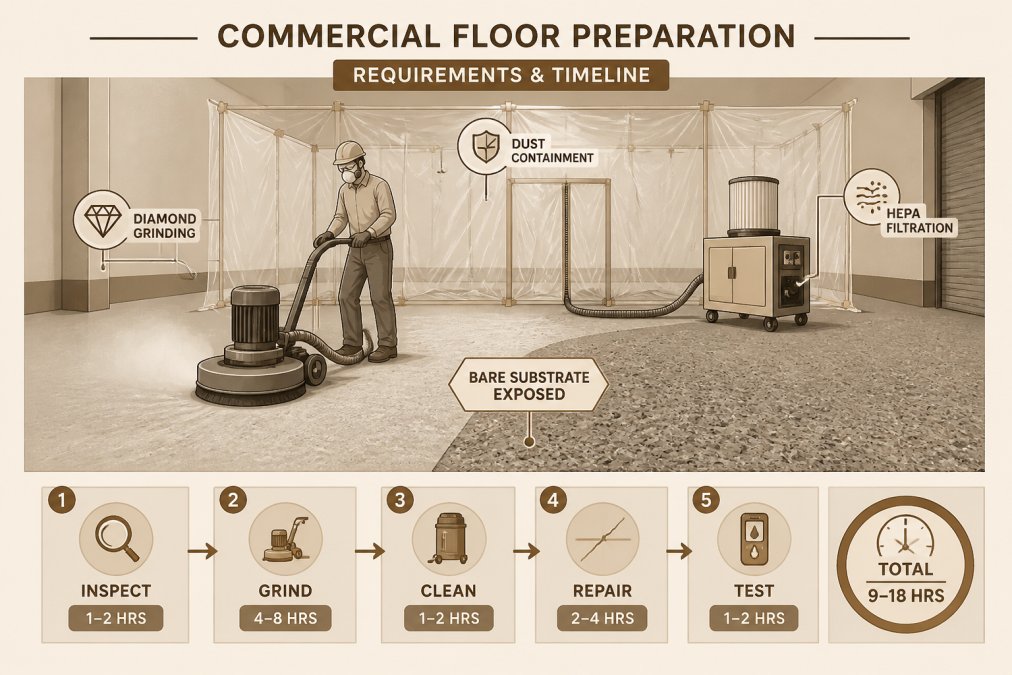
The preparation process begins with a moisture test. Concrete naturally wicks moisture from below. If moisture vapor transmission exceeds the epoxy system's tolerance, the coating will blister and peel. Testing determines whether you need a moisture barrier, a permeable epoxy system, or deeper remediation.
Diamond grinding removes old sealers, coatings, and the top 1-2 mils of concrete, opening the surface for epoxy adhesion. Shot blasting uses steel shot propelled at high velocity to achieve the same goal. Both methods create dust and require containment and HEPA filtration. Grinding typically takes 2-4 hours per 1,000 square feet.
After grinding or blasting, the floor is vacuumed and cleaned. Any cracks, spalls, or voids are filled with epoxy putty or self-leveling epoxy. The entire process typically takes 1-3 days depending on floor size and condition.
Curing time affects project timeline significantly. Standard epoxy systems require 24-48 hours between coats. Polyaspartic systems cure much faster, sometimes in 4-8 hours, allowing faster project completion. Fast-curing systems cost more but reduce downtime for commercial spaces that can't afford extended closure.
Types of Commercial Epoxy Systems: Pricing and Performance
Different epoxy systems serve different purposes. Choosing the right one depends on your facility's use, aesthetic goals, and budget.
Solid Color and Metallic Epoxy Systems
Solid-color epoxy is the most straightforward option. A single color is mixed into the base coat, creating a uniform finish. It's durable, easy to maintain, and the least expensive epoxy option. Solid-color systems work well for warehouses, manufacturing facilities, and utilitarian spaces.
Metallic epoxy systems suspend metallic pigments in the epoxy, creating a three-dimensional, flowing appearance that shifts with viewing angle. The effect is striking and commands a premium price because the material costs more and application requires precision. Metallic systems are popular in retail showrooms, office lobbies, and facilities where appearance drives customer perception.
Call (919) 824-5403 or email craigrfear@gmail.com for a free estimate →
Decorative Flake and Self-Leveling Options
Decorative flake systems broadcast colored flakes into the tacky base coat. The flakes settle into the epoxy, creating texture and visual interest. A clear topcoat seals everything. Flake systems hide imperfections better than solid colors and offer customization through flake size, color, and density. They cost more than solid color but less than metallic.
Self-leveling epoxy flows and levels itself, eliminating brush marks and creating a seamless, glass-like finish. It requires a perfectly prepped substrate because any imperfection telegraphs through the smooth surface. Self-leveling systems are more expensive and demand greater installer skill, but they deliver a premium aesthetic for high-visibility commercial spaces.
Commercial Epoxy Flooring Installation Process and Labor Costs
The installation process unfolds in distinct phases, each requiring specific expertise and time.
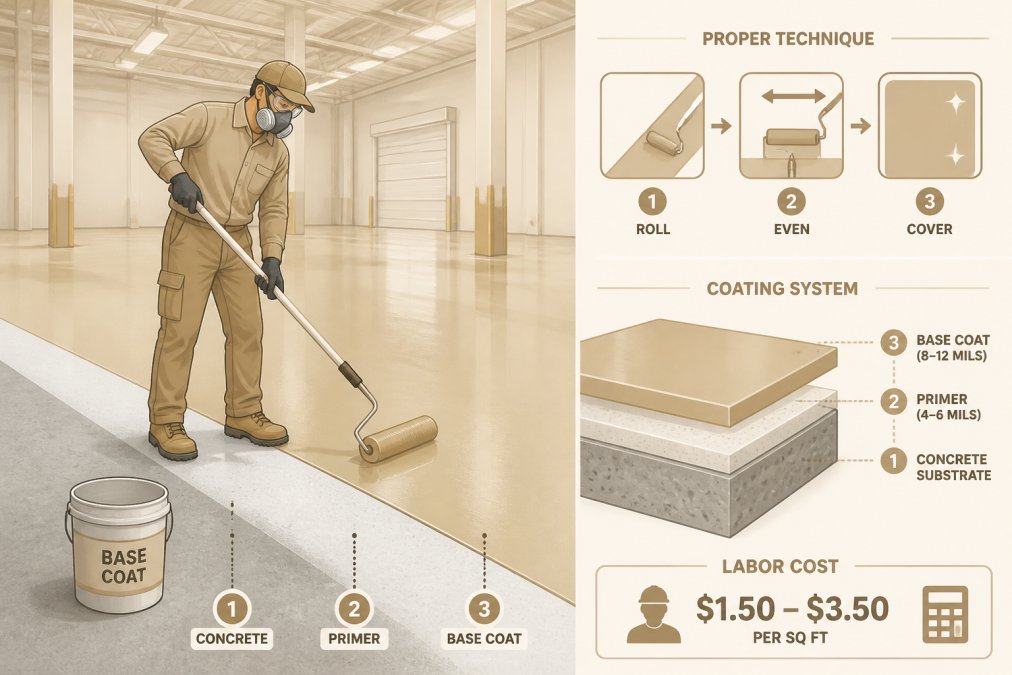
The installer begins by confirming surface preparation is complete, with no dust, contaminants, or moisture issues. The primer coat is applied first, creating adhesion between the concrete substrate and the epoxy system. Primer typically requires 4-24 hours cure time before the base coat.
The base coat is applied next, usually with a roller for solid colors or with broadcast application for flake systems. For flake systems, colored flakes are broadcast into the tacky base coat at the correct moment, timing is critical and separates skilled installers from inexperienced ones. Base coat cure time is typically 24-48 hours.
The topcoat is applied last, sealing the system and adding slip-resistant additives if required. Topcoat cure time varies by system; standard epoxy might require 48-72 hours, while polyaspartic cures in 4-8 hours.
Labor costs for installation depend on system complexity and installer experience. A basic solid-color system on clean concrete moves quickly. A decorative flake system with extensive surface prep takes longer. Experienced installers work faster and produce better results, but they charge accordingly.
Hidden Costs and Additional Fees to Budget For
Beyond material and labor, several costs surprise commercial property managers if not anticipated upfront.
Moisture barriers or epoxy primer systems designed for high-moisture concrete cost extra but prevent failure in facilities with moisture issues. Crack repair and patching add cost if your concrete has structural damage. Deep cracks might require epoxy injection or routing and filling.
Slip-resistant additives, typically aluminum oxide particles mixed into the topcoat, add cost but are essential in wet areas or facilities with safety requirements. Protective coating for edges, transitions, and baseboards adds labor time and material.
Downtime costs aren't direct contractor fees, but they're real. If your facility must close during installation and curing, that's lost revenue. Fast-curing polyaspartic systems reduce downtime but cost more upfront.
Equipment rental for dust containment, HEPA filtration, or climate control during installation might be included in contractor quotes or billed separately. Confirm this upfront.
Commercial vs. Residential Epoxy Flooring Cost Differences
Commercial epoxy flooring must withstand heavy foot traffic, equipment movement, chemical exposure, temperature fluctuations, and safety requirements that residential applications don't face. Commercial-grade epoxy systems are formulated for durability and chemical resistance. Surface preparation is more rigorous because failure isn't cosmetic, it's operational.
Labor rates for commercial projects are typically higher because the work requires greater skill and experience. Material costs per square foot might be similar between residential and commercial, but commercial systems often include additives for slip resistance, chemical resistance, or UV protection that residential systems skip.
The real difference is lifecycle value. A residential epoxy floor that lasts 5-7 years might be acceptable. A commercial floor that fails in 3 years is a disaster. Commercial epoxy systems cost more upfront but deliver 10-15+ years of reliable performance, making the lifecycle cost lower even though the initial investment is higher.
Understanding commercial epoxy flooring cost per square foot requires looking beyond the headline price. The factors that drive costs, surface condition, system type, labor rates, preparation rigor, are the same factors that determine whether your coating lasts 3 years or 15. At Concrete-Enhancements, we've spent over 20 years helping commercial facility managers in the Raleigh-Durham Triangle and NC Triad navigate this decision. We start every project with a thorough assessment of your concrete substrate, moisture conditions, and operational needs. That assessment drives an honest quote that reflects the work required, not a low-ball number that cuts corners. Call (919) 824-5403 or email craigrfear@gmail.com for a free estimate, and we'll walk you through exactly what your project requires and why.
Frequently Asked Questions
How much does it cost to epoxy 1,000 square feet of commercial space?
Commercial epoxy flooring cost per square foot varies widely based on surface preparation, epoxy system type, and regional labor rates. Pricing depends on whether your concrete substrate requires diamond grinding, shot blasting, crack filling, or subfloor repair. A 1,000 sq ft project with standard solid color epoxy and moderate prep work typically costs more per square foot than larger projects due to setup and mobilization fees. Contact Concrete-Enhancements for a free estimate tailored to your specific space and condition.
What factors influence the price per square foot of commercial epoxy?
Six primary factors affect commercial epoxy flooring cost per square foot: concrete substrate condition and moisture vapor transmission levels, surface preparation method (diamond grinding vs. shot blasting), epoxy system type (metallic, flake, or solid color), mil thickness and number of coats, regional labor rates in your area, and project scale. Industrial-grade systems with slip-resistant additives and chemical resistance cost more than basic options. Site accessibility and curing time requirements also impact labor costs.
What's included in the installation labor cost, and what counts as hidden fees?
Installation labor typically covers primer coat application, base coat, topcoat, and basic surface preparation. Hidden costs often include crack filling, subfloor repair, moisture mitigation, VOC compliance measures, and extended curing time if your facility must remain closed. Some contractors charge separately for site accessibility challenges, equipment rental, or additional topcoats for high-traffic durability. Request a detailed quote that itemizes each phase: surface prep, primer, base, topcoat, and any specialty work.
Is commercial epoxy flooring more expensive than residential epoxy?
Yes, commercial epoxy flooring typically costs more per square foot than residential applications. Commercial projects require industrial-grade epoxy systems with higher mil thickness, chemical resistance, and slip-resistant additives to withstand heavy foot traffic and equipment use. Commercial spaces often have larger square footage, which lowers per-square-foot costs slightly, but the material and performance specifications drive overall expenses higher. Warehouses and retail showrooms also demand faster curing times and minimal downtime, adding labor costs.
How long does commercial epoxy flooring last, and what's the lifecycle cost?
Commercial epoxy flooring typically lasts 5-10 years with proper maintenance, depending on traffic intensity and environmental conditions. High-traffic warehouses may see reduced service life. Lifecycle cost analysis reveals that while initial installation cost is higher than concrete sealers, epoxy's durability, low maintenance, and chemical resistance often deliver better ROI over 10 years. Factor in minimal recoating needs, reduced cleaning labor, and protection against damage. Compare this to concrete resurfacing or overlay replacement costs over the same period.
Does the cost of commercial epoxy include surface preparation?
Surface preparation is usually quoted separately or as a distinct line item. Basic prep (cleaning and light grinding) may be included in standard quotes, but extensive work such as diamond grinding, shot blasting, crack filling, or subfloor repair typically adds significant cost. Moisture vapor transmission testing and mitigation are often additional fees. Always ask your contractor to itemize surface prep costs separately so you understand what's included in the base price per square foot.
What's the difference between epoxy systems, and how do prices compare?
Solid color epoxy is the most affordable option and offers good durability for standard commercial spaces. Metallic pigment systems cost more but provide decorative appeal and visual depth. Decorative flake systems fall in the mid-to-high price range and add texture and slip-resistance. Self-leveling epoxy commands premium pricing but works well on uneven substrates. Polyaspartic topcoats cost more than standard urethane but cure faster and resist UV damage, reducing downtime in retail or showroom environments.
This article was written using GrandRanker
Frequently Asked Questions
Commercial epoxy flooring cost per square foot varies widely based on surface preparation, epoxy system type, and regional labor rates. Pricing depends on whether your concrete substrate requires diamond grinding, shot blasting, crack filling, or subfloor repair. A 1,000 sq ft project with standard solid color epoxy and moderate prep work typically costs more per square foot than larger projects due to setup and mobilization fees. Contact Concrete-Enhancements for a free estimate tailored to your specific space and condition.
Six primary factors affect commercial epoxy flooring cost per square foot: concrete substrate condition and moisture vapor transmission levels, surface preparation method (diamond grinding vs. shot blasting), epoxy system type (metallic, flake, or solid color), mil thickness and number of coats, regional labor rates in your area, and project scale. Industrial-grade systems with slip-resistant additives and chemical resistance cost more than basic options. Site accessibility and curing time requirements also impact labor costs.
Installation labor typically covers primer coat application, base coat, topcoat, and basic surface preparation. Hidden costs often include crack filling, subfloor repair, moisture mitigation, VOC compliance measures, and extended curing time if your facility must remain closed. Some contractors charge separately for site accessibility challenges, equipment rental, or additional topcoats for high-traffic durability. Request a detailed quote that itemizes each phase: surface prep, primer, base, topcoat, and any specialty work.
Yes, commercial epoxy flooring typically costs more per square foot than residential applications. Commercial projects require industrial-grade epoxy systems with higher mil thickness, chemical resistance, and slip-resistant additives to withstand heavy foot traffic and equipment use. Commercial spaces often have larger square footage, which lowers per-square-foot costs slightly, but the material and performance specifications drive overall expenses higher. Warehouses and retail showrooms also demand faster curing times and minimal downtime, adding labor costs.
Commercial epoxy flooring typically lasts 5-10 years with proper maintenance, depending on traffic intensity and environmental conditions. High-traffic warehouses may see reduced service life. Lifecycle cost analysis reveals that while initial installation cost is higher than concrete sealers, epoxy's durability, low maintenance, and chemical resistance often deliver better ROI over 10 years. Factor in minimal recoating needs, reduced cleaning labor, and protection against damage. Compare this to concrete resurfacing or overlay replacement costs over the same period.
Surface preparation is usually quoted separately or as a distinct line item. Basic prep (cleaning and light grinding) may be included in standard quotes, but extensive work such as diamond grinding, shot blasting, crack filling, or subfloor repair typically adds significant cost. Moisture vapor transmission testing and mitigation are often additional fees. Always ask your contractor to itemize surface prep costs separately so you understand what's included in the base price per square foot.
Solid color epoxy is the most affordable option and offers good durability for standard commercial spaces. Metallic pigment systems cost more but provide decorative appeal and visual depth. Decorative flake systems fall in the mid-to-high price range and add texture and slip-resistance. Self-leveling epoxy commands premium pricing but works well on uneven substrates. Polyaspartic topcoats cost more than standard urethane but cure faster and resist UV damage, reducing downtime in retail or showroom environments.