ultimate_guide
Epoxy Floor Coating for Warehouse: Complete 2026 Guide
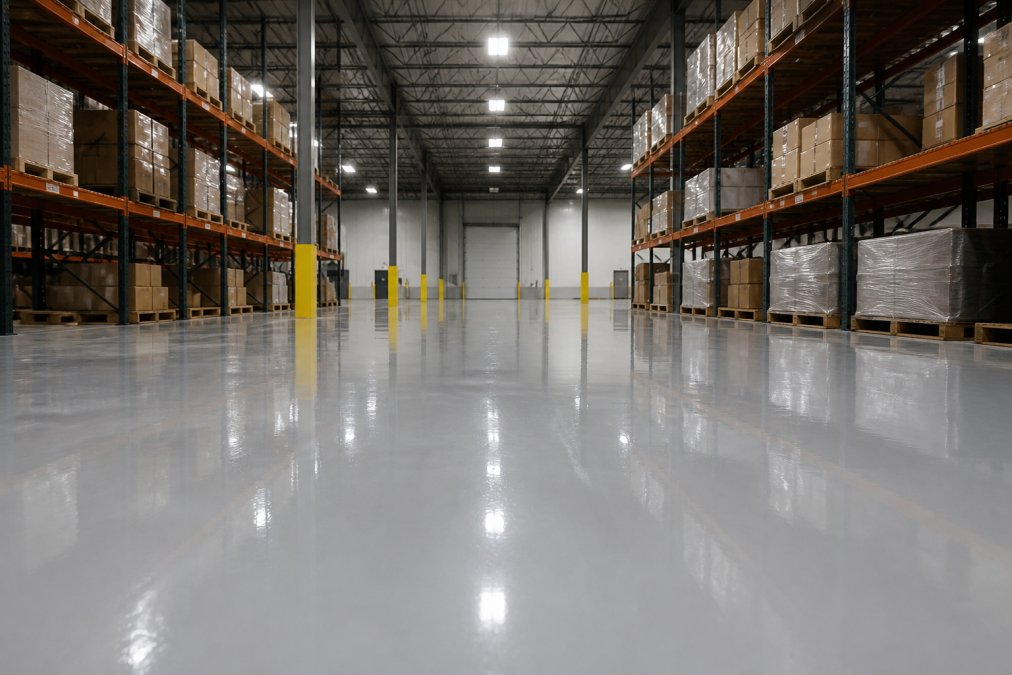
Table of Contents
- Why Epoxy Floor Coating for Warehouse Floors Matters
- Types of Epoxy Flooring for Industrial Use
- Chemical and Abrasion Resistance for Warehouse Operations
- Epoxy Floor Installation Guide: Surface Prep and Application
- Warehouse Floor Maintenance and Long-Term Care
- Industrial Epoxy Flooring Cost: 10-Year Cost-Benefit Analysis
- Safety Features: Slip Resistance and Warehouse Compliance
- Environmental Impact and VOC Compliance
Last Updated: August 2, 2026
Why Epoxy Floor Coating for Warehouse Floors Matters
Epoxy floor coating solves a problem uncoated concrete cannot: withstanding heavy equipment, chemical spills, moisture, and constant foot traffic without deteriorating. Bare concrete degrades rapidly under industrial conditions, and replacement costs far exceed upfront protection with a durable epoxy system.
Warehouses face exceptional flooring demands. Forklifts weighing up to 10,000 pounds move across the surface daily. Oils, coolants, and cleaning chemicals splash onto floors. Temperature swings between heated interiors and cold loading docks create thermal stress. Moisture vapor transmission from below the concrete surface causes coating failures if not properly managed. Surface preparation determines 80% of coating success, yet it's frequently rushed or skipped.
The best epoxy floor coating prevents these problems while reducing maintenance costs, improving safety compliance, and extending concrete life by decades.
The Problem: Uncoated Concrete in High-Traffic Spaces
Bare concrete absorbs moisture, oils, and dust like a sponge. Within months, the surface becomes a slip hazard and maintenance nightmare. Moisture vapor transmission moves upward through uncoated concrete constantly, carrying salts that crystallize on the surface and cause spalling and deterioration.
How Epoxy Solves Durability and Safety Issues
Epoxy creates a seamless, impermeable barrier that stops moisture vapor transmission and prevents dust generation. Impact resistance under forklift traffic remains intact for 10-15 years with proper maintenance, compared to 2-3 years for uncoated concrete.
Safety improves immediately. Slip-resistant additives reduce accidents. Warehouse safety markings adhere permanently to epoxy, creating clear zones for pedestrians, equipment paths, and hazard areas. Many facilities report reduced workers' compensation claims after coating installation.
Types of Epoxy Flooring for Industrial Use
The epoxy market offers several system types, each designed for specific warehouse conditions. Selecting the right type delivers 15+ years of reliable performance.
Standard Two-Part Epoxy Systems
Two-part epoxy systems remain the most common choice for warehouses because they balance cost, durability, and ease of application. These systems consist of a resin component and hardener that chemically react to form a hard, durable coating.
Standard epoxy delivers 3-5 mm thickness and cures to a high-gloss finish unless slip-resistant additives are included. Tensile strength ranges from 8,000-10,000 PSI, resisting cracking under thermal shock and heavy equipment load. Setup typically takes 24-48 hours before light foot traffic can resume, though full curing takes 7 days.
Polyurethane Topcoat Systems
Polyurethane topcoats applied over epoxy primers create a hybrid system that exceeds pure epoxy in UV resistance and chemical tolerance. The polyurethane layer adds flexibility that pure epoxy lacks, reducing cracking from thermal shock.
This system works best in warehouses with significant outdoor exposure or where chemical resistance matters most. Pharmaceutical storage facilities, automotive shops, and food processing plants rely on polyurethane topcoats because they resist a broader spectrum of industrial chemicals and oils. The tradeoff is cost, polyurethane systems run 20-30% higher than standard epoxy.
Self-Leveling vs. Broadcast Aggregate Epoxy
Self-leveling epoxy flows across the concrete substrate and settles flat, creating a smooth, seamless surface ideal for warehouses where appearance and cleaning ease matter.
Broadcast aggregate epoxy incorporates small stones or quartz particles into wet resin, creating texture and additional slip resistance. This type improves abrasion resistance, making it ideal for high-traffic loading areas. For most warehouses, a hybrid approach works best: broadcast aggregate in main floor and receiving areas, self-leveling in offices and break areas.
Chemical and Abrasion Resistance for Warehouse Operations
Industrial chemicals and heavy equipment traffic represent the two biggest threats to warehouse flooring.
Protection Against Industrial Chemicals and Oils
Standard two-part epoxy resists most common warehouse chemicals, hydraulic oils, antifreeze, diesel fuel, and light solvents, for extended periods. However, prolonged exposure to strong acids, caustics, or specialty solvents can eventually penetrate the coating.
Polyurethane topcoats excel here, extending chemical resistance significantly. The key variable is curing time. Epoxy that hasn't fully cured (less than 7 days) remains porous to aggressive chemicals.
Impact and Abrasion Resistance Under Forklift Traffic
Forklift traffic creates two distinct stresses: impact (shock of tires hitting the surface) and abrasion (grinding friction of repeated passes).
Standard epoxy with broadcast aggregate handles forklift traffic well for 10-15 years. However, in extremely heavy-traffic areas like receiving docks, the aggregate can gradually wear away. Polyurethane topcoats resist this wear pattern better, often delivering 15-20 year performance versus 10-15 years for standard epoxy.
The concrete substrate beneath also matters. Weak concrete with low compressive strength (below 3,000 PSI) will spall under forklift traffic regardless of coating quality.
Epoxy Floor Installation Guide: Surface Prep and Application
Installation quality determines whether your epoxy floor lasts 5 years or 15 years. Poor surface preparation is the single most common cause of premature failure.
Step 1: Concrete Substrate Assessment and Moisture Testing
Before any coating work begins, the concrete must be evaluated for moisture content and surface condition. Moisture vapor transmission testing (MVTR) measures how much moisture moves up through the concrete from below. If MVTR exceeds 3 pounds per 1,000 square feet per 24 hours, the concrete is too wet for epoxy adhesion.
Concrete strength testing confirms the substrate is solid enough to support the coating. Existing epoxy, paint, or sealers must be completely removed. Cracks wider than 1/8 inch must be filled with epoxy crack filler before the main coating is applied.
Step 2: Shot Blasting and Diamond Grinding
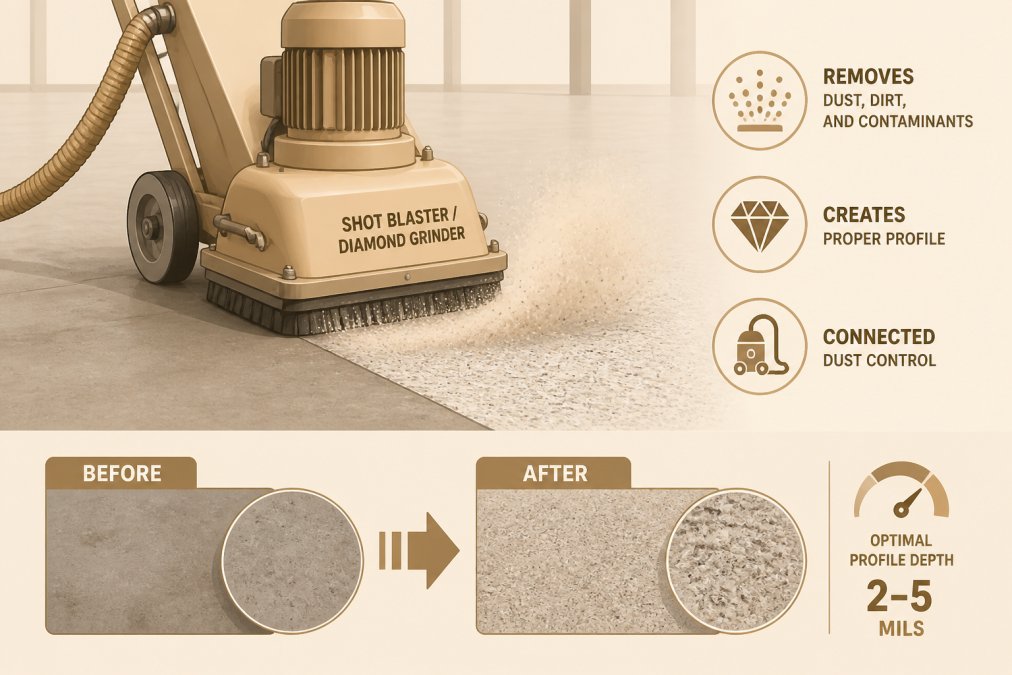
Shot blasting uses steel shot propelled at high velocity to strip the concrete surface clean and create a profile (microscopic texture) that allows epoxy to bond. Diamond grinding provides an alternative, using rotating diamond-impregnated wheels to remove the top layer of concrete.
The concrete surface must reach a Surface Profile (SP) rating of SP-6 to SP-10 (per ICRI standards). Setup typically takes 1-3 days depending on floor size.
Step 3: Primer, Resin Application, and Curing Time
The primer coat seals the prepared concrete and ensures the main resin layer adheres uniformly. Primer application takes 4-8 hours depending on floor size.
The resin layer is applied next, usually 24 hours after primer curing. Temperature and humidity during application are critical. Epoxy application requires 50-85°F ambient temperature and 50-85% relative humidity. Most systems cure to "light foot traffic" in 24 hours but require 7 days for full chemical and impact resistance.
Common Installation Failures and How to Avoid Them
Peeling and delamination occur when surface preparation is inadequate. Prevention requires proper shot blasting and adhesion testing.
Bubbling and blistering result from moisture vapor transmission pushing through the epoxy layer. Prevention requires moisture testing before application and climate control during curing.
Cracking develops when thermal stress exceeds the epoxy's tensile strength. Polyurethane topcoats resist thermal cracking better than pure epoxy.
Yellowing and discoloration indicate the coating is beginning to degrade. Polyurethane topcoats resist UV damage far better than epoxy alone.
Warehouse Floor Maintenance and Long-Term Care
A properly installed epoxy floor requires minimal maintenance but demands consistent attention to maximize longevity.
Daily and Weekly Cleaning Protocols
Daily sweeping removes dust and debris that can scratch the surface under forklift traffic. Weekly wet mopping with a pH-neutral cleaner maintains the epoxy finish without degrading the resin. Avoid acidic cleaners, bleach, and strong solvents. Spills should be cleaned immediately, especially chemical spills.
Preventing Thermal Shock and Seasonal Stress
Temperature swings between heated interiors and cold loading docks create expansion and contraction stress in the epoxy. Manage thermal shock by maintaining consistent warehouse temperatures when possible. Loading dock areas benefit from strip curtains or vestibules that minimize temperature extremes.
Recoating and Floor Longevity Expectations
A well-maintained epoxy floor lasts 10-15 years before requiring recoating. High-traffic areas may need recoating after 8-10 years, while light-traffic areas can extend beyond 15 years. Recoating typically involves light surface preparation followed by a new epoxy layer and costs 40-60% of the original installation cost.
Industrial Epoxy Flooring Cost: 10-Year Cost-Benefit Analysis
Understanding true cost of epoxy flooring requires examining total cost of ownership over a decade.
Initial Investment vs. Uncoated Concrete Replacement
Material costs vary based on system type, floor condition, and square footage. Labor represents 40-60% of total installation cost. A warehouse that replaces concrete every 5-7 years will spend 2-3 times more over a decade than one that installed epoxy upfront.
Labor, Material, and Downtime Costs
Installation typically requires 3-10 days of facility downtime depending on floor size and epoxy system complexity. Many facilities schedule installation during planned downtime or low-season periods to minimize operational impact.
Maintenance Savings and Reduced Replacement Cycles
Epoxy reduces maintenance labor significantly compared to uncoated concrete. Over 10 years, cumulative savings in maintenance labor, cleaning supplies, and dust control measures often exceed the initial installation cost. A warehouse with 20,000 square feet of epoxy flooring might save 200-300 hours per year in maintenance labor.
| Cost Category | Year 1 | Years 2-5 | Years 6-10 | 10-Year Total |
|---|---|---|---|---|
| Initial Installation | High | , | , | Baseline |
| Maintenance Labor | Low | Low | Low | 20-30% of install |
| Cleaning Supplies | Low | Low | Low | 15-25% of install |
| Emergency Repairs | Minimal | Minimal | Minimal | 10-15% of install |
| Recoating (Year 10) | , | , | High | 40-60% of install |
| Total 10-Year Cost | Highest Year 1 | Stable | Recoating spike | 2-2.5x install |
Safety Features: Slip Resistance and Warehouse Compliance
Warehouse safety regulations require flooring systems that minimize slip hazards and integrate with facility safety protocols.
Slip-Resistant Additives and USDA-Approved Coatings
Slip resistance is measured by the Coefficient of Friction (COF). OSHA recommends a COF of at least 0.50 for walking surfaces, though many facilities target 0.60+ for added safety margin.
Slip-resistant additives, typically aluminum oxide particles or quartz aggregate, are broadcast into wet epoxy to increase surface texture. USDA-approved epoxy coatings meet food safety standards for facilities that store or process food products.
Integration with Warehouse Safety Markings and Zones
Epoxy floors accept permanent safety markings, yellow lines for equipment paths, red zones for hazards, white lines for pedestrian areas. These markings adhere directly to the epoxy surface and remain visible for years without fading or peeling.
Environmental Impact and VOC Compliance
Modern epoxy formulations balance performance with environmental responsibility.
Low-VOC Epoxy Options and EPA Regulations
Volatile Organic Compounds (VOCs) are chemicals that evaporate during epoxy curing and can affect air quality. The EPA regulates VOC emissions from industrial coatings, and many states have additional restrictions.
Low-VOC epoxy formulations have become standard in most markets. These systems emit significantly fewer fumes during application and curing. Facility managers should request VOC documentation from contractors before installation.
Sustainable Practices in Application and Disposal
Professional installers use techniques that minimize overspray and material waste. The longevity of epoxy flooring itself represents an environmental benefit. A floor that lasts 15 years generates less waste than concrete that requires replacement every 5-7 years.
Choosing the Right Epoxy Floor Coating for Warehouse Success
The decision to install an epoxy floor coating should be based on specific facility conditions, operational demands, and long-term goals.
Start with a professional site assessment that includes moisture testing, concrete strength evaluation, and chemical exposure analysis. Request references from the contractor, including installations from 5+ years ago.
At Concrete-Enhancements, our 20+ years of experience in concrete resurfacing and epoxy coatings has shown us that the difference between a floor that lasts 5 years and one that lasts 15 years comes down to three factors: honest substrate assessment, meticulous surface preparation, and realistic expectations about curing and maintenance timelines.
We're a CTi Certified Dealer committed to delivering installations that perform. We've worked with commercial facilities across the Raleigh-Durham Triangle, NC Triad, and Coastal SC to transform warehouse floors into durable, professional surfaces that require minimal upkeep.
The investment in quality epoxy flooring pays dividends through reduced maintenance labor, fewer emergency repairs, improved safety, and a professional appearance. Most facilities see positive ROI within 3-5 years as maintenance costs decline and operational disruptions drop to near zero.
ICRI concrete surface preparation standards provide the technical framework that professional installers follow to ensure epoxy adhesion and long-term performance.
If you're ready to transform your warehouse floor from a maintenance burden into a durable, professional asset, Concrete-Enhancements can help. We'll conduct a thorough site assessment, recommend the right epoxy system for your specific conditions, and execute an installation that delivers reliable performance.
Call us at (919) 824-5403 or email craigrfear@gmail.com for a free estimate. Let's discuss how an epoxy floor coating for warehouse use can improve your facility's safety, appearance, and bottom line.
Frequently Asked Questions
What are the main benefits of epoxy floor coating for warehouse floors?
Epoxy floor coatings provide chemical resistance against oils and industrial solvents, abrasion resistance to forklift traffic and heavy equipment loads, and seamless protection that eliminates dust and concrete deterioration. They also improve safety through slip-resistant additives and create a low-maintenance, easy-to-clean surface that reduces labor costs over time compared to uncoated concrete.
How long does epoxy flooring last in a warehouse environment?
Industrial epoxy flooring typically lasts 5-10 years under heavy warehouse traffic, depending on the specific resin system, application quality, and maintenance. Two-part epoxy systems with polyurethane topcoats offer longer durability. Proper surface preparation, moisture control, and regular cleaning extend floor longevity. Recoating specific high-wear zones can refresh the coating without replacing the entire floor.
What is the typical installation process for warehouse epoxy flooring?
Installation begins with concrete substrate assessment and moisture vapor transmission testing. The floor is then shot blasted or diamond ground to remove coatings and contaminants. A primer is applied, followed by the epoxy resin layer, with optional broadcast aggregate for slip resistance. Curing time typically ranges from 24-72 hours before equipment can return. Proper preparation prevents peeling and premature failure.
How much does warehouse epoxy flooring cost compared to replacing concrete?
Epoxy coating costs depend on floor size, surface condition, and system type. Over 10 years, epoxy coatings typically cost less than concrete replacement due to lower labor, reduced maintenance, and extended floor life. Maintenance savings from fewer repairs and simpler cleaning further offset the initial investment. For specific pricing on your warehouse, contact Concrete-Enhancements for a free estimate based on your facility's square footage and current conditions.
Can epoxy flooring handle heavy forklift and equipment traffic?
Yes. Industrial epoxy systems are designed for impact and abrasion resistance under heavy equipment loads. Two-part epoxy with polyurethane topcoats provides tensile strength and flexibility to withstand forklift wheels, pallet jacks, and constant traffic without cracking. Proper surface preparation and application are critical to ensure the coating bonds securely to the concrete substrate and resists thermal shock from temperature changes.
What maintenance does an epoxy warehouse floor require?
Daily maintenance involves sweeping and spot cleaning with mild soap and water. Avoid harsh chemicals that may damage the topcoat. Weekly deep cleaning with neutral pH cleaners keeps the floor looking new. Inspect for spills, thermal stress, or wear patterns monthly. Recoat high-traffic zones every 5-7 years. Low-maintenance epoxy systems eliminate concrete dust and reduce labor compared to uncoated floors, making them ideal for food-safe or USDA-regulated warehouses.
Is epoxy flooring slip-resistant and USDA-compliant for food warehouses?
Yes. Epoxy coatings can include slip-resistant additives that meet safety standards for high-traffic environments. USDA-approved epoxy systems are available for food storage and processing warehouses. Aggregate-free epoxy or broadcast aggregate options both provide grip under wet conditions. When integrated with warehouse safety markings and floor zones, epoxy creates a compliant, low-maintenance surface that meets regulatory requirements while protecting the concrete substrate.
This article was written using GrandRanker
Frequently Asked Questions
Epoxy floor coatings provide chemical resistance against oils and industrial solvents, abrasion resistance to forklift traffic and heavy equipment loads, and seamless protection that eliminates dust and concrete deterioration. They also improve safety through slip-resistant additives and create a low-maintenance, easy-to-clean surface that reduces labor costs over time compared to uncoated concrete.
Industrial epoxy flooring typically lasts 5-10 years under heavy warehouse traffic, depending on the specific resin system, application quality, and maintenance. Two-part epoxy systems with polyurethane topcoats offer longer durability. Proper surface preparation, moisture control, and regular cleaning extend floor longevity. Recoating specific high-wear zones can refresh the coating without replacing the entire floor.
Installation begins with concrete substrate assessment and moisture vapor transmission testing. The floor is then shot blasted or diamond ground to remove coatings and contaminants. A primer is applied, followed by the epoxy resin layer, with optional broadcast aggregate for slip resistance. Curing time typically ranges from 24-72 hours before equipment can return. Proper preparation prevents peeling and premature failure.
Epoxy coating costs depend on floor size, surface condition, and system type. Over 10 years, epoxy coatings typically cost less than concrete replacement due to lower labor, reduced maintenance, and extended floor life. Maintenance savings from fewer repairs and simpler cleaning further offset the initial investment. For specific pricing on your warehouse, contact Concrete-Enhancements for a free estimate based on your facility's square footage and current conditions.
Yes. Industrial epoxy systems are designed for impact and abrasion resistance under heavy equipment loads. Two-part epoxy with polyurethane topcoats provides tensile strength and flexibility to withstand forklift wheels, pallet jacks, and constant traffic without cracking. Proper surface preparation and application are critical to ensure the coating bonds securely to the concrete substrate and resists thermal shock from temperature changes.
Daily maintenance involves sweeping and spot cleaning with mild soap and water. Avoid harsh chemicals that may damage the topcoat. Weekly deep cleaning with neutral pH cleaners keeps the floor looking new. Inspect for spills, thermal stress, or wear patterns monthly. Recoat high-traffic zones every 5-7 years. Low-maintenance epoxy systems eliminate concrete dust and reduce labor compared to uncoated floors, making them ideal for food-safe or USDA-regulated warehouses.
Yes. Epoxy coatings can include slip-resistant additives that meet safety standards for high-traffic environments. USDA-approved epoxy systems are available for food storage and processing warehouses. Aggregate-free epoxy or broadcast aggregate options both provide grip under wet conditions. When integrated with warehouse safety markings and floor zones, epoxy creates a compliant, low-maintenance surface that meets regulatory requirements while protecting the concrete substrate.