comparison
Epoxy vs Polished Concrete for Warehouses
Table of Contents
- Epoxy vs Polished Concrete: Quick Comparison
- Durability and Abrasion Resistance
- Installation Time and Operational Downtime
- Chemical and Stain Resistance
- Warehouse Floor Maintenance Costs
- OSHA Flooring Requirements for Warehouses
- Lifespan of Industrial Concrete Flooring
- Repairability and Long-Term Value
Last Updated: August 14, 2026
Epoxy vs Polished Concrete: Quick Comparison
When warehouse managers choose between epoxy and polished concrete, the decision hinges on traffic patterns, budget, and long-term operational goals. Both provide durable, maintainable floors that handle heavy use, but they solve the problem differently. The wrong choice can cost tens of thousands in premature failure or unnecessary maintenance.
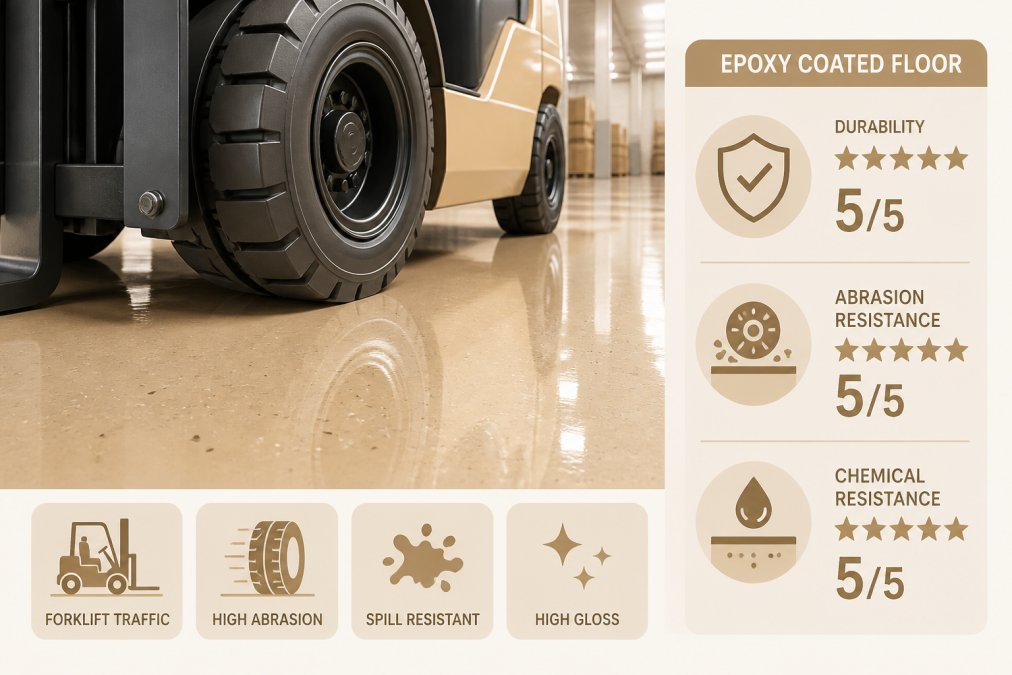
Epoxy creates a protective barrier through a polyurethane topcoat or resin system. Polished concrete mechanically refines the existing surface by removing the top cement paste layer and exposing the stronger aggregate beneath. At Concrete-Enhancements, we've worked with warehouse operators facing this exact choice, the answer depends on your specific operational demands.
This comparison breaks down durability, installation downtime, chemical resistance, maintenance costs, regulatory compliance, and lifespan. By the end, you'll understand which flooring type fits your facility's needs.
| Feature | Epoxy Flooring | Polished Concrete |
|---|---|---|
| Initial Cost | Higher upfront investment | Lower upfront cost |
| Installation Downtime | 3-7 days typical | 2-5 days typical |
| Lifespan | 5-10 years (varies by traffic) | 15-20+ years |
| Abrasion Resistance | High (with topcoat) | Very high (exposed aggregate) |
| Chemical Resistance | Excellent | Good (with densifier) |
| Maintenance | Monthly cleaning, periodic recoating | Quarterly maintenance, no recoating |
| Best For | High-chemical environments, aesthetics | Heavy traffic, long-term ROI |
Durability and Abrasion Resistance
Epoxy flooring delivers high abrasion resistance through its polyurethane topcoat, which shields concrete from forklift traffic, pallet jacks, and foot traffic. The protective layer absorbs impact effectively until micro-cracks or peeling expose the underlying concrete, which then degrades rapidly.
Polished concrete achieves durability through mechanical refinement that hardens the concrete surface itself by exposing denser aggregate. This increases the material's inherent abrasion resistance rather than adding a sacrificial layer. Heavy forklift traffic actually polishes the surface further, creating a self-healing effect over time.
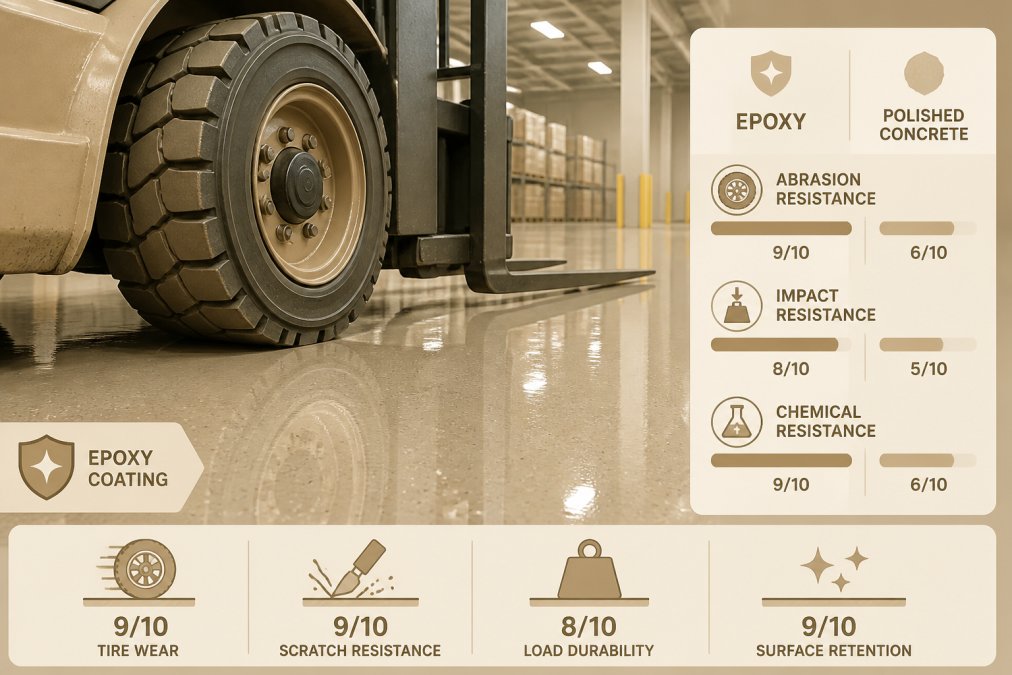
In high-traffic zones, epoxy performs well but depends entirely on coating thickness and quality. Polished concrete, once properly densified with a lithium silicate treatment like PROSOCO Consolideck LS, maintains consistent hardness across the entire floor. Epoxy wears unevenly, creating visible traffic patterns within 2-3 years. Polished concrete maintains appearance longer because wear distributes uniformly across the surface.
Installation Time and Operational Downtime
Installation timeline directly determines whether a flooring project is feasible for your facility's operational model. The choice hinges partly on how much downtime your warehouse can absorb.
Epoxy Installation Requirements and Timeline
Epoxy installation typically requires 3-7 days of complete facility shutdown. The process is sequential and cannot be phased:
- Surface preparation (1-2 days): Diamond grinding to remove contaminants and laitance.
- Primer application (0.5 days): Applied to the prepared surface.
- Epoxy resin installation (1-2 days): Base coat application, requiring 24 hours between coats.
- Topcoat application (0.5-1 day): Final protective layer.
- Curing time (3-7 days): Full chemical cure before equipment traffic.
Temperature and humidity are critical. Epoxy requires 50-85°F and relative humidity below 85%. Cold or humid conditions extend curing or cause failure. The facility must remain completely offline during the entire process. A 50,000 sq ft facility typically requires 5-7 days of complete shutdown.
Polished Concrete Installation Requirements and Timeline
Polished concrete installation runs 2-5 days for comparable square footage, with a critical advantage: phased installation capability. The mechanically refined surface requires fewer sequential steps and no chemical hardening period:
- Grinding and polishing (1-3 days): Mechanical refinement, performed section by section.
- Densification (0.5-1 day): Application of lithium silicate densifier, drying within 4-8 hours.
- Final polishing and sealing (0.5-1 day): Optional sealer application.
Unlike epoxy, polished concrete allows sectional installation. You can complete 25-50% of the floor and return those areas to light traffic within 24 hours and full use within 48 hours while other sections are refined. This flexibility is transformative for distribution centers that cannot afford week-long shutdowns.
Operational Impact by Warehouse Type
High-Volume Distribution Centers (24/7 operations): Epoxy's complete shutdown requirement is often prohibitive. A week-long closure costs $250,000-$500,000+ in lost throughput. Polished concrete's phased approach maintains 50-75% operational capacity during installation, reducing revenue impact to $50,000-$150,000. For these operations, polished concrete is often the only feasible option.
Seasonal Warehouses: Facilities with predictable slow periods can schedule epoxy during low-traffic windows, minimizing impact. Polished concrete remains advantageous but is less critical.
Manufacturing or Cross-Dock Facilities: Mixed traffic patterns benefit from polished concrete's phased approach. You can prioritize high-traffic zones first, allowing operations to resume while lower-traffic zones are completed.
Curing Time and Return-to-Service
Epoxy reaches light traffic capacity within 24-48 hours but requires 7 days before full load capacity. Polished concrete reaches full operational capacity within 24 hours in most cases, providing faster return-to-service for time-sensitive facilities.
Environmental Constraints
Epoxy installation is weather dependent. Cold temperatures (below 50°F) or high humidity (above 85%) delay or prevent installation. In northern climates, the installation window may be limited to late spring through early fall. Polished concrete is less sensitive to environmental conditions.
Hidden Downtime Costs
Epoxy requires periodic recoating every 5-7 years, each cycle representing 3-5 days of shutdown. Over 20 years, expect 2-3 recoating shutdowns. Polished concrete avoids this recurring downtime penalty. For facilities where operational continuity is critical, polished concrete's shorter installation window and faster return-to-service make it more operationally feasible.
Chemical and Stain Resistance
Epoxy excels in chemical-resistant applications. The polyurethane topcoat creates an impermeable barrier that resists oils, solvents, acids, and caustics, making it preferred for manufacturing facilities, automotive shops, and chemical storage areas where spills are routine.
Polished concrete offers good chemical resistance when treated with a concrete densifier. The densified surface resists common warehouse spills (water, light oils, dust) but lacks epoxy's impermeability. Aggressive chemicals can penetrate if left standing for extended periods. A sealer application improves resistance, but the floor remains more permeable than epoxy.
For pure chemical resistance, epoxy wins. Most warehouses don't face constant chemical exposure. If your facility stores general merchandise or handles light manufacturing, polished concrete's chemical resistance is adequate. If you handle industrial solvents, battery acid, or corrosive compounds regularly, epoxy becomes necessary.
Call (919) 824-5403 or email craigrfear@gmail.com for a free estimate →
Warehouse Floor Maintenance Costs
Maintenance cost comparison requires lifecycle cost analysis (LCCA) over a 20-year operational horizon. Over this period, the math shifts dramatically in favor of polished concrete, despite higher upfront costs.
Epoxy Maintenance Cost Model (20-Year Horizon):
Epoxy requires active, ongoing intervention. Monthly cleaning with pH-neutral cleaners costs $0.15-$0.25 per square foot annually. More significantly, epoxy demands periodic topcoat refreshing every 5-7 years in high-traffic zones, costing $15,000-$35,000 per cycle. Over 20 years, expect 2-3 complete recoating cycles. Localized repairs add $2,000-$8,000 annually in high-traffic facilities. The cumulative 20-year maintenance budget typically reaches $80,000-$150,000 for a 50,000 sq ft facility.
Polished Concrete Maintenance Cost Model (20-Year Horizon):
Polished concrete demands less frequent intervention. Quarterly maintenance with dust control and light cleaning costs $0.05-$0.10 per square foot annually. No recoating is required. Localized repairs cost $500-$2,000 per repair, with most facilities requiring 1-2 repairs over 20 years. A mid-life refresh at year 10-12 costs $8,000-$15,000 and extends service life another 10+ years. The cumulative 20-year maintenance budget typically reaches $15,000-$35,000 for a 50,000 sq ft facility.
Lifecycle Cost Analysis: The Real Financial Picture
When initial installation costs are factored in alongside maintenance, the advantage becomes pronounced. For a 50,000 sq ft warehouse:
- Epoxy total 20-year cost: $75,000-$150,000 (installation) + $80,000-$150,000 (maintenance) = $155,000-$300,000
- Polished concrete total 20-year cost: $125,000-$225,000 (installation) + $15,000-$35,000 (maintenance) = $140,000-$260,000
Polished concrete's lifecycle cost is competitive or lower, despite higher upfront investment. The advantage grows in facilities with longer operational horizons or higher traffic intensity, where epoxy recoating cycles become more frequent.
Operational Cost Considerations
Epoxy recoating requires 3-5 days of facility shutdown every 5-7 years. For a distribution center operating on $50,000+ daily revenue, a single recoating cycle represents $150,000-$250,000 in lost operational capacity. Polished concrete avoids this recurring downtime penalty. Over 20 years, the operational cost of multiple epoxy recoating shutdowns can exceed the direct maintenance budget.
Maintenance labor also differs. Epoxy requires trained technicians for recoating work, often necessitating contractor engagement at premium rates. Polished concrete repairs can often be handled by in-house facilities staff with basic training, reducing labor costs and improving response time to damage.
OSHA Flooring Requirements for Warehouses
OSHA doesn't specify a particular flooring type for warehouses but establishes performance standards that flooring must meet. The key requirement is slip resistance, with a minimum coefficient of friction of 0.5 for walking surfaces per ADA accessibility standards.
Both epoxy and polished concrete can meet these standards with proper application. Epoxy can be installed with textured or slip-resistant finishes. Polished concrete's smooth finish typically requires a slip-resistant coating or chemical treatment to meet standards in wet areas. Without modification, polished concrete's high gloss creates a slipping hazard near water sources.
OSHA also requires that warehouse flooring prevent tripping hazards and allow safe equipment operation. Epoxy's visible wear patterns can become trip hazards if not addressed promptly. Polished concrete's uniform surface wear reduces trip hazard risk over time. Both options work with proper installation and maintenance to meet regulatory standards.
Lifespan of Industrial Concrete Flooring
Epoxy flooring typically lasts 5-10 years in high-traffic warehouse environments. In moderate-traffic settings, epoxy can reach 10-12 years. In heavy-traffic distribution centers, expect 5-7 years before significant wear or coating failure requires replacement.
Polished concrete, when properly installed and maintained, delivers 15-20+ years of service life in the same environments. The mechanical refinement process creates a durable surface that improves with age and traffic. Because hardness is inherent to the concrete itself, degradation is slower and more predictable.
This lifespan difference compounds into significant financial implications. A warehouse floor replaced every 7-8 years (epoxy) generates three complete replacement cycles over 20+ years. A polished concrete floor installed once provides service across the entire period with minimal intervention. Both require competent execution to achieve their stated lifespans.
Repairability and Long-Term Value
Epoxy flooring presents repair challenges. Small cracks or peeling sections require localized recoating, which is difficult to blend seamlessly with existing coating. Larger damage necessitates section removal and reinstallation, creating visible seams or color variations.
Polished concrete is highly repairable. Damaged sections can be re-ground and re-densified to match surrounding areas. The repair process leaves no visible seams because the repair integrates with the existing surface. This repairability extends the floor's practical lifespan significantly.
For facilities expecting 20+ year operational horizons, repairability translates to long-term value. Polished concrete floors can be refreshed with additional polishing and densification treatments, effectively resetting their wear clock. Epoxy floors cannot be refreshed the same way; recoating creates a new layer that introduces adhesion risks and uneven surfaces.
Choosing between epoxy and polished concrete for warehouses isn't about finding a universally "best" option, it's about matching the flooring system to your facility's traffic patterns, chemical exposure, maintenance capacity, and financial horizon. Epoxy wins for high-chemical environments and immediate aesthetic appeal. Polished concrete wins for heavy traffic, low lifecycle costs, and long-term durability.
For warehouse operators in the region facing this decision, Concrete-Enhancements offers professional assessment and installation of both systems. Our CTi Certified team has 20+ years of experience evaluating facility-specific requirements and recommending the flooring solution that delivers the best long-term value. OSHA general industry standards for workplace safety establish the performance baseline your floor must meet, regardless of type. Contact us at (919) 824-5403 or craigrfear@gmail.com for a free estimate and facility assessment to determine which flooring system is right for your warehouse.
Frequently Asked Questions
Which is cheaper upfront: epoxy or polished concrete?
Epoxy flooring typically has a lower initial installation cost than polished concrete systems. However, pricing depends on substrate condition, facility size, and the specific system chosen. Polished concrete requires extensive surface preparation and grinding, which adds labor costs. For accurate pricing tailored to your warehouse, contact Concrete-Enhancements for a free estimate to compare both options.
How long does polished concrete last compared to epoxy in a warehouse?
Polished concrete can last 10-15 years or longer with proper maintenance, while epoxy typically lasts 5-10 years before requiring recoating. The lifespan of industrial concrete flooring depends heavily on traffic volume and maintenance. Polished concrete's durability increases with use as the surface hardens, whereas epoxy can wear down faster under heavy forklift traffic. Proper maintenance extends both options significantly.
Is polished concrete slippery for warehouse operations?
Polished concrete can present slip hazards, especially in wet conditions or high-traffic areas. The coefficient of friction matters for OSHA flooring requirements for warehouses, which recommend a minimum slip resistance value. Epoxy systems can be applied with textured or slip-resistant finishes to meet safety standards. If you choose polished concrete, adding a sealer with anti-slip additives helps meet safety requirements without sacrificing aesthetics.
Which flooring handles heavy forklift traffic better?
Both can handle forklift traffic, but they excel in different ways. Epoxy resin provides immediate impact resistance and protects against chemical spills from hydraulic fluid leaks. Polished concrete's abrasion resistance actually improves with traffic as the surface densifies, making it ideal for high-volume operations. For warehouses with constant heavy equipment movement, polished concrete offers superior long-term durability, while epoxy provides faster protection and easier maintenance of the top surface.
This article was written using GrandRanker
Frequently Asked Questions
Epoxy flooring typically has a lower initial installation cost than polished concrete systems. However, pricing depends on substrate condition, facility size, and the specific system chosen. Polished concrete requires extensive surface preparation and grinding, which adds labor costs. For accurate pricing tailored to your warehouse, contact Concrete-Enhancements for a free estimate to compare both options.
Polished concrete can last 10-15 years or longer with proper maintenance, while epoxy typically lasts 5-10 years before requiring recoating. The lifespan of industrial concrete flooring depends heavily on traffic volume and maintenance. Polished concrete's durability increases with use as the surface hardens, whereas epoxy can wear down faster under heavy forklift traffic. Proper maintenance extends both options significantly.
Polished concrete can present slip hazards, especially in wet conditions or high-traffic areas. The coefficient of friction matters for OSHA flooring requirements for warehouses, which recommend a minimum slip resistance value. Epoxy systems can be applied with textured or slip-resistant finishes to meet safety standards. If you choose polished concrete, adding a sealer with anti-slip additives helps meet safety requirements without sacrificing aesthetics.
Both can handle forklift traffic, but they excel in different ways. Epoxy resin provides immediate impact resistance and protects against chemical spills from hydraulic fluid leaks. Polished concrete's abrasion resistance actually improves with traffic as the surface densifies, making it ideal for high-volume operations. For warehouses with constant heavy equipment movement, polished concrete offers superior long-term durability, while epoxy provides faster protection and easier maintenance of the top surface.