how-to
5 Food-Safety Mistakes With Epoxy Kitchen Counters
Last Updated: October 26, 2026
Quick Summary
Food-safe epoxy countertops are epoxy resin formulations that meet FDA standards for incidental food contact under 21 CFR 175.300 after full cure. They require 72 hours minimum to cure, proper surface preparation, and are safe for plates and spills but not for direct cutting of raw food.
- Full cure takes 72 hours minimum, ideally 7 days, before food can safely contact the surface.
- Verify the product has explicit 21 CFR 175.300 compliance language in the technical data sheet, not just marketing claims.
- Food-safe epoxy countertops handle incidental contact like plates and spills, but require a separate cutting board for raw meat and produce.
- Most food-contact epoxy resists temperatures up to 140-160°F; use trivets for hot cookware above this range.
- Improper mix ratio, contaminated substrate, or incomplete cure compromises food safety and the coating's compliance.
Table of Contents
- What Makes Food-Safe Epoxy for Kitchen Counters Different
- FDA-Approved Epoxy for Countertops: Understanding Certification
- Epoxy Countertop Cure Time and Food-Contact Readiness
- How to Apply Epoxy to Countertops Safely for Food Preparation
- Step 1: Inspect the substrate before anything else
- Step 2: Clean, sand, and re-clean
- Step 3: Mask and protect the work area
- Step 4: Mix at the exact ratio and degas
- Step 5: Pour, spread, and level
- Step 6: Remove bubbles
- Step 7: Apply the topcoat within the recoat window
- Step 8: Control the environment through cure
- Step 9: Verify full cure before food contact
- Epoxy Countertop Heat Resistance and Hot Cookware
- Incidental Food Contact vs. Direct Food Preparation on Epoxy
- Getting Your Food-Safe Epoxy Countertop Installed
- Frequently Asked Questions
What Makes Food-Safe Epoxy for Kitchen Counters Different
Food-safe epoxy for kitchen counters is epoxy resin that meets FDA standards for incidental food contact after it fully cures.
Standard epoxy works fine for garage floors or decorative surfaces.
Here's what matters: food-safe epoxy countertops require full cure before any food preparation happens, proper surface prep to prevent contamination, and realistic expectations about what "food safe" actually means.
FDA-Approved Epoxy for Countertops: Understanding Certification
"FDA approved" is one of the most misused phrases in the epoxy countertop market. The FDA does not approve finished countertop coatings the way it approves a drug or a food additive. What exists is a regulation, 21 CFR 175.300, "Resinous and Polymeric Coatings", that sets the conditions under which a resinous coating may be used as a food-contact surface. A manufacturer can formulate and test a product to comply with that regulation. Find answers about food-safe epoxy certification and product specifications.
What 21 CFR 175.300 actually covers
The regulation addresses resinous and polymeric coatings intended for use as the food-contact surface of articles used in producing, manufacturing, packing, processing, preparing, treating, packaging, transporting, or holding food.
The regulation works by listing permitted substances and setting extraction limits, the amount of a given substance that may migrate into food under specified test conditions.
How to read a technical data sheet for a real claim
A legitimate food-contact claim lives in the technical data sheet (TDS), not the product label or the sales page. When you open the TDS, look for these specific items:
- Explicit regulatory language. The document should state "21 CFR 175.300 compliant" or "meets the requirements of 21 CFR 175.300", not "food safe," "FDA approved," or "non-toxic." Vague terms are not verifiable.
- The tested formulation. Confirm the claim applies to the exact product you are buying, including the specific hardener. A resin sold with two hardener options may only carry the claim with one of them.
- Contact conditions. Look for the intended use statement: incidental contact, dry food, aqueous food, fatty food, or acidic food. A coating tested for dry crackers is not automatically cleared for vinegar or tomato sauce.
What certification does not guarantee
Even a fully compliant coating has boundaries. Certification does not mean the surface is sterile, scratch-proof, or safe for direct cutting. It does not survive abuse: a gouged or peeling coating exposes the substrate beneath, and that substrate is not covered by the resin's compliance. It also does not transfer to a different product, a different mix ratio, or a partially cured film.
The verification checklist
Before you buy, ask the manufacturer or supplier for four things: the TDS with explicit 21 CFR 175.300 language, the intended-use statement with contact conditions, the full-cure time and temperature, and confirmation that the claim applies to the exact resin-and-hardener combination you are purchasing. If any of those four is missing, the product is not verified, regardless of what the label says.
Super Epoxy Systems guidance on food-safe epoxy illustrates how a manufacturer should document the distinction between a compliant formulation and a generic "food safe" claim. The certification applies only to the specific product formulation after full cure.
Epoxy Countertop Cure Time and Food-Contact Readiness
Full cure for food-safe epoxy countertops takes 72 hours minimum, and ideally 7 days. During this window, the epoxy hardens from the inside out. At 24 hours, the surface feels hard. At 72 hours, it's structurally sound. At 7 days, the chemical reaction is complete and the material becomes fully inert.
Temperature and humidity affect cure time. Cold, humid conditions slow the process.
Here's what you need to verify before food touches the surface:
- Surface is completely hard to pressure (no soft spots)
- No sticky residue remains when you touch it
- Smell has faded significantly (chemical smell indicates ongoing cure)
Rushing this step is how countertops fail. Food particles embed into partially cured epoxy. Liquids seep into micro-gaps.
Concrete-Enhancements guidance on epoxy cure timelines provides detailed timelines for different conditions and applications.
Food-safe epoxy countertops require specific cure times before they are ready for kitchen use.
| Cure Stage | Time | What Happens |
|---|---|---|
| Surface hardness | 24 hours | Surface feels hard to touch |
| Structural soundness | 72 hours | Epoxy is structurally sound and ready |
| Full chemical cure | 7 days | Chemical reaction complete, material fully inert |
| Food contact readiness | 72 hours minimum, ideally 7 days | Surface is hard, no sticky residue, chemical smell faded |
How to Apply Epoxy to Countertops Safely for Food Preparation
Applying epoxy for food use is a sequence, not a single pour. Each stage protects the next: a contaminated substrate ruins the bond, a bad mix ratio ruins the cure, and a rushed cure ruins food safety. The workflow below covers the full sequence, including the inspection, masking, leveling, and cure-verification steps that most guides skip.
Step 1: Inspect the substrate before anything else
Before you clean or sand, inspect the surface for moisture, cracks, and contamination. Concrete should be dry, a simple plastic-sheet test taped down for 24 hours will show condensation if moisture is migrating through the slab. Patch cracks and fill voids with a compatible patching compound and let it cure fully. Existing laminate or tile must be sound, firmly bonded, and free of wax or polish.
Step 2: Clean, sand, and re-clean
Degrease with a suitable cleaner, then sand with 120-150 grit to create a mechanical profile. Vacuum with a HEPA-equipped shop vacuum, then wipe with a damp cloth and let the surface dry completely, at least 4 hours in normal conditions. Sanding dust and cooking oil are the two most common bond killers on kitchen counters.
Step 3: Mask and protect the work area
Tape off backsplashes, cabinet edges, sink rims, and adjacent flooring with painter's tape and plastic sheeting. Epoxy drips are permanent once cured. Set up your mixing station within reach of the counter so you are not carrying a full mixing cup across the room.
Step 4: Mix at the exact ratio and degas
Measure resin and hardener by volume or weight exactly as the TDS specifies, most food-contact systems use 1:1 or 2:1. A wrong ratio is the single most common cause of a sticky or soft cure. Proper mixing ensures that the final surface remains inert and durable, which is the foundational principle of resin food safety when considering the long-term use of handmade cutting boards.
Call (919) 824-5403 or email craigrfear@gmail.com for a free estimate →
Step 5: Pour, spread, and level
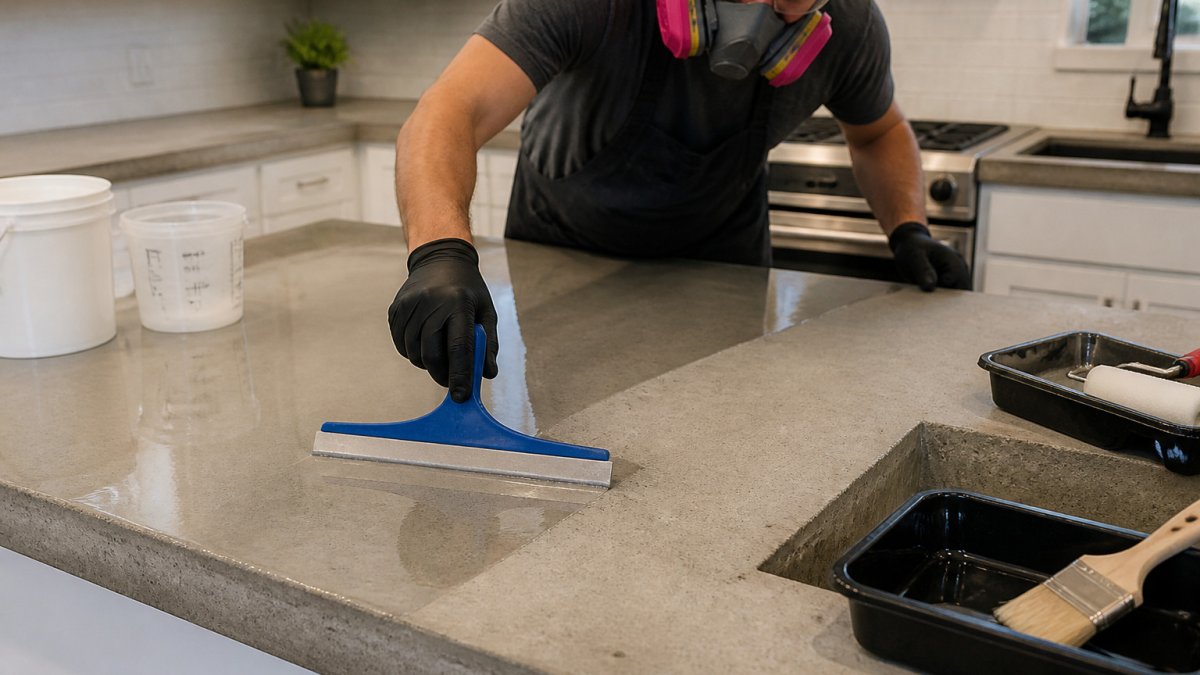
Pour in sections and spread with a squeegee or roller at the thickness the TDS specifies, often around 1/8 inch for a countertop build. Work steadily so the coating self-levels before it begins to gel. Uneven thickness cures unevenly and shows as waves or soft spots later.
Step 6: Remove bubbles
Pass a heat gun or torch gently over the surface 2-3 times to release trapped air. Keep the gun moving, you are releasing bubbles, not curing the film. Overheating can scorch the surface or create fisheyes.
Step 7: Apply the topcoat within the recoat window
Apply the topcoat when the first coat has reached the manufacturer's recoat window, often around 24 hours, but confirm on the TDS. Miss the window and you may need to sand and solvent-wipe before recoating. The topcoat seals micro-gaps and adds wear resistance.
Step 8: Control the environment through cure
Temperature and humidity drive cure. Most systems want a stable room temperature in the 70s°F and moderate humidity; cold or damp conditions slow the reaction and can leave a soft film. Keep the space dust-free and ventilated, and keep pets and foot traffic off the surface during cure.
Step 9: Verify full cure before food contact
Do not judge cure by the clock alone. Check for hardness under thumb pressure, no tackiness, and a faded chemical odor. A coin or fingernail test in an inconspicuous spot should not leave a mark. If any spot is soft or sticky, the cure is incomplete, wait, warm the room, and recheck before any food touches the surface.
Concrete-Enhancements guidance on epoxy cure timelines provides detailed timelines for different conditions and applications. Cure time isn't negotiable, it's chemistry.
Epoxy Countertop Heat Resistance and Hot Cookware
Cured epoxy can handle moderate heat. A warm plate? Fine. A hot pan fresh from the stove?
Most food-contact epoxy resists temperatures up to 140-160°F for brief contact. A hot skillet can reach 300-400°F.
The practical rule: use trivets, hot pads, or cooling racks.
Cold items are fine. A cold plate, a bowl of ice, a chilled glass, no problem.
Incidental Food Contact vs. Direct Food Preparation on Epoxy
This distinction separates safe use from unsafe use.
Incidental food contact means food touches the surface briefly and indirectly. A plate sits on the countertop.
Direct food preparation means raw food, chicken, beef, vegetables, is cut, chopped, or prepared directly on the surface.
Why? Cutting creates micro-scratches. These scratches trap bacteria and food particles.
The safe boundary: use your epoxy countertop as a work surface for plated food, prepared meals, and general kitchen tasks.
Getting Your Food-Safe Epoxy Countertop Installed
Applying food-safe epoxy yourself is possible. But mistakes are costly. Improper cure, wrong mix ratios, contaminated surfaces, or incomplete sealing all compromise food safety.
Professional installation ensures the job is done right. Concrete-Enhancements offers free estimates for epoxy countertop installation with CTi-certified materials and proven installation techniques.
Learn about our concrete overlay and epoxy installation process to see how professional application differs from DIY attempts.
Frequently Asked Questions
Is food-safe epoxy for kitchen counters actually FDA-approved?
Some epoxy products are formulated to meet FDA regulation 21 CFR 175.300 for indirect food contact. However, not all epoxy countertop products carry this certification. Always check the product's technical data sheet and look for explicit language stating compliance with 21 CFR 175.300. A product labeled as food-safe should specify which regulation it meets and under what conditions (fully cured, incidental contact only). If the label doesn't mention the regulation or cure requirements, contact the manufacturer before installation.
How long does epoxy countertop cure time take before food contact is safe?
Most quality epoxy products require a minimum of 72 hours to cure before incidental food contact, though 7 days of full curing is ideal for optimal hardness and food safety. Environmental conditions matter: cooler temperatures and high humidity extend cure time. Do not place food, dishes, or cookware on the surface before full cure. Even after the initial cure window, avoid cutting raw food directly on the epoxy surface, as the resin can still be vulnerable to knife marks and contamination during early use.
Can you cut food directly on an epoxy countertop?
No. Even food-safe epoxy countertops should not be used as cutting surfaces. Direct cutting with knives damages the cured coating, creates grooves where bacteria can hide, and compromises the food-safe seal. Use a cutting board placed on top of the epoxy. Food-safe epoxy is certified for incidental contact, dishes, glasses, and cold snacks resting on the surface, not for active food preparation or knife work.
What should you look for on a food-contact epoxy label?
Look for explicit mention of FDA compliance (21 CFR 175.300), the required cure time before food contact, and a statement that the product is for indirect or incidental food contact only. Verify the product name and batch number match the technical data sheet. If the label only says 'food safe' without specifying the regulation or cure time, request the full technical documentation from the manufacturer or installer. Reputable food-contact epoxy products will have this information readily available and clearly stated.
Food-safe epoxy countertops are durable, attractive, and practical for kitchens when installed and used correctly. The key is understanding what "food safe" actually means, respecting cure time, and knowing the boundaries of safe use. If you're ready to install food-safe epoxy countertops in your kitchen, request a free estimate from Concrete-Enhancements today. Call (919) 824-5403 or fill out our online form to get started.

Tags: food-safe epoxy countertops, food-safe epoxy for kitchen counters, fda-approved epoxy for countertops, epoxy countertop cure time, how to apply epoxy to countertops
Frequently Asked Questions
Some epoxy products are formulated to meet FDA regulation 21 CFR 175.300 for indirect food contact. However, not all epoxy countertop products carry this certification. Always check the product's technical data sheet and look for explicit language stating compliance with 21 CFR 175.300. A product labeled as food-safe should specify which regulation it meets and under what conditions (fully cured, incidental contact only). If the label doesn't mention the regulation or cure requirements, contact the manufacturer before installation.
Most quality epoxy products require a minimum of 72 hours to cure before incidental food contact, though 7 days of full curing is ideal for optimal hardness and food safety. Environmental conditions matter: cooler temperatures and high humidity extend cure time. Do not place food, dishes, or cookware on the surface before full cure. Even after the initial cure window, avoid cutting raw food directly on the epoxy surface, as the resin can still be vulnerable to knife marks and contamination during early use.
No. Even food-safe epoxy countertops should not be used as cutting surfaces. Direct cutting with knives damages the cured coating, creates grooves where bacteria can hide, and compromises the food-safe seal. Use a cutting board placed on top of the epoxy. Food-safe epoxy is certified for incidental contact—dishes, glasses, and cold snacks resting on the surface—not for active food preparation or knife work.
Look for explicit mention of FDA compliance (21 CFR 175.300), the required cure time before food contact, and a statement that the product is for indirect or incidental food contact only. Verify the product name and batch number match the technical data sheet. If the label only says 'food safe' without specifying the regulation or cure time, request the full technical documentation from the manufacturer or installer. Reputable food-contact epoxy products will have this information readily available and clearly stated.