blog
How to Choose Removable Epoxy Flooring Options
Quick Summary
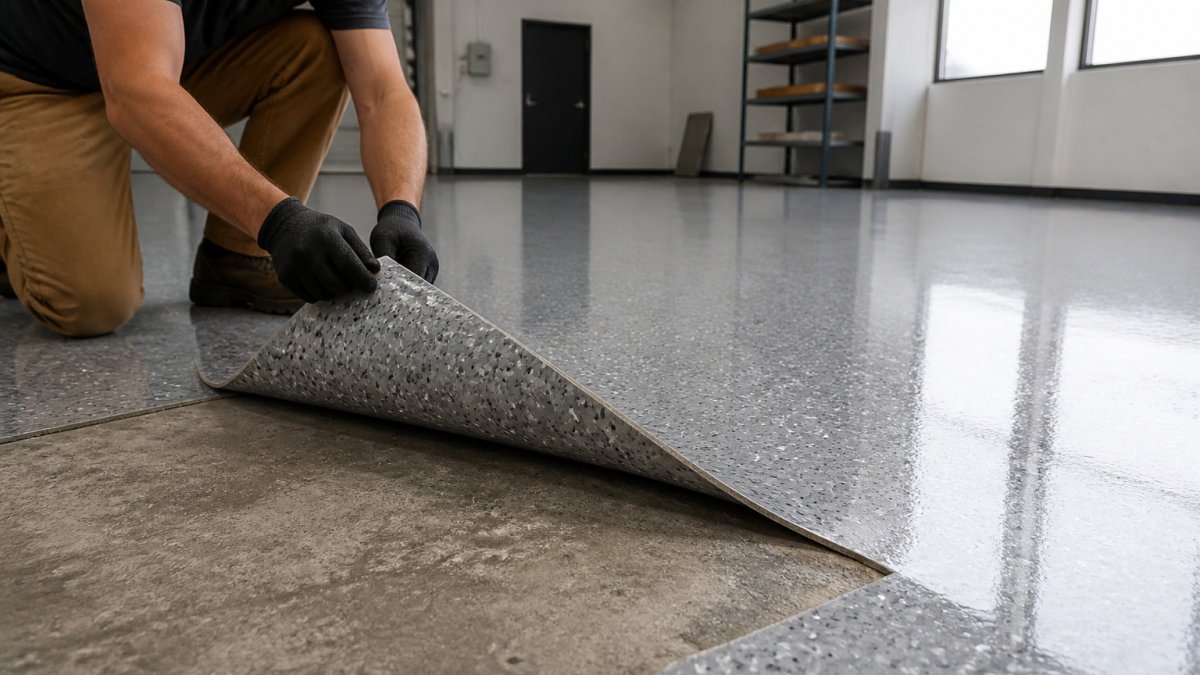
Removable epoxy flooring options include interlocking epoxy-coated tiles, peel-and-stick epoxy sheets, and epoxy applied over a barrier membrane. Interlocking tiles offer the easiest removal since no adhesive touches the concrete, while standard epoxy bonds chemically and requires grinding to remove.
- Interlocking epoxy-coated tiles float or snap together, so panels can be lifted and reinstalled elsewhere.
- Peel-and-stick epoxy sheets use removable adhesive, but residue can complicate removal on rough or porous surfaces.
- Epoxy over a barrier membrane peels up with the coating, but the membrane is single-use.
- Standard epoxy flake and solid-color systems bond chemically and need diamond grinding or shot blasting to remove.
- Ask the installer for the manufacturer's written removal procedure before buying any product marketed as temporary.
Table of Contents
- What Makes an Epoxy Floor Removable
- Removable Epoxy Flooring Options Compared
- Epoxy Flooring Alternatives That Come Up Easily
- How to Remove Epoxy From Concrete Without Damaging the Slab
- Temporary Floor Coating for Concrete: Cost and Reversibility
- Choosing the Right System for Your Space
- Scheduling a Free Estimate for Your Concrete Floor
- Frequently Asked Questions
What Makes an Epoxy Floor Removable
Last Updated: October 29, 2026
Most epoxy floors are not removable, and that is the first thing to understand when you search for removable epoxy flooring options. Standard epoxy coatings bond chemically to the concrete beneath them.
A floor becomes removable when the system is designed to separate cleanly from the slab.
Here is a quick way to test whether a product fits the "removable" label:
- Attachment method: Does it float, snap together, or use a removable adhesive?
- Bond to concrete: Does the manufacturer state a removal procedure in writing?
- Residue: Will it leave adhesive or coating behind that needs grinding?
- Reuse: Can the panels or sheets be taken up and reinstalled elsewhere?
Watch out: Some products are marketed as temporary but still require aggressive grinding to remove. Ask for removal instructions before purchase, not after installation.
Removable Epoxy Flooring Options Compared
The term "removable epoxy" covers several different products, and they behave very differently on removal. The table below compares the main categories by attachment method, removal effort, and where each makes sense.
| Option | How It Attaches | Removal Effort | Reuse? | Best For |
|---|---|---|---|---|
| Interlocking epoxy-coated tiles | Floats or snaps together; no adhesive to slab | Low, lift, stack, and relocate | Yes, panels can be reinstalled | Garages, showrooms, and spaces you may relocate |
| Peel-and-stick epoxy sheets | Pressure-sensitive removable adhesive | Low to moderate, adhesive residue possible | Sometimes, if adhesive releases cleanly | Short-term events, rentals, pop-up spaces |
| Epoxy over a barrier membrane | Coating bonds to a release membrane, not the slab | Moderate, membrane peels up, coating goes with it | No, membrane is single-use | Semi-permanent commercial spaces |
| Standard epoxy flake system | Chemically bonded to prepared concrete | High, diamond grinding or shot blasting required | No | Long-term, low-change floors |
| Solid-color epoxy coating | Chemically bonded, often with a primer | High, grinding, sometimes chemical stripping first | No | Warehouses, shops, heavy traffic |
| Metallic epoxy finish | Bonded base coat with decorative metallic topcoat | High, grinding removes both layers | No | Showrooms, lobbies where appearance matters |
| Polyaspartic topcoat over epoxy | Bonds to the epoxy base, which bonds to slab | High, topcoat and base come off together | No | Fast-return-to-service commercial floors |
Interlocking tiles usually offer the cleanest removal, since no adhesive touches the concrete. Peel-and-stick sheets are the cheapest route to a temporary look, but adhesive residue can complicate removal on rough or porous surfaces. Coatings over a membrane sit in the middle: the finish looks like epoxy, but the removable layer is the membrane, not the coating itself.
Removability by Coating Type
Not all epoxy coatings are equally hard to remove, and the differences matter if reversibility is part of your plan.
- Epoxy flake systems: The flake broadcast is embedded in a base coat that cures hard against the slab. Removal means grinding through the flake layer and the base coat, and often a few millimeters of concrete, so plan for dust containment and surface repair afterward.
- Solid-color coatings: A single pigmented coat over a primer. These tend to be thinner than flake systems, so grinding goes faster, but the primer still bonds to the concrete and must come off too.
- Metallic finishes: A decorative metallic layer over a base coat. The visual appeal is high, but removal is a two-layer grind, and the metallic pigments can smear under heat from grinding, which slows the job.
- Polyaspartic topcoats: Often applied over epoxy for fast cure and UV stability. The topcoat is harder than the epoxy beneath it, so grinding removes the polyaspartic first and the epoxy second, a two-pass process on many floors.
A common pattern among installers is that the thicker and more decorative the system, the more grinding passes removal takes. If you are choosing a floor with future removal in mind, ask the installer how many passes a grinder will need and whether the slab will need leveling afterward.
Pricing depends on the system, slab condition, quantity, and delivery timing. Request written quotes that list removal costs separately from installation, or visit Concrete-Enhancements's website or call for a current quote.
Epoxy Flooring Alternatives That Come Up Easily
If you want a floor you can change later, you may not need epoxy at all. Several alternatives go down and come up with far less effort.
Many homeowners consider modular vinyl tile and rigid interlocking floor panels for garages and workshops.
For a finished concrete look without permanent coating, a densified or sealed slab with a removable rug system can also serve.
These alternatives are rarely as durable as a commercial epoxy system. They suit spaces where flexibility matters more than wear resistance.
How to Remove Epoxy From Concrete Without Damaging the Slab
If you already have epoxy down and want it gone, removal is the harder problem. Done poorly, it can scar or weaken the concrete. The two main approaches are mechanical removal and chemical stripping, and they suit different situations.
Mechanical Grinding and Shot Blasting
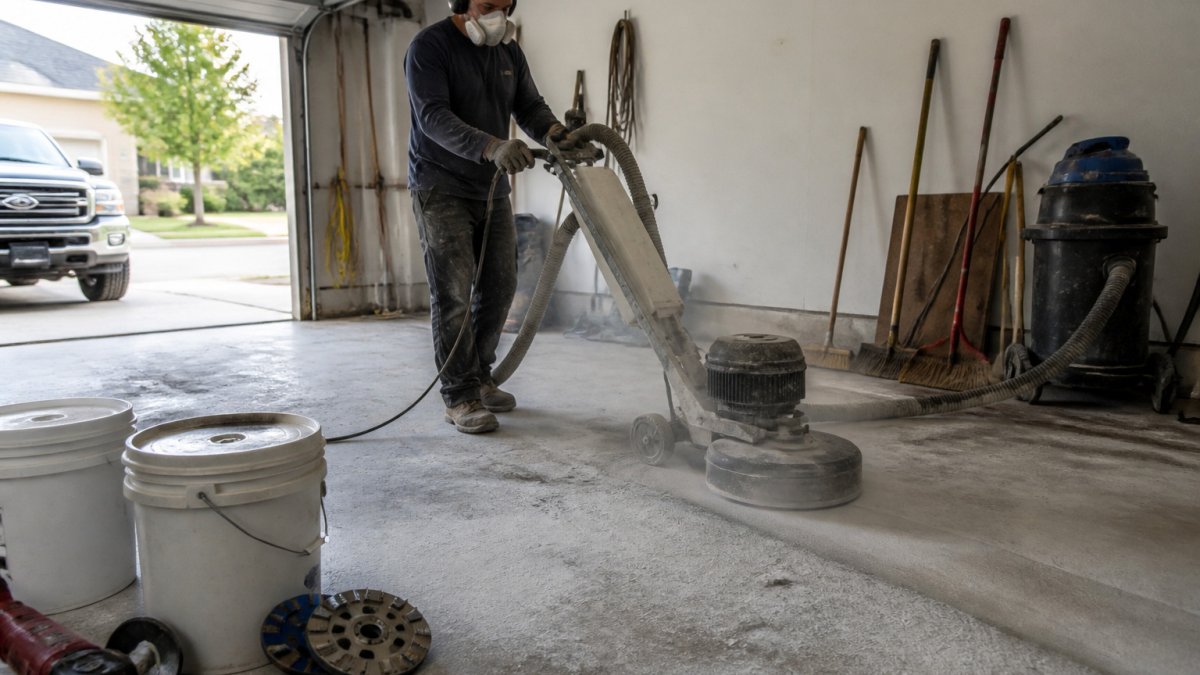
Mechanical methods are the most reliable way to remove bonded epoxy. A diamond grinder cuts through the coating and a few millimeters of surface, while a shot blaster propels steel media to strip the floor more evenly. Mechanical grinding is commonly used to remove bonded epoxy.
Expect dust and noise. Wear a properly fitted respirator, eye protection, and hearing protection, and use a vacuum attachment rated for fine silica dust. Grinding also removes surface concrete, which changes the slab's profile, so plan for leveling or a new coating afterward.
Call (919) 824-5403 or email craigrfear@gmail.com for a free estimate →
Chemical Stripping and Its Limits
Chemical strippers soften some coatings so they can be scraped away. They are gentler on the concrete surface in principle, but they work unevenly on cured epoxy and leave residue that must be neutralized and rinsed. For thick or fully bonded epoxy, chemical stripping often takes multiple applications and still needs a mechanical pass to finish the job.
Chemical methods make the most sense for thin, recently applied coatings or small areas. For a full garage or warehouse floor, most professionals start with mechanical removal.
Temporary Floor Coating for Concrete: Cost and Reversibility
A temporary floor coating is one designed to be applied and later removed. Reversibility depends almost entirely on the bond between coating and slab. Coatings with a weak or designed-release bond come up more easily than standard epoxy, but no temporary system is risk-free on every slab.
What Removal Actually Costs
Removal pricing is rarely quoted as a single number because it depends on four separate cost drivers. Most contractors break it down like this:
- Coating removal: Mechanical grinding or shot blasting is priced by square footage and by the number of passes required. Thicker systems and multiple coating layers take more passes.
- Disposal: Grinding produces dust and debris that must be captured and disposed of. Fine silica dust requires vacuum equipment rated for it, and disposal fees vary by volume and local rules.
- Surface repair: Grinding removes some surface concrete, so cracks, divots, and low spots often need patching or leveling before a new floor goes down.
- Replacement installation: If you are replacing the floor, the new system's prep and installation costs stack on top of removal.
A common pattern is that removal can approach the cost of installation when grinding is required, which is why asking for both figures in writing matters. For a benchmark on installed coating costs, epoxy and polyaspartic jobs are reported at $1,600 to $8,600 or more for a residential garage, according to QuoteIQ coating cost data.
The broader epoxy coating market is projected to grow from $47.44 billion in 2026 to $70.95 billion by 2034, according to Fortune Business Insights epoxy coatings market forecast, which reflects rising demand but says nothing about removability.
Reversibility by System
Reversibility is not a yes-or-no property; it sits on a spectrum:
- Fully reversible: Interlocking tiles and roll-out systems that never bond to the slab. They lift intact and can be reinstalled elsewhere.
- Partially reversible: Peel-and-stick sheets and coatings over a release membrane. They come up with effort, but adhesive residue or membrane fragments may need cleanup.
- Effectively permanent: Standard epoxy, flake, solid-color, metallic, and polyaspartic systems. Removal means grinding, and the slab will need repair and recoating afterward.
Decision Guidance by Use Case
Match the system to how long you need the floor and how much removal effort you can tolerate:
- Rental or under one year: Interlocking tiles or peel-and-stick sheets. Removal is low-effort and the slab is left largely intact.
- Two to five years, moderate traffic: Epoxy over a membrane, if removal is part of the plan and you accept moderate effort.
- Permanent, heavy traffic: A standard epoxy flake or solid-color system, accepting that removal later means grinding, disposal, and surface repair.
Also consider the slab. Cracks, moisture, and oil stains affect whether any coating will bond or release cleanly. A slab with existing damage may need repair before any system goes down, and that repair cost applies whether the floor is permanent or temporary.
Choosing the Right System for Your Space
Start with how long you need the floor, then match the system to that timeline.
- Under one year or a rental: Interlocking tiles or peel-and-stick sheets.
- Two to five years, moderate traffic: An epoxy over a membrane, if removal is part of the plan.
- Permanent, heavy traffic: A standard epoxy flake system, accepting that removal later means grinding.
Also consider the slab. Cracks, moisture, and oil stains affect whether any coating will bond or release cleanly. A slab with existing damage may need repair before any system goes down.
Concrete-Enhancements works with residential and commercial clients across the Raleigh-Durham Triangle, NC Triad, and Coastal SC. As a CTi Certified Dealer with more than 20 years of experience, we can help you choose a system that fits how long you want the floor to last.
Scheduling a Free Estimate for Your Concrete Floor
The right system depends on your slab, your timeline, and whether removal matters to you. Call (919) 824-5403 or email craigrfear@gmail.com to request a free estimate.
Frequently Asked Questions
Can epoxy flooring be removed?
Yes, but usually not by peeling it up. Epoxy bonds chemically and mechanically to concrete, so removal typically requires grinding, shot blasting or aggressive stripping that takes off the coating and a thin layer of the slab. Cost and time depend on floor area, coating thickness and how the slab was prepared. Because outcomes vary by substrate, get an on-site assessment before committing to removal.
What is the easiest way to remove epoxy from a concrete floor?
For most floors, mechanical removal with a diamond grinder or shot blaster is the most predictable method. Chemical strippers can soften some coatings, but they often leave residue and take longer on thick systems. Grinding also exposes the concrete for inspection, which helps identify cracks or moisture problems before a new floor is installed. Test a small area first to confirm which method suits your coating and slab.
Can you install a temporary coating over an existing epoxy floor?
Sometimes, but adhesion depends on the condition of the existing epoxy. A sound, well-bonded coating can be prepared by light abrasion and profiled for a new layer. A peeling or hazed coating must be removed first, since new material will not bond to loose film. Ask for a surface assessment before choosing an overlay, because a temporary coating over a failing system usually fails early.
How long does epoxy floor removal take?
Removal time depends on the size of the area, the coating thickness and the method used. Grinding a typical residential garage often takes a day or two including cleanup, while large commercial floors can take longer. Chemical stripping adds dwell time and rinsing. Schedule removal around your project timeline, and confirm the estimated duration in your written quote.

Tags: removable epoxy flooring, removable epoxy flooring options, epoxy flooring alternatives, how to remove epoxy from concrete, temporary floor coating for concrete
Frequently Asked Questions
Yes, but usually not by peeling it up. Epoxy bonds chemically and mechanically to concrete, so removal typically requires grinding, shot blasting or aggressive stripping that takes off the coating and a thin layer of the slab. Cost and time depend on floor area, coating thickness and how the slab was prepared. Because outcomes vary by substrate, get an on-site assessment before committing to removal.
For most floors, mechanical removal with a diamond grinder or shot blaster is the most predictable method. Chemical strippers can soften some coatings, but they often leave residue and take longer on thick systems. Grinding also exposes the concrete for inspection, which helps identify cracks or moisture problems before a new floor is installed. Test a small area first to confirm which method suits your coating and slab.
Sometimes, but adhesion depends on the condition of the existing epoxy. A sound, well-bonded coating can be prepared by light abrasion and profiled for a new layer. A peeling or hazed coating must be removed first, since new material will not bond to loose film. Ask for a surface assessment before choosing an overlay, because a temporary coating over a failing system usually fails early.
Removal time depends on the size of the area, the coating thickness and the method used. Grinding a typical residential garage often takes a day or two including cleanup, while large commercial floors can take longer. Chemical stripping adds dwell time and rinsing. Schedule removal around your project timeline, and confirm the estimated duration in your written quote.