how-to
How to Remove Oil Stains Before Epoxy (2026 Guide)
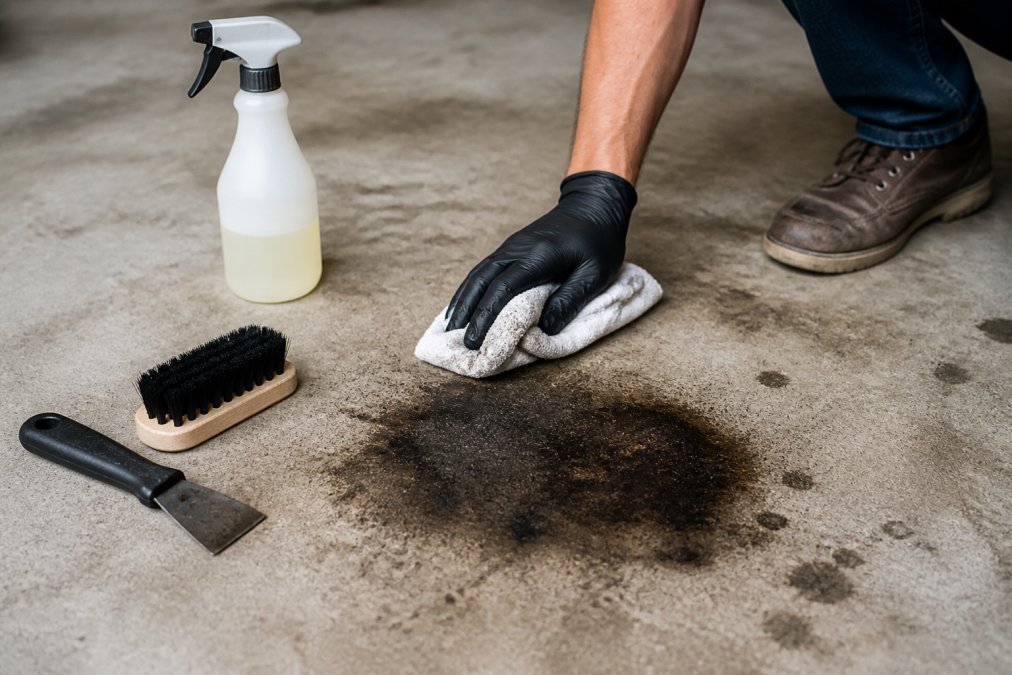
Table of Contents
- Why Oil Stains Cause Epoxy Floor Adhesion Problems
- How to Test Concrete for Oil Contamination
- Choosing the Best Concrete Degreaser for Epoxy Prep
- Step-by-Step: How to Remove Oil Stains Before Epoxy
- Mechanical Grinding and Drying Time Before You Coat
- Frequently Asked Questions
Last Updated: September 15, 2026
Why Oil Stains Cause Epoxy Floor Adhesion Problems
Oil contamination is the single most common reason epoxy floor coatings fail, and the failure almost never shows up on installation day. According to the American Concrete Institute's guidance on surface preparation, coatings bond to concrete through direct mechanical and chemical contact with the substrate. Oil interrupts that contact at the molecular level.
Understanding why that happens is the difference between a floor that lasts and one you pay for twice.
How Oil Breaks the Bond at the Surface
Concrete is porous. Those pores are what let epoxy grip, and they're also what let oil sink in and stay there.
When oil soaks into a concrete slab, it leaves behind a hydrophobic film inside the pores. Epoxy is a rigid material that needs a clean, dry, slightly roughened surface to form a mechanical lock. Oil prevents that lock from forming, and the result is delamination: the coating separates from the slab, usually starting at the edges of the contaminated zone.
A common mistake is assuming a stain that looks gone is actually gone. Oil that has penetrated deeply can be invisible on the surface and still destroy adhesion.
Deep-Set Stains vs. Surface Stains
Surface stains sit in the top layer of the concrete and respond well to scrubbing and degreasing. Deep-set stains have migrated into the slab's interior through porosity, sometimes reaching depths that no brush can touch.
The practical difference matters because the two require different approaches. Surface contamination is a cleaning problem. Deep saturation is a preparation problem that may require repeated treatment cycles or mechanical removal of the affected layer.
How to Test Concrete for Oil Contamination
The water bead test is the fastest, cheapest way to find out whether a slab is actually clean enough for epoxy. It takes about five minutes and requires nothing but water.
Here's how it works: pour a small puddle of clean water onto the suspect area and watch what happens. If the water beads up and sits on the surface, the concrete is still hydrophobic, which means oil residue remains. If the water spreads out and soaks in within a minute or two, the surface is ready for the next step.
The Water Bead Test
Run the test in several spots, not just the visible stain. Oil spreads laterally through a slab, so contamination often extends well past the dark patch you can see.
- Pour water in the center of the stain and at each edge
- Wait 60 seconds and observe
- Beading water = more cleaning needed
- Sheeting and absorption = clean enough to proceed
This test is the single most useful quality check in the entire process. It tells you the truth when your eyes can't.
Choosing the Best Concrete Degreaser for Epoxy Prep
The best concrete degreaser for epoxy prep is the one that removes the oil and rinses out of the slab completely. Those are two different jobs, and most products only do one well. The category you pick should be driven by how deep the oil has migrated and whether the slab will tolerate a residue film.
Call (919) 824-5403 or email craigrfear@gmail.com for a free estimate →
Alkaline Cleaners: Saponification and Emulsification
Alkaline degreasers, the class that includes sodium hydroxide, potassium hydroxide, and sodium metasilicate builders, work by two mechanisms. Saponification converts triglycerides (the fats in motor oil and cooking oil) into water-soluble soap. Emulsification surrounds the remaining oil with surfactant molecules so water can carry it off the slab.
What matters for epoxy prep is the rinse. Alkaline cleaners are water-soluble by design, so a thorough rinse with clean water removes them. But many consumer "heavy-duty" degreasers add fragrances, dyes, and optical brighteners that are not water-soluble. Those additives stay in the pores after rinsing and become the bond line between your slab and your epoxy. That is the residue problem most how-to guides never mention.
- Look for a concentrate with a short ingredient list, hydroxide or metasilicate plus surfactant, nothing else
- Avoid "citrus" or "orange" cleaners marketed for driveways; the d-limonene leaves an oily film
- Dilute per label; over-concentration leaves more residue, not less
Solvent-Based Degreasers: Dissolving Deep-Set Oil
Solvent degreasers, typically petroleum distillates, xylene, or acetone blends, dissolve oil directly and carry it out of the pore structure. They reach contamination that alkaline products cannot, which makes them the right choice for old, saturated, or repeatedly re-oiled stains.
The trade-offs are real. Solvents are flammable, require respiratory protection, and need longer to flash off before coating. They also can drive oil deeper into the slab if applied without extraction, the solvent dissolves the oil, and if you do not pull it out with a wet vac or absorbent, it re-deposits further down.
| Degreaser Type | Mechanism | Best For | Residue Risk | Drying Time |
|---|---|---|---|---|
| Alkaline (hydroxide/metasilicate) | Saponification + emulsification | Surface grease, light stains, routine prep | Low if rinsed; high if additives present | Short (hours) |
| Solvent (distillate/xylene) | Direct dissolution | Deep-set, old, saturated stains | Low if extracted; high if left to evaporate | Long (24-72 hrs) |
| Poultice (absorbent + solvent) | Capillary draw | Stains that have fully saturated the slab | Low | Long |
The Two-Stage Approach Most Pros Use
For a typical residential garage slab, the sequence that works is alkaline first, solvent second, water bead test between each. The alkaline pass lifts the surface film and any emulsifiable oil. The solvent pass targets whatever the water bead test still flags as hydrophobic. Then a final alkaline rinse to remove solvent residue.
What Not to Use Before Epoxy
A few products that show up in DIY threads and should not be used on a slab headed for epoxy:
- Dish soap and laundry detergent, leave surfactant and fragrance residue that epoxy cannot bond through
- Bleach, does not remove oil, and the chloride residue can interfere with some epoxy chemistries
- Acid etch (muriatic), etches the surface but does not remove oil; oil left under an etched profile is still oil
- Paint thinner alone, flashes off too fast to extract oil from the pore structure
If you are unsure whether a product leaves residue, test it on a scrap of the same concrete, let it dry fully, and run the water bead test. If water beads, the product left something behind.
Step-by-Step: How to Remove Oil Stains Before Epoxy
Removing oil stains before epoxy is a multi-stage process: scrape, degrease, scrub, soak, extract, and verify. Skipping any stage leaves residue that will cause bond failure later.
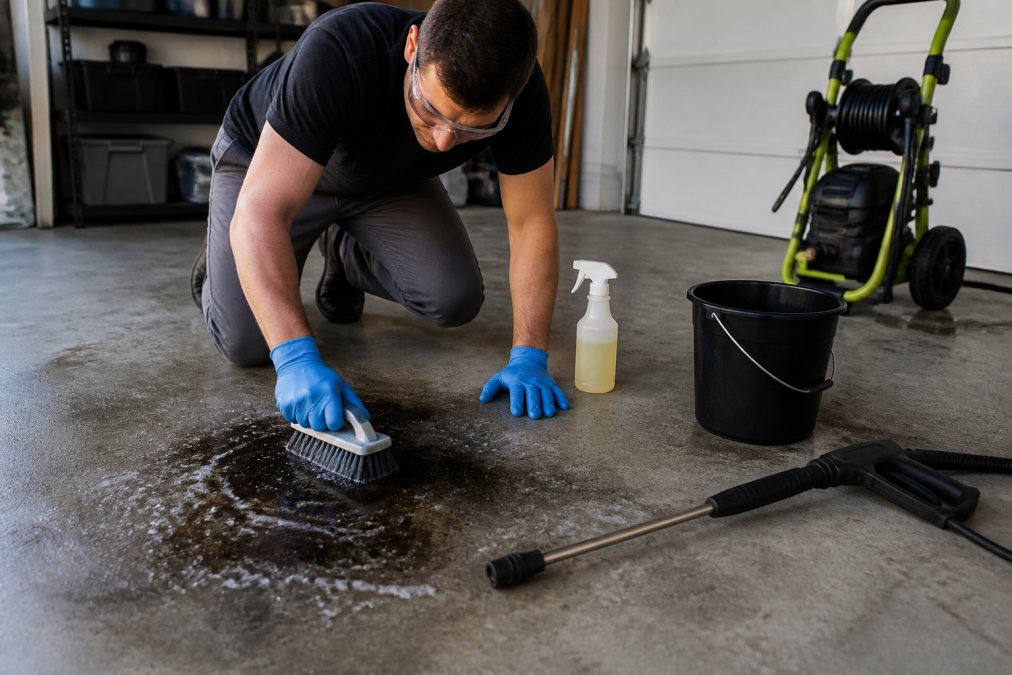
Tools and Materials You'll Need
Scrubbing, Soaking, and Extracting the Oil
Mechanical Grinding and Drying Time Before You Coat
Why Grinding Beats Acid Etching for Oil-Contaminated Slabs
Post-Cleaning Drying Time: The Moisture Threshold
How Long to Wait After Cleaning
Frequently Asked Questions
Can old oil stains be removed from concrete before epoxy application?
Yes, but old stains take more work. Oil that has sat for months soaks deeper into the concrete's porosity, so a single scrub won't cut it. You'll need repeated cycles of degreaser, soaking time, and scrubbing, followed by mechanical grinding to open the surface. After cleaning, run a water bead test: if water soaks in evenly instead of beading up, the slab is ready. If it still beads, the oil is present and epoxy won't bond.
What is the best concrete degreaser for epoxy prep?
There's no single best product, but alkaline cleaners and solvent-based degreasers handle most oil stains. Alkaline cleaners work well on surface oil and grease because they emulsify it for easy rinsing. Solvent-based degreasers penetrate deeper into the slab for set-in stains. Whichever you choose, pick one labeled residue-free. Leftover cleaner residue can interfere with epoxy adhesion just as badly as the oil did, so rinse thoroughly and let the slab dry completely before coating.
Will epoxy adhere to concrete if oil stains remain?
No. Oil creates a barrier that stops epoxy from bonding to the concrete substrate. Even a thin film of oil can cause bond failure, leading to peeling, delamination, and coating failure within months. This is one of the most common causes of epoxy floor adhesion problems. Test with the water bead method after cleaning. If water beads up, oil is still there. Clean again or grind the surface until water soaks in evenly.
How do I know if the concrete is clean enough for epoxy?
The water bead test is the simplest check. Pour a small amount of water on the cleaned slab. If it soaks in within a few minutes and darkens the concrete evenly, the surface is porous and ready. If it beads up or pools on top, oil or residue is blocking absorption. You can also check for residue by wiping with a white cloth: any dark transfer means clean again. Let the slab dry fully before applying epoxy.
Tags: remove oil stains, how to remove oil stains before epoxy, best concrete degreaser for epoxy prep, how to test concrete for oil contamination, epoxy floor adhesion problems
Frequently Asked Questions
Yes, but old stains take more work. Oil that has sat for months soaks deeper into the concrete's porosity, so a single scrub won't cut it. You'll need repeated cycles of degreaser, soaking time, and scrubbing, followed by mechanical grinding to open the surface. After cleaning, run a water bead test: if water soaks in evenly instead of beading up, the slab is ready. If it still beads, the oil is present and epoxy won't bond.
There's no single best product, but alkaline cleaners and solvent-based degreasers handle most oil stains. Alkaline cleaners work well on surface oil and grease because they emulsify it for easy rinsing. Solvent-based degreasers penetrate deeper into the slab for set-in stains. Whichever you choose, pick one labeled residue-free. Leftover cleaner residue can interfere with epoxy adhesion just as badly as the oil did, so rinse thoroughly and let the slab dry completely before coating.
No. Oil creates a barrier that stops epoxy from bonding to the concrete substrate. Even a thin film of oil can cause bond failure, leading to peeling, delamination, and coating failure within months. This is one of the most common causes of epoxy floor adhesion problems. Test with the water bead method after cleaning. If water beads up, oil is still there. Clean again or grind the surface until water soaks in evenly.
The water bead test is the simplest check. Pour a small amount of water on the cleaned slab. If it soaks in within a few minutes and darkens the concrete evenly, the surface is porous and ready. If it beads up or pools on top, oil or residue is blocking absorption. You can also check for residue by wiping with a white cloth: any dark transfer means clean again. Let the slab dry fully before applying epoxy.