listicle
Residential Concrete Floor Transformation Ideas
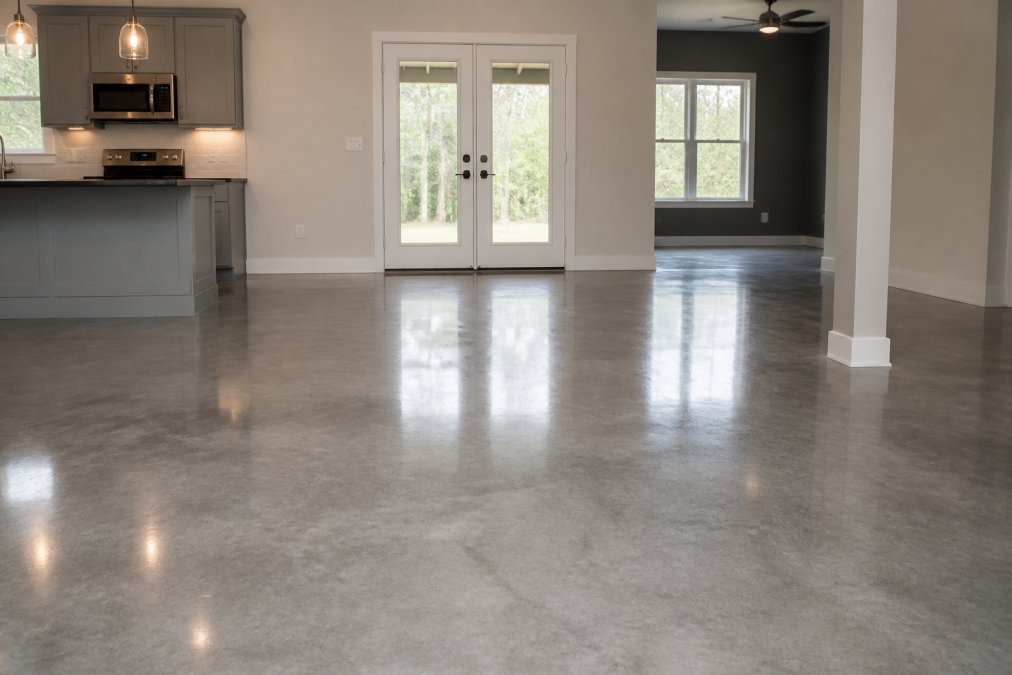
Table of Contents
- Why Concrete Floor Transformation Matters for Your Home
- Surface Preparation and Cleaning: The Foundation of Success
- Epoxy Floor Coating Pros and Cons
- Concrete Staining and Dyeing for Custom Color
- Polished Concrete Cost Per Square Foot and Long-Term Value
- DIY Concrete Floor Resurfacing vs. Professional Installation
- Maintenance and Care to Protect Your Investment
- Conclusion: Transform Your Concrete Into a Design Statement
Last Updated: August 13, 2026
Why Concrete Floor Transformation Matters for Your Home
Your concrete floors don't have to stay gray and utilitarian. A residential concrete floor transformation can completely redefine how your space looks and functions, turning a plain slab into a statement piece that reflects your design vision. Whether you're working with a basement, garage, patio, or interior living space, the right transformation approach can increase property value, improve durability, and create a surface that actually feels intentional.
At Concrete-Enhancements, we've seen firsthand how the right approach changes the entire character of a home. Most homeowners don't realize that a stunning finish starts weeks before any color or coating goes down. What happens during surface preparation determines whether your transformation lasts five years or fifteen.
Today's options far exceed basic paint or stain. You can achieve polished concrete finishes that rival natural stone, epoxy coatings with decorative flakes, acid-stained surfaces with unique marbled patterns, or decorative overlays that look like tile or brick. Each approach has distinct advantages, real limitations, and a specific cost structure. Choosing correctly means understanding not just what looks good, but what performs well in your climate, traffic level, and maintenance tolerance.
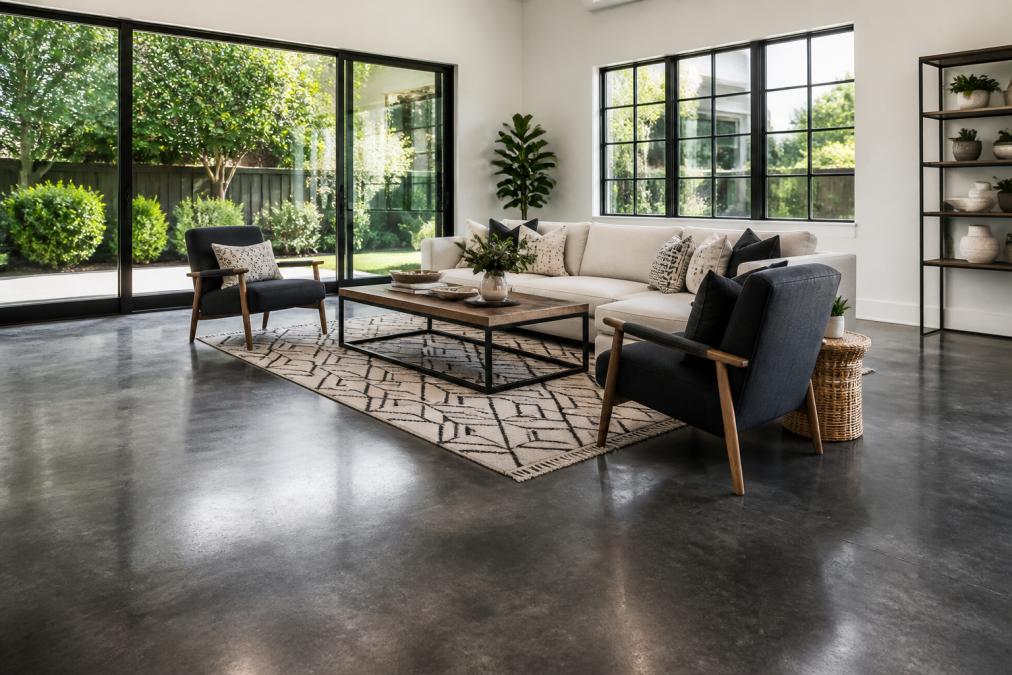
This guide walks you through every major concrete floor transformation option available to homeowners. We'll cover what actually works, what fails regularly, and how to avoid the mistakes that lead to peeling, cracking, or disappointingly short lifespan.
Surface Preparation and Cleaning: The Foundation of Success
Surface preparation isn't the exciting part of a concrete floor transformation, but it's the part that determines success or failure. A poorly prepared surface will cause any coating or stain to fail prematurely, regardless of product quality.
Concrete is porous and absorbs moisture, oils, dust, and contaminants. Before any transformation work begins, that surface must be cleaned to bare concrete, all contaminants removed, and any structural issues addressed. The cleaning method depends on what's currently on the floor and what finish you're applying.
For basic cleaning, pressure washing at 3,000-4,000 PSI removes surface dirt and loose material. If the concrete has been sealed previously, you may need chemical strippers or grinding to remove the old coating. Concrete used as a garage floor often has oil stains requiring degreasing compounds or enzymatic cleaners. Moisture testing is essential before applying epoxy or stain; if the concrete is too wet, the coating won't adhere properly and will peel within months.
Grinding removes thin coatings, smooths uneven surfaces, and opens the concrete's pores to accept stain or sealer. For a polished concrete finish, grinding is the primary tool that creates the aesthetic. For epoxy or stain applications, light grinding (typically 120-150 grit) is usually sufficient. The concrete needs to feel slightly rough to the touch, like fine sandpaper.
Crack repair comes before any aesthetic work. Small hairline cracks can be left alone if stable, but anything wider than 1/8 inch should be filled with concrete filler or epoxy injection to prevent moisture infiltration and future damage.
Epoxy Floor Coating Pros and Cons
Epoxy has become the most popular choice for garage floors and commercial spaces because it delivers durability, chemical resistance, and customization options. Understanding the real trade-offs prevents expensive mistakes.
The primary advantage of epoxy is durability. A properly applied two-part epoxy system resists oil, gasoline, salt, and most household chemicals. It's highly customizable with decorative flakes, metallic effects, or solid colors. Installation is relatively fast, typically one to three days. The surface is easy to clean and maintain.
The cons are equally important. Epoxy is moisture-sensitive during application and curing. If humidity is too high or concrete moisture content exceeds certain thresholds, the epoxy won't cure properly and will bubble or peel. Epoxy can also be slippery when wet, which matters for safety. Some products emit VOCs during application, requiring ventilation. Finally, epoxy is brittle compared to polyurethane or polyaspartic topcoats, and impact damage can chip the surface.
One-part epoxy systems like BEHR PREMIUM Concrete & Garage Self-Priming 1-Part Epoxy are easier to apply and don't require precise mixing ratios, making them popular for DIY projects. However, they're not as durable as two-part systems and typically last 3-5 years before requiring recoating. Two-part systems last significantly longer, often 7-10 years with proper maintenance.
The cost of epoxy varies widely based on quality and customization. Basic single-color epoxy costs considerably less than decorative flake systems or metallic finishes. Professional installation typically costs more than DIY, but the difference in longevity and appearance often justifies the expense.
Concrete Staining and Dyeing for Custom Color
Concrete staining offers a fundamentally different approach compared to coatings. Stain penetrates the concrete itself rather than sitting on top as a layer. This means it won't peel, and the color becomes part of the material.
Two main types exist: acid-based and water-based. Acid stains like Brickform Blush-Tone Acid Stain chemically react with minerals in the concrete, creating permanent, translucent color with natural variation. Each application is unique because the reaction depends on the concrete's mineral content and age. Acid stains produce earth tones: tans, browns, rust colors, and soft greens. They can't create bright colors.
Water-based stains use pigments suspended in water rather than a chemical reaction. Brickform ARTesian Stain and similar products offer hundreds of color options and more consistent results than acid stains. The trade-off is that water-based stains don't penetrate as deeply and may require a sealer for long-term durability. They're also easier to apply and safer to handle than acid stains.
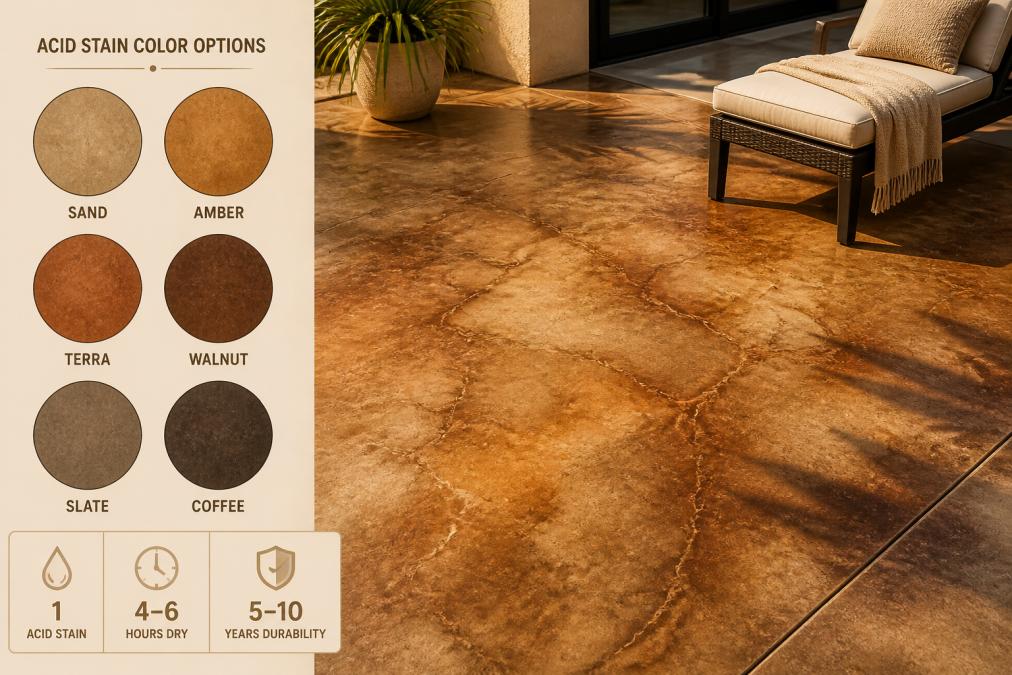
For residential applications, staining works best on interior floors where the concrete is relatively clean and you want a natural aesthetic. Acid staining suits spaces where you want that mottled, stone-like appearance. Water-based staining is better for achieving specific colors or consistent results.
The limitation of staining is that it only changes color and doesn't add protection or increase durability. Stained concrete is still porous and susceptible to staining from spills. After staining, apply a sealer to protect the color and make the surface easier to maintain.
Polished Concrete Cost Per Square Foot and Long-Term Value
Polished concrete has become increasingly popular for interior spaces because it creates a sophisticated, high-end appearance without the maintenance requirements of natural stone. Understanding polished concrete cost per square foot and the long-term value proposition is essential for deciding if it fits your budget.
Polished concrete involves grinding the surface progressively finer, typically from 80-grit through 400-grit or higher, depending on the desired finish level. A higher grit produces a glossier, more reflective surface. The process also exposes the aggregate (small stones) in the concrete, creating visual depth and texture. A concrete densifier is usually applied to harden the surface and improve its resistance to staining and wear.
Call (919) 824-5403 or email craigrfear@gmail.com for a free estimate →
The cost per square foot varies significantly based on the current condition of the concrete, the desired grit level, and whether decorative elements like stenciling or scoring are included. Basic polishing to 120-150 grit costs considerably less than high-gloss polishing to 400+ grit. Professional polishing typically requires specialized equipment and expertise.
The long-term value of polished concrete is strong. Once polished, the surface is extremely durable and requires minimal maintenance, just regular sweeping and occasional mopping. It doesn't need resealing every few years like stained concrete. Polished concrete also reflects light, improving brightness and reducing lighting needs.
The main limitation is that polished concrete is slippery, especially when wet. Anti-slip additives can be applied to the sealer, but they reduce the glossy appearance.
| Finish Level | Grit Range | Appearance | Cost Relative to Basic | Slip Resistance |
|---|---|---|---|---|
| Basic | 80-150 | Matte, aggregate visible | Baseline | Moderate |
| Medium | 200-300 | Satin sheen, smooth | 1.2x-1.5x | Moderate-Low |
| High-Gloss | 400+ | Mirror-like reflection | 1.8x-2.5x | Low |
DIY Concrete Floor Resurfacing vs. Professional Installation
The decision between DIY concrete floor resurfacing and professional installation depends on your skill level, time availability, and project scope. Some transformations are genuinely achievable for homeowners with basic tools and patience. Others require specialized equipment and experience that justify professional installation.
DIY concrete floor resurfacing works best for straightforward projects like applying a single-part epoxy paint or water-based stain to a small area. Products like DRYLOK Latex Concrete Floor Paint or Valspar Latex Porch, Floor & Patio Paint are designed for homeowner application. If your concrete is already relatively clean and you're not attempting a complex decorative finish, DIY can save money.
The reality is that most DIY projects fail because homeowners underestimate surface preparation. Rushing through cleaning, skipping moisture testing, or applying products in poor environmental conditions leads to peeling, bubbling, or inadequate adhesion. These failures are expensive to fix because you often need to remove the failed coating before starting over.
Professional installation makes sense for multi-part epoxy systems, polished concrete, decorative overlays, or acid staining. These processes require equipment most homeowners don't own and knowledge about environmental conditions, curing times, and proper mixing ratios. Contractors like Concrete-Enhancements have invested in specialized tools and experience troubleshooting problems that arise during application.
The cost difference between DIY and professional installation varies by project type. For a simple paint application, DIY might save 40-50% of labor cost. For polished concrete or decorative overlays, the savings are often smaller because material cost dominates and technical difficulty is high. Professional installation also includes a warranty, which protects your investment.
Maintenance and Care to Protect Your Investment
A concrete floor transformation only delivers long-term value if you maintain it properly. Maintenance requirements vary depending on which transformation method you chose, but all concrete surfaces need regular attention.
For epoxy-coated floors, regular sweeping removes dirt and dust that can scratch the surface. Damp mopping with a pH-neutral cleaner keeps the surface clean without damaging the coating. Avoid acidic cleaners, which can etch the epoxy. Spills should be cleaned promptly, especially oil or chemicals. Most epoxy floors need recoating every 5-10 years depending on traffic level and maintenance quality.
Stained concrete requires sealing immediately after staining and periodic resealing, typically every 2-3 years for interior floors or annually for exterior surfaces. The sealer protects the stain color and makes the surface easier to clean. Without sealing, stained concrete will gradually fade and become more susceptible to staining.
Polished concrete needs minimal maintenance once sealed. Regular sweeping and damp mopping are sufficient. The sealer should be reapplied every 3-5 years, depending on traffic and sealer type. The advantage of polished concrete is that maintenance is straightforward and inexpensive.
Decorative overlays and resurfaced concrete require maintenance similar to the underlying finish type. Most overlays benefit from sealing to protect against moisture and staining.
Moisture is the enemy of all concrete finishes. If water infiltrates from below, it can cause coatings to fail from underneath, leading to bubbling and peeling. This is particularly common in basements or on slabs built directly on soil without a moisture barrier. Addressing moisture issues before applying any finish prevents expensive failures.
Conclusion: Transform Your Concrete Into a Design Statement
Concrete doesn't have to be an eyesore in your home. A thoughtful residential concrete floor transformation can turn a utilitarian surface into something you actually enjoy. The key is matching the right transformation method to your specific situation, climate, traffic level, aesthetic goals, and maintenance tolerance.
The difference between a transformation that lasts and one that fails within a few years comes down to preparation and execution. At Concrete-Enhancements, we've completed hundreds of concrete floor transformations, and the pattern is always the same: the projects that succeed are the ones where surface preparation was treated as seriously as the finish itself.
If you're ready to transform your concrete floors, contact Concrete-Enhancements for a free estimate. As a CTi Certified Dealer with over 20 years of experience, we specialize in decorative concrete overlays and epoxy coatings that deliver both aesthetic appeal and durability. Call (919) 824-5403 or email craigrfear@gmail.com to discuss your project and learn how professional installation can protect your investment for years to come.
Frequently Asked Questions
What's the cheapest way to transform a concrete floor?
Water-based concrete stains and basic latex floor paints offer the most budget-friendly concrete floor transformation options. DIY application of these products can reduce labor costs significantly. However, the longevity and appearance vary: basic paint may peel within a year if surface preparation is inadequate, while water-based stains provide better durability at a lower cost than acid stains or epoxy systems. For the absolute lowest cost, concrete stain applied to a properly cleaned surface delivers decent results without breaking your budget.
How much does polished concrete cost per square foot?
Polished concrete pricing depends on existing surface condition, desired finish level, and whether you hire professionals or tackle it yourself. Professional polishing typically ranges based on your specific project requirements. For accurate pricing tailored to your square footage and finish preference, contact a local concrete specialist for a free estimate. DIY polishing equipment rental is available, but the learning curve and equipment costs can offset savings on smaller projects.
Can I do DIY concrete floor resurfacing myself, or do I need a professional?
DIY concrete floor resurfacing is possible for simple projects like basic staining or painting, but success depends heavily on proper surface preparation. Many homeowners who attempt epoxy coatings without professional guidance experience peeling or adhesion failure within months. Water-based stains and latex paints are more forgiving for DIY application. For complex finishes like polished concrete, decorative overlays, or epoxy systems in high-traffic areas, professional installation ensures durability and proper subsurface integrity, which directly impacts how long your transformation lasts.
What's the difference between acid stain and water-based stain for concrete?
Acid stains chemically react with minerals in concrete, creating permanent, translucent, and naturally marbled effects with earth-tone colors. Each application is unique and cannot be repeated exactly. Water-based stains use pigments for consistent, predictable color with hundreds of options and easier cleanup. Acid stains penetrate deeper and resist fading better, while water-based stains are simpler to apply and safer for DIY use. Acid stains require neutralization after application, making them more technical; water-based stains dry faster with minimal odor.
This article was written using GrandRanker
Frequently Asked Questions
Water-based concrete stains and basic latex floor paints offer the most budget-friendly concrete floor transformation options. DIY application of these products can reduce labor costs significantly. However, the longevity and appearance vary: basic paint may peel within a year if surface preparation is inadequate, while water-based stains provide better durability at a lower cost than acid stains or epoxy systems. For the absolute lowest cost, concrete stain applied to a properly cleaned surface delivers decent results without breaking your budget.
Polished concrete pricing depends on existing surface condition, desired finish level, and whether you hire professionals or tackle it yourself. Professional polishing typically ranges based on your specific project requirements. For accurate pricing tailored to your square footage and finish preference, contact a local concrete specialist for a free estimate. DIY polishing equipment rental is available, but the learning curve and equipment costs can offset savings on smaller projects.
DIY concrete floor resurfacing is possible for simple projects like basic staining or painting, but success depends heavily on proper surface preparation. Many homeowners who attempt epoxy coatings without professional guidance experience peeling or adhesion failure within months. Water-based stains and latex paints are more forgiving for DIY application. For complex finishes like polished concrete, decorative overlays, or epoxy systems in high-traffic areas, professional installation ensures durability and proper subsurface integrity, which directly impacts how long your transformation lasts.
Acid stains chemically react with minerals in concrete, creating permanent, translucent, and naturally marbled effects with earth-tone colors. Each application is unique and cannot be repeated exactly. Water-based stains use pigments for consistent, predictable color with hundreds of options and easier cleanup. Acid stains penetrate deeper and resist fading better, while water-based stains are simpler to apply and safer for DIY use. Acid stains require neutralization after application, making them more technical; water-based stains dry faster with minimal odor.