listicle
Best Concrete Grinders for Epoxy: 2026 Guide
Last Updated: October 23, 2026
Quick Summary
Concrete grinders for epoxy create a surface profile between 60-90 mils, remove all contaminants and old coatings, and include dust extraction to meet safety standards. Rotary grinders work well for residential projects; planetary grinders handle aggressive removal and larger commercial jobs.
- Surface profile must measure 60-90 mils for epoxy to bond mechanically to concrete
- Dust control with a sealed shroud and HEPA vacuum is required by OSHA and prevents respiratory hazards
- Rotary grinders suit residential projects while planetary grinders are more efficient for commercial spaces and epoxy removal
- Diamond tooling grit selection depends on concrete age and hardness: 30-60 grit for standard prep, 16-30 grit for old epoxy removal
- Rotary grinder rentals cost $100-200 per day; planetary rentals $200-400 per day
Table of Contents
- Why Choosing the Right Concrete Grinder for Epoxy Matters
- How to Grind Concrete for Epoxy: Preparation Fundamentals
- Concrete Grinder for Epoxy Removal: Coating and Residue Extraction
- Best Diamond Grinding Wheel for Concrete: Selection and Specifications
- Concrete Floor Preparation for Epoxy Coating: Equipment and Process
- Top Grinder Options for Epoxy Work: Specifications and Use Cases
- Key Specifications to Compare: Motor Power, Width, and Dust Shroud Design
- Common Mistakes When Grinding Concrete Before Epoxy
- Frequently Asked Questions
Why Choosing the Right Concrete Grinder for Epoxy Matters
Selecting the right concrete grinder for epoxy preparation means understanding which tool delivers the surface profile your coating needs to bond.
Concrete-Enhancements has over 20 years of experience in concrete preparation and epoxy application. The most common mistake is choosing a grinder on price or brand alone; the right choice depends on your concrete condition, the coating you're removing, and project size.
This guide covers the concrete grinders for epoxy that deliver results, walking through equipment types, diamond tooling, dust control, and the specifications that matter.
How to Grind Concrete for Epoxy: Preparation Fundamentals
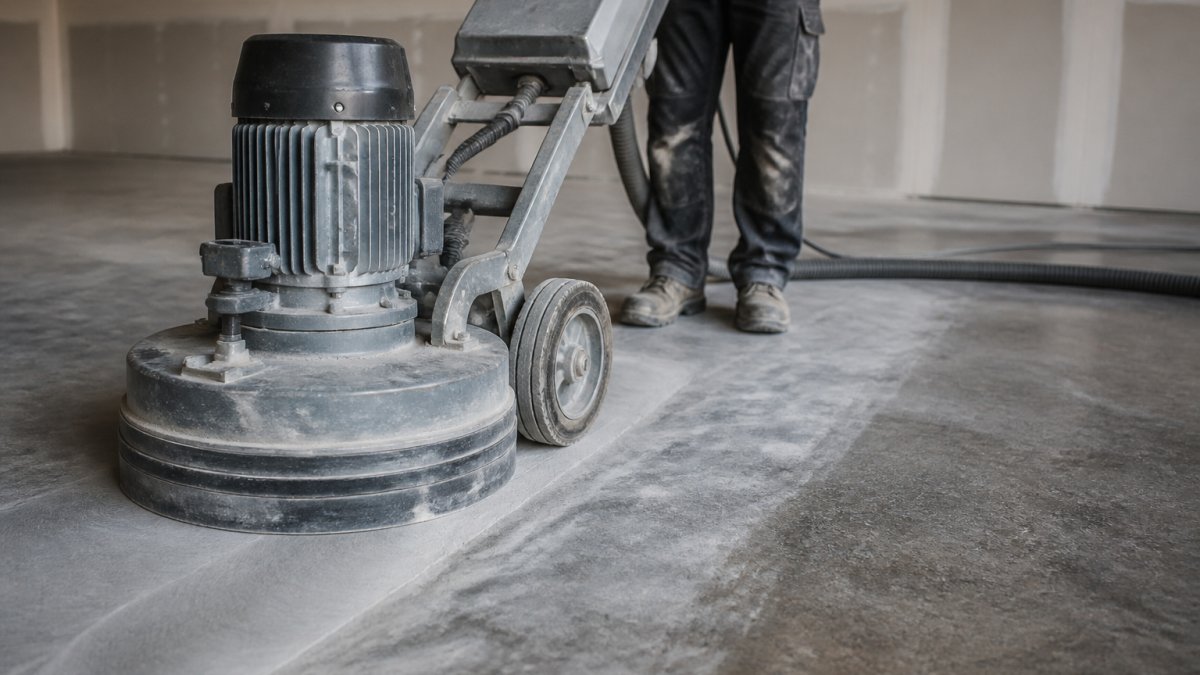
Grinding concrete for epoxy isn't polishing. Learn how to prepare concrete for epoxy coating with detailed step-by-step guidance covering surface cleaning, repair, and moisture testing. You're creating a surface that lets epoxy mechanically bond, which requires understanding surface profile and why dust control matters.
Grinding removes contaminants, old coatings, and the top layer of concrete to expose fresh aggregate for epoxy to grip. Skip it or do it poorly, and your epoxy will peel within months.
Surface Profile Requirements
Surface profile is measured in mils (thousandths of an inch). For epoxy to bond, you need 60-90 mils, enough texture for mechanical adhesion without destabilizing the substrate.
A rotary grinder with diamond tooling typically creates a 60-80 mil profile; planetary grinders can achieve deeper profiles faster when you need aggressive removal.
You've reached the right profile when the surface shows exposed aggregate and feels slightly rough. A smooth, polished surface means you're polishing instead of profiling.
Dust Control and Safety Considerations
Concrete dust contains silica, which poses serious respiratory risks. OSHA requires dust control, and grinding without proper extraction creates a hazardous environment and spreads fine dust.
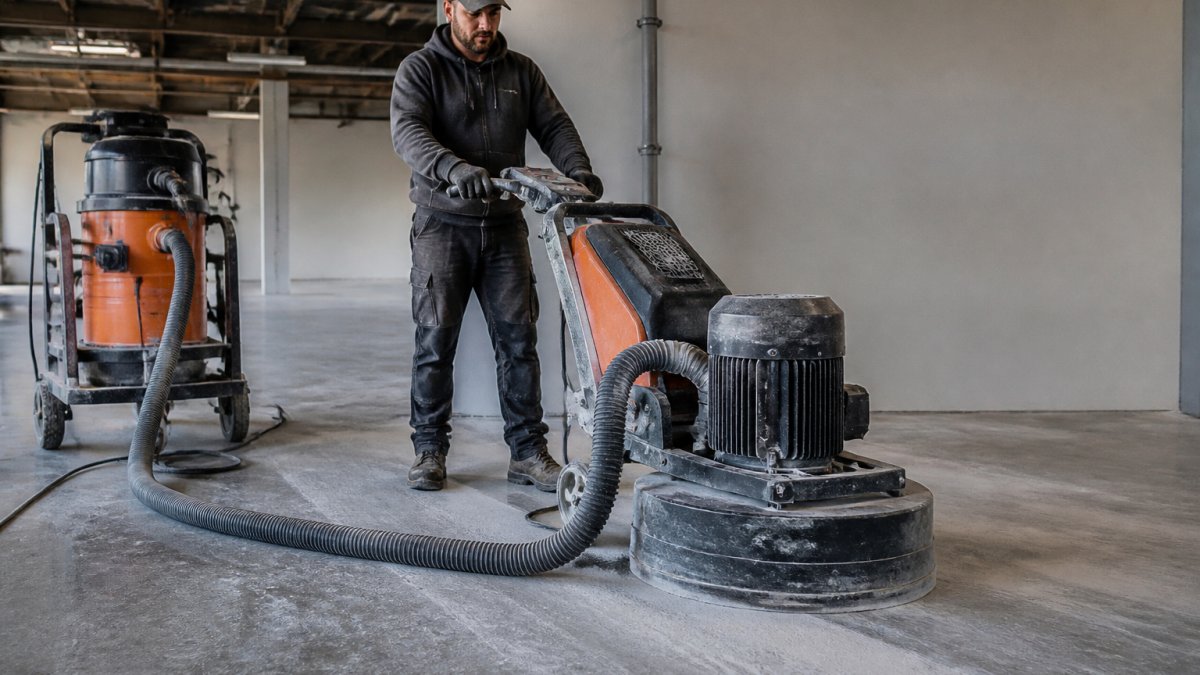
A quality concrete grinder for epoxy work includes a dust shroud connected to a HEPA-filter vacuum, essential for worker safety and to prevent dust from contaminating the epoxy application.
Look for sealed dust collection systems. Onboard vacuums or external units both work, but the connection must be airtight.
Concrete Grinder for Epoxy Removal: Coating and Residue Extraction
When removing old epoxy, paint, or other coatings before applying new epoxy, a concrete grinder for epoxy removal is your primary tool.
Old epoxy is harder than the concrete underneath. The right diamond tooling removes the coating while leaving concrete intact, which makes grit selection and bond hardness critical.
For cured epoxy removal, use aggressive tooling: 16-30 grit diamonds on a hard bond.
With the right equipment, removal takes one to two passes: the first strips most of the coating, the second cleans residue and brings concrete to profile. An undersized grinder means extra passes and higher labor costs.
OSHA concrete dust and silica exposure standards
Best Diamond Grinding Wheel for Concrete: Selection and Specifications
Diamond tooling is where most people make their first mistake: assuming all wheels are the same. Grit, bond hardness, and diamond concentration determine performance on your concrete and coating.
Diamond Grit and Bond Hardness
Grit is diamond particle size. Coarse grits (16-30) remove material fast and suit old coatings or hard concrete; finer grits (60-120) create a smoother surface.
Bond hardness determines how long diamonds stay attached. A hard bond holds diamonds longer for aggressive materials like old epoxy; a soft bond releases them faster for softer concrete or finer finishes.
For epoxy removal, pair coarse grit (16-30) with a hard bond. For standard prep, 30-60 grit with a medium bond is typical.
Matching Tooling to Concrete Condition
Before selecting tooling, assess your concrete: new or old, hard or soft, coated or bare? These factors determine your approach.
New concrete (under a year old) is softer and grinds easily with 30-60 grit.
Existing coatings change the equation. Epoxy is harder than concrete, so it needs harder bond diamonds and coarser grit; paint is softer and takes less aggressive tooling.
Test a small section with your planned tooling before committing to the full floor. It tells you whether to adjust grit, bond, or technique.
Concrete Floor Preparation for Epoxy Coating: Equipment and Process
Concrete floor preparation for epoxy coating involves more than grinding. Learn how to fix uneven concrete for epoxy using grinding, patching, and self-leveling methods to create a smooth substrate.
Grinding is one step: before it, repair cracks, patch low spots, or remove old coatings; after it, clean thoroughly, test for moisture, and allow drying time before epoxy application.
Call (919) 824-5403 or email craigrfear@gmail.com for a free estimate →
Equipment choice affects how quickly you move through these steps. Too small means extended grinding time; too aggressive can damage the substrate.
For residential projects (500-2,000 sq ft), a rotary grinder works well.
Concrete surface preparation standards for epoxy coating provide guidelines for profile depth, cleanliness, and moisture testing.
Top Grinder Options for Epoxy Work: Specifications and Use Cases
When evaluating concrete grinders for epoxy, focus on motor power, grinding width, dust shroud design, and whether the grinder suits your specific work. These determine efficiency and whether results meet epoxy standards.
Rotary Grinders for Residential and Light Commercial Projects
Rotary grinders use a single rotating head with diamond tooling. They're lighter, more maneuverable, and ideal for smaller spaces. Most range from 7.5 to 15 horsepower with 11-23 inch widths.
The Xingyi CG-580 is a 23-inch rotary grinder with 7.5 horsepower on 240-volt single-phase power. It suits residential driveways, patios, and garage floors, covering ground quickly without being hard to control. It holds six tools, so you can switch grits without changing the entire assembly.
Rotary grinders create consistent profiles on residential concrete, are easy to operate, and need less training than planetary models. The main limitation is speed on large commercial spaces.
For residential epoxy projects, a rotary grinder is often the most practical choice: lower rental costs, straightforward operation, reliable results.
Planetary Grinders for Aggressive Removal and Polishing
Planetary grinders use multiple heads rotating around a central axis, creating more aggressive action and faster coverage than rotary models.
Planetary grinders typically run 15-30 horsepower with 24-36 inch widths. Multiple heads mean faster removal and more consistent profiles.
For epoxy removal or large commercial prep, a planetary grinder is more efficient.
Rental vs. Purchase: Budget and Project-Size Considerations
Rental versus purchase depends on project frequency and size. For a one-time residential project, rent. For contractors doing regular epoxy prep, purchase becomes economical.
Rotary grinder rentals typically run $100-200 per day; planetary rentals $200-400 per day.
At four or more epoxy projects annually, purchase becomes cost-effective. A quality rotary grinder costs $3,000-8,000; a planetary grinder $8,000-20,000 or more.
Maintenance matters too: grinders need regular service, diamond tooling replacement, seal inspection, and electrical checks. Renting shifts that to the rental company; owning makes it yours.
Key Specifications to Compare: Motor Power, Width, and Dust Shroud Design
When comparing concrete grinders for epoxy, these specifications determine real-world performance:
| Specification | Why It Matters | What to Look For |
|---|---|---|
| Motor Power (horsepower) | Higher power handles harder concrete and aggressive grinding without bogging down | 7.5-15 HP for rotary; 15-30 HP for planetary |
| Grinding Width | Wider coverage means faster project completion on large floors | 11-23 inches for rotary; 24-36 inches for planetary |
| Dust Shroud Design | Sealed shroud prevents dust escape and improves vacuum efficiency | Sealed design that fully surrounds grinding head; airtight connection to vacuum |
| Voltage/Phase | Determines electrical requirements on your job site | 120V single-phase for portable units; 240V single-phase for mid-size; 480V three-phase for industrial |
| Tool Capacity | Allows switching between diamond grits without stopping to change entire assembly | 4-6 tool positions is standard |
| Weight | Affects maneuverability and operator fatigue | 150-300 lbs for rotary; 400-800 lbs for planetary |
Motor power is often overlooked: an undersized motor bogs down on hard concrete or thick epoxy, slowing work and risking damage. Grinding width affects coverage, a 23-inch rotary covers twice the area per pass as an 11-inch model.
Dust shroud design impacts worker safety and epoxy quality. A poorly sealed shroud lets dust escape, creating a hazard and contaminating the surface with particles that interfere with bonding.
Common Mistakes When Grinding Concrete Before Epoxy
Most grinding failures come from preventable mistakes. Avoiding these saves costly rework and safety issues.
Skipping the surface profile assessment. Many grind until the surface "looks clean" rather than measuring profile.
Grinding too aggressively. Pushing a grinder hard damages the substrate, creating divots and uneven surfaces that are hard to repair.
Skipping moisture testing. Concrete that looks dry may still hold moisture that prevents bonding.
Concrete moisture testing requirements for epoxy application
Concrete-Enhancements brings 20 years of experience in concrete preparation and epoxy application for floors that hold up in real-world conditions. If you're planning an epoxy project and want guidance on preparation, contact us for a free estimate.
Frequently Asked Questions
What size concrete grinder do you need for an epoxy floor?
The right size depends on your project area and surface condition. For residential floors under 2,000 square feet, a 17- to 20-inch rotary grinder works well. Larger commercial spaces benefit from 23-inch or wider planetary grinders for faster coverage. Smaller handheld grinders suit edges and corners but aren't efficient for full-floor preparation. Consult with a professional to match grinder width to your concrete floor preparation needs.
Is it necessary to grind concrete before epoxy?
Yes. Concrete must be ground to create the proper surface profile for epoxy adhesion. Grinding removes contaminants, old coatings, and sealer, exposing clean concrete. This mechanical bond is essential for epoxy longevity. Without grinding, epoxy may peel or fail within months. The concrete floor preparation for epoxy coating always includes grinding as a critical first step.
What is the best tool for grinding concrete?
The best concrete grinder depends on your project type. Rotary grinders work well for general surface preparation and smaller residential projects. Planetary grinders excel at aggressive removal of thick epoxy or coatings and provide faster, more even results on large commercial floors. For epoxy removal specifically, a rotary or planetary grinder with a dust shroud and vacuum compatibility prevents silica dust exposure. Choose based on project size, budget, and whether you're removing existing coatings or prepping bare concrete.
Can you use a handheld grinder to prepare a concrete floor for epoxy?
Handheld grinders are not ideal for full-floor epoxy preparation. They work only for small areas, edges, and corners, and they're tiring to operate over large surfaces. Floor grinders, rotary or planetary models, are designed for this task and deliver consistent surface profiles. Handheld tools may create uneven grinding depth, leading to poor epoxy adhesion. For complete concrete floor preparation for epoxy coating, use a dedicated floor grinder.

Tags: concrete grinders for epoxy, best concrete grinders for epoxy, how to grind concrete for epoxy, concrete grinder for epoxy removal, best diamond grinding wheel for concrete
Frequently Asked Questions
The right size depends on your project area and surface condition. For residential floors under 2,000 square feet, a 17- to 20-inch rotary grinder works well. Larger commercial spaces benefit from 23-inch or wider planetary grinders for faster coverage. Smaller handheld grinders suit edges and corners but aren't efficient for full-floor preparation. Consult with a professional to match grinder width to your concrete floor preparation needs.
Yes. Concrete must be ground to create the proper surface profile for epoxy adhesion. Grinding removes contaminants, old coatings, and sealer, exposing clean concrete. This mechanical bond is essential for epoxy longevity. Without grinding, epoxy may peel or fail within months. The concrete floor preparation for epoxy coating always includes grinding as a critical first step.
The best concrete grinder depends on your project type. Rotary grinders work well for general surface preparation and smaller residential projects. Planetary grinders excel at aggressive removal of thick epoxy or coatings and provide faster, more even results on large commercial floors. For epoxy removal specifically, a rotary or planetary grinder with a dust shroud and vacuum compatibility prevents silica dust exposure. Choose based on project size, budget, and whether you're removing existing coatings or prepping bare concrete.
Handheld grinders are not ideal for full-floor epoxy preparation. They work only for small areas, edges, and corners, and they're tiring to operate over large surfaces. Floor grinders—rotary or planetary models—are designed for this task and deliver consistent surface profiles. Handheld tools may create uneven grinding depth, leading to poor epoxy adhesion. For complete concrete floor preparation for epoxy coating, use a dedicated floor grinder.