ultimate-guide
Is It Worth Resurfacing Your Gravel Driveway?
Last Updated: November 2, 2026
Quick Summary
The cost to resurface gravel driveway projects usually falls between $500 and $2,500, based on a residential rate of $1 to $3 per square foot from Pro Operator Network's 2026 resurfacing cost analysis. Material alone runs $0.50 to $2.00 per square foot, with grading and labor making up 40% to 60% of the total.
- Grading an existing gravel surface typically runs $300 to $1,500 according to MS Dirt's 2026 grading cost data.
- A 600-square-foot two-car drive resurfaced at 3 inches deep needs about 8.6 tons of stone with compaction allowance.
- One cubic yard of typical crushed stone weighs about 1.4 tons, so order 5% to 10% extra for compaction loss.
- A properly resurfaced drive needs a crown of roughly 2% to 4% so water sheds to the edges.
- Annual maintenance for replenishing lost gravel runs $100 to $300 according to Pavemade's maintenance estimates.
Table of Contents
- What Resurfacing a Gravel Driveway Actually Involves
- Cost to Resurface Gravel Driveway per Square Foot
- What Drives Your Gravel Driveway Repair Cost
- Best Gravel Types for Driveway Resurfacing
- Gravel Depth and Tonnage: How Much New Stone You Need
- Drainage and Edge Management That Make Resurfacing Last
- When Resurfacing Is Not Enough
- Request a Free Resurfacing Estimate
- Frequently Asked Questions
What Resurfacing a Gravel Driveway Actually Involves
The cost to resurface gravel driveway projects usually falls between $500 and $2,500, based on a standard residential resurfacing rate of $1 to $3 per square foot reported by Pro Operator Network's 2026 resurfacing cost analysis. At Concrete-Enhancements, we walk homeowners through this distinction constantly, because most people searching for a price are not sure which service they actually need.
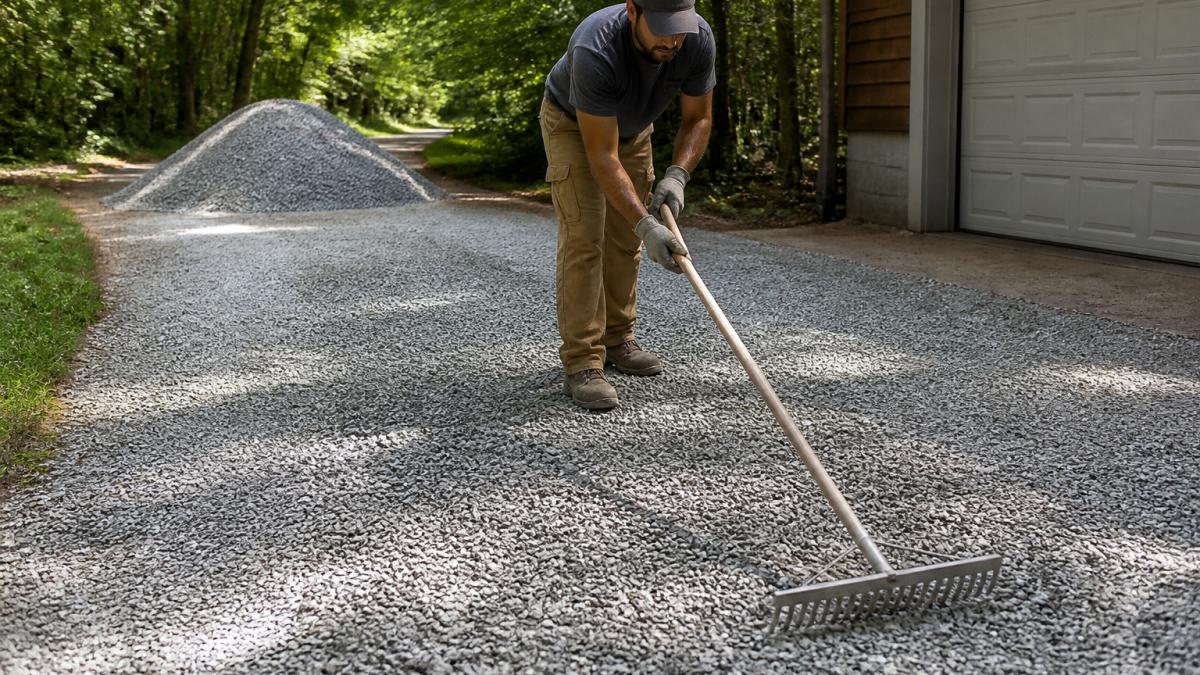
Resurfacing is the process of adding a fresh layer of aggregate over an existing, structurally sound gravel base. You can browse our articles on resurfacing and driveway care for more guides. It restores the driving surface without removing what is underneath.
That definition matters. A driveway that has lost its top inch of stone is a resurfacing candidate. One with a failed subgrade, standing water, or deep ruts is not, no matter how good a new layer looks on day one.
Resurfacing vs. Grading, Repair, and Rebuilding
Four terms get used interchangeably in contractor quotes, and they should not be. Grading reshapes the existing surface and restores crown and slope, typically running $300 to $1,500 for an existing gravel surface according to MS Dirt's 2026 grading cost data. Repair targets specific failures: potholes, washouts, rutted sections. Resurfacing adds new stone across the whole drive. Rebuilding strips the base and starts over.
The practical difference shows up in a quote.
Cost to Resurface Gravel Driveway per Square Foot
Resurfacing a gravel driveway costs $1 to $3 per square foot for most residential projects, per Pro Operator Network's 2026 pricing guide. Material alone runs $0.50 to $2.00 per square foot, according to Pavemade's gravel cost breakdown, which means labor, grading, and delivery typically account for 40% to 60% of the final number.
That per-square-foot range is a starting point, not an estimate. To compare quotes like-for-like, build the number from its parts: area, target depth, material price per ton, delivery, grading, and labor.
The Resurfacing Cost Formula
A transparent resurfacing estimate follows five steps:
- Area: length x width in feet gives square footage.
- Volume: square footage x target depth in feet gives cubic feet; divide by 27 for cubic yards.
- Tonnage: cubic yards x about 1.4 tons per cubic yard for typical crushed stone.
- Material cost: tons x price per ton ($10 to $50 depending on type and source).
- Add-ons: delivery, grading, labor, and drainage work.
Material and delivery are generally predictable, while grading and labor are where quotes for the same driveway can vary.
Worked Example: 600-Square-Foot Two-Car Drive
A standard two-car drive at 600 square feet, resurfaced at 3 inches deep:
- 600 sq ft x 0.25 ft = 150 cubic feet
- 150 / 27 = about 5.6 cubic yards
- 5.6 x 1.4 = about 7.8 tons, plus 10% for compaction = about 8.6 tons
- Material at $30 per ton = about $258
- Delivery for a short haul = roughly $100 to $250
- Grading and labor = the remaining 40% to 60% of the project
Material is a small share of a project like this; grading and labor make up much of the cost.
Worked Example: 1,200-Square-Foot Rural Drive
A long rural drive at 1,200 square feet, 3 inches deep:
- 1,200 x 0.25 = 300 cubic feet
- 300 / 27 = about 11.1 cubic yards
- 11.1 x 1.4 = about 15.5 tons, plus 10% = about 17 tons
- Material at $30 per ton = about $510
- Delivery on a longer haul = $250 to $500 or more
- Grading and labor scale with area
The material line is a relatively small part of the total, which is why a quote that only lists stone is not a complete resurfacing quote.
Common Driveway Sizes at a Glance
| Driveway Size | Square Footage | Resurfacing Range |
|---|---|---|
| Single car, short | 300 sq ft | $300 - $900 |
| Standard two-car | 600 sq ft | $600 - $1,800 |
| Long rural drive | 1,200 sq ft | $1,200 - $3,600 |
| Extended drive with turnaround | 2,000 sq ft | $2,000 - $6,000 |
Nationally, the average gravel driveway project runs $1,800 according to Angi's 2026 gravel driveway cost report, though that figure covers installation and major projects rather than resurfacing alone. A standard 12x50 foot gravel driveway lands between $1,200 and $3,600 for most homeowners, per Hello Gravel's 2026 cost guide.
Project cost tracks with square footage, how much grading is needed, and haul distance. Watch out: a per-square-foot price without a stated target depth is not comparable, because 2 inches and 3 inches of stone are different projects with different material costs.
What Drives Your Gravel Driveway Repair Cost
Repair and resurfacing are different services with different cost structures, and mixing them in a quote is the most common source of sticker shock. Repair targets a specific failure and is priced by the job or hour; resurfacing adds new stone across the whole drive and is priced by area and depth. Confirm which service the contractor is pricing before comparing numbers.
Three variables move a gravel driveway repair cost more than anything else: total area, surface preparation the existing drive needs, and site access. Material volume is easy to estimate; what happens before the stone arrives is where quotes diverge. Because site access and surface preparation can become more demanding on a slope, the work needed to fix a gravel driveway may depend as much on managing the grade as on adding stone.
Labor, Equipment, and Haul Distance
Professional installation runs $2 to $5 per square foot while DIY material-only projects run $1 to $3 per square foot, based on Land Clearing and Excavation's 2026 cost data. That spread is your labor and equipment line item, and it is not padding. A skid steer, a grading attachment, and a competent operator cost real money per hour.
Haul distance is the sleeper cost. Stone price depends on type and source, but delivery fees scale with distance from the quarry. A driveway farther from the nearest supplier pays more than one closer by, for identical stone.
Site access matters too. A narrow gate, steep approach, or soft shoulder that will not hold a loaded dump truck forces smaller loads and more trips, each a separate delivery charge.
Call (919) 824-5403 or email craigrfear@gmail.com for a free estimate →
How Repair, Grading, and Resurfacing Combine in a Quote
A real quote separates four line items, and each has its own price driver:
- Grading: reshapes the existing surface and restores crown and slope, typically $300 to $1,500 for an existing gravel surface according to MS Dirt's 2026 grading cost data. Priced by area and how far out of shape the drive is.
- Repair: potholes, washouts, and rutted sections, priced by the job or by the hour.
- Resurfacing: new stone across the whole drive, priced by area and depth.
- Drainage and edging: crown, ditches, culverts, and edge containment, which are often priced as add-ons and which affect how long a job lasts.
A quote that lumps these into one number hides the drivers. Ask for the breakdown, and compare the grading and drainage lines specifically, because that is where a cheap quote and a durable one diverge.
Best Gravel Types for Driveway Resurfacing
Crushed stone with angular faces and proper gradation is generally a common choice for resurfacing because it locks together under tire traffic and resists displacement. Rounded stone like pea gravel looks good and performs poorly as a driving surface, rolling and migrating under load.
The main options break down like this: For a side-by-side look at concrete vs pavers for driveways in NC, see our comparison guide.
- #57 crushed stone: the standard top layer for residential drives, roughly 3/4 to 1 inch, drains well and compacts into a stable mat
- Crushed asphalt: a growing alternative, with contractors quoting 4-inch-thick applications as a durable resurfacing option, per contractor discussion on Reddit
- Road base: a mixed-grade aggregate for the structural layer, not typically the finish surface
- Pea gravel: decorative only, unsuitable for vehicle traffic
Gravel Depth and Tonnage: How Much New Stone You Need
Resurfacing typically calls for new stone over a sound base, with depth and volume depending on the project. One cubic yard of typical crushed stone weighs about 1.4 tons, so a 600-square-foot two-car drive at a 3-inch depth needs approximately 6 cubic yards.
The calculation is straightforward:
- Measure length and width in feet, multiply for square footage
- Multiply square footage by desired depth in feet (3 inches = 0.25 feet)
- Divide by 27 to convert cubic feet to cubic yards
- Multiply cubic yards by 1.4 for approximate tonnage
Order 5% to 10% extra for compaction loss and spillage. Under-ordering by a ton means a second delivery fee, which can wipe out any savings on material.
Drainage and Edge Management That Make Resurfacing Last
Water destroys more gravel driveways than traffic does. Grading and drainage are the primary cost drivers beyond material volume, according to AccuDirt's 2026 driveway analysis, and they are also the primary predictors of how long a resurfacing job holds up.
A properly resurfaced drive has a crown of roughly 2% to 4% so water sheds to the edges rather than soaking in and softening the base.
The upfront-versus-maintenance tradeoff is real. Investing in proper drainage during resurfacing reduces long-term repair frequency and cost, per Avail Valley's driveway guidance. For concrete repair and sealing in Raleigh NC, our team can help protect the finished surface.
When Resurfacing Is Not Enough
Resurfacing fails when the problem is underneath.
Signs you need more than a surface layer:
- Ponding water that persists 24 hours after rain
- Ruts that return within months of regrading
- Sinkholes or soft spots that move under a tire
- Base failure across more than 30% of the drive
In those cases, rebuilding the base or switching to a hard surface usually costs less over ten years than repeated resurfacing. Our driveway repair vs replacement cost comparison guide breaks down the pricing and decision framework.
Annual maintenance for replenishing lost gravel runs $100 to $300 according to Pavemade's maintenance estimates, which is the honest ongoing cost of gravel ownership regardless of how well the initial job is done.
Request a Free Resurfacing Estimate
Every driveway's number comes down to square footage, stone depth, grading needs, and drainage.
We provide free estimates. Our team offers professional concrete repair.
Get started with Concrete-Enhancements and request your free resurfacing estimate today. Call (919) 824-5403 or email craigrfear@gmail.com.
Gravel resurfacing rewards homeowners who understand what they are buying. The difference between a patch job and a proper resurfacing is often the grading, drainage, and depth done right the first time.
Frequently Asked Questions
How much does it cost to resurface a gravel driveway per square foot?
Resurfacing cost depends on area, stone depth, material, delivery, grading, and labor. Get a written, itemized quote before work starts, because drainage fixes and edge repairs are often billed separately.
Is resurfacing a gravel driveway worth it compared to paving?
Resurfacing an existing gravel base is generally a less involved project than paving. Paving makes sense when the base is failing or you want a hard surface. For many driveways with an intact subgrade, resurfacing is the more economical path.
How often should a gravel driveway be resurfaced?
Plan on replenishing lost stone periodically. A full resurfacing with fresh aggregate may be needed depending on traffic, slope, and how well water drains off the surface. Driveways on a grade or with heavy use wear faster. Inspect each spring for ruts and bare patches, and fix them before the base layer starts to break down.
What are the best gravel types for driveway resurfacing?
Crushed stone with angular edges locks together and stays put, which is why a crushed stone top layer over a road base is the standard choice for resurfacing. Pea gravel looks tidy but rolls under tires and migrates to the edges. Match the new stone to the existing base so the layers bind instead of sliding. A 3/4-inch crushed aggregate is a common top layer,

Tags: resurface gravel driveway, cost to resurface gravel driveway, cost to resurface gravel driveway per square foot, gravel driveway repair cost, best gravel types for driveway resurfacing
Frequently Asked Questions
Resurfacing cost depends on area, stone depth, material, delivery, grading, and labor. Get a written, itemized quote before work starts, because drainage fixes and edge repairs are often billed separately.
Resurfacing an existing gravel base is generally a less involved project than paving. Paving makes sense when the base is failing or you want a hard surface. For many driveways with an intact subgrade, resurfacing is the more economical path.
Plan on replenishing lost stone periodically. A full resurfacing with fresh aggregate may be needed depending on traffic, slope, and how well water drains off the surface. Driveways on a grade or with heavy use wear faster. Inspect each spring for ruts and bare patches, and fix them before the base layer starts to break down.
Crushed stone with angular edges locks together and stays put, which is why a crushed stone top layer over a road base is the standard choice for resurfacing. Pea gravel looks tidy but rolls under tires and migrates to the edges. Match the new stone to the existing base so the layers bind instead of sliding. A 3/4-inch crushed aggregate is a common top layer,