how-to
How Long Does Epoxy Floor Take to Cure? Timelines
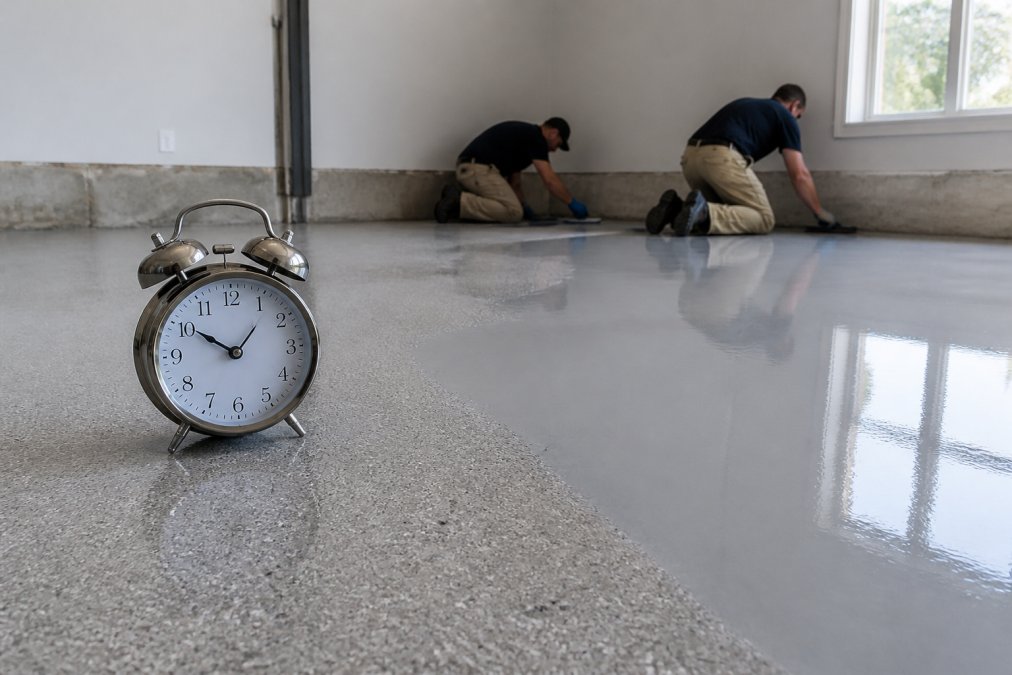
Table of Contents
- Epoxy Floor Cure Time: The Short Answer
- Can You Walk on Epoxy Floor After 24 Hours?
- How Long Before Parking Car on Epoxy Floor?
- Factors Affecting Epoxy Cure Rate
- Troubleshooting Slow-Curing Epoxy Floors
- What Happens If You Walk or Drive on Epoxy Too Soon?
- The Bottom Line on Epoxy Cure Times
- Frequently Asked Questions
Last Updated: September 4, 2026
Epoxy Floor Cure Time: The Short Answer
How long epoxy floor takes to cure depends on what you mean by "cured." Most coatings are dry to the touch within 8 to 12 hours, but the chemical reaction creating a durable, vehicle-ready surface continues for several days (the EPA). At Concrete-Enhancements, we tell clients the full cure window for most residential garage floor systems is 5 to 7 days, with light foot traffic allowed much sooner.
The confusion happens because "dry" and "cured" are different stages. A coating can feel dry yet remain soft enough to dent under pressure. The resin and hardener need time to complete polymerization, the cross-linking process that gives the floor hardness and chemical resistance.
Below, we break down the exact timelines for walking, parking, and heavy use, plus the environmental factors that can speed up or slow down the entire process.
Can You Walk on Epoxy Floor After 24 Hours?
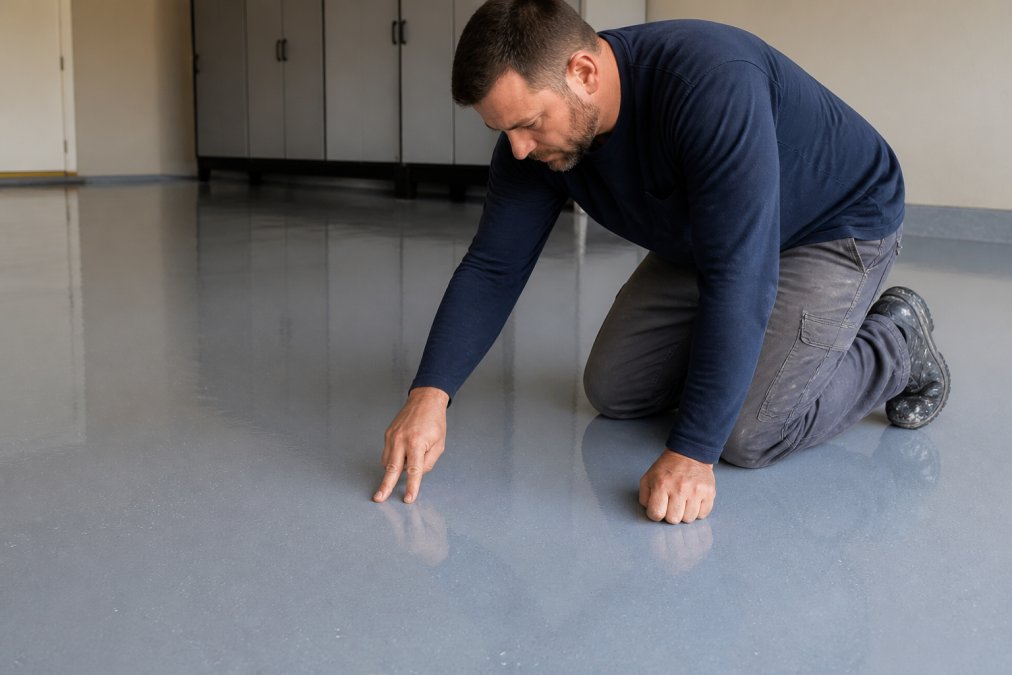
Yes, you can typically walk on an epoxy floor 24 hours after application, provided the coating is tack-free and conditions were normal. This is the standard "dry to touch" threshold for most two-part epoxy systems. Light foot traffic is generally safe, but the surface is still in its early curing phase.
Avoid anything heavy, sharp, or abrasive at the 24-hour mark. Moving furniture, dropping tools, or dragging boxes can leave permanent marks. The epoxy has hardened enough for socks and bare feet but not reached full structural strength.
For commercial spaces with constant foot traffic, extending that wait to 48 hours is a safer bet. This aligns with how long it takes for the initial cure rate to build enough hardness for daily use without risk of indentation.
How Long Before Parking Car on Epoxy Floor?
Vehicle traffic demands the longest wait, typically 5 to 7 days for a standard epoxy system. This is the most critical timeline for garage floors because cars concentrate hundreds of pounds of pressure onto four small contact patches. Parking too soon is the leading cause of permanent tire marks.
The specific chemistry of your coating changes this number. Polyaspartic coatings can often handle vehicle traffic in as little as 24 to 48 hours because they cure through a faster chemical reaction than standard epoxy resin. If using a traditional epoxy system, plan for the full week before parking.
Hot tires are the real danger after the first few days. Even at day four or five, tire heat can soften a not-fully-cured coating and leave depressions where the car rests. The table below summarizes safe timelines by traffic type.
| Traffic Type | Minimum Wait Time | Risk If Too Early |
|---|---|---|
| Foot traffic (socks/bare feet) | 24 hours | Surface scuffs, light marks |
| Foot traffic (shoes) | 48 hours | Indentation, scuffing |
| Furniture and light objects | 72 hours | Permanent dents, scratches |
| Vehicle traffic | 5-7 days | Tire tracks, depressions, peeling |
| Full chemical resistance | 7-14 days | Staining, softening from spills |
Factors Affecting Epoxy Cure Rate
Several variables control how long your floor takes to cure. The cure rate shifts with the environment, substrate, and products used. Most DIY guides stop at temperature and humidity, but the factors causing the most field failures are substrate moisture and product chemistry.
Temperature and Humidity
Ambient temperature is the single biggest factor in epoxy cure time. Most systems cure between 60°F and 80°F. At the low end, the reaction slows considerably, potentially doubling time to full cure. Below 50°F, many epoxies essentially stop reacting (astm.org). Above 90°F, the coating may cure too quickly, becoming brittle or trapping solvent, leading to a soft film.
Relative humidity matters almost as much. High humidity, generally above 75%, can cause amine blush, a waxy film that prevents proper hardening. Low humidity speeds solvent evaporation but can make the coating dry too fast for proper leveling.
Substrate Moisture: The Hidden Variable Most Guides Skip
Concrete is porous and holds moisture long after it looks dry. The standard measure is the moisture vapor emission rate (MVER), expressed in pounds per 1,000 square feet per 24 hours. Most manufacturers require an MVER below 3 pounds (concrete.org). If your slab reads 5 or higher, moisture will interfere with bonding and curing, leaving soft patches or blisters.
A simple plastic sheet test gives a rough read: tape a 24-inch square of clear plastic to the concrete, seal the edges, and wait 24 hours. If condensation forms underneath, the slab needs more time or a moisture barrier before you apply epoxy. For a definitive number, use a calcium chloride test kit, which gives an MVER reading in about 72 hours.
Coating Thickness and Product Chemistry
The mil thickness of your application directly extends cure time. A standard coating at 10 to 12 mils dries faster than a high-build system at 15 to 20 mils because there is more material for the reaction to complete.
Product chemistry is where many DIY guides go wrong because they treat all epoxies as the same. Three distinct chemistries dominate the residential and light-commercial market, each with a different cure profile:
- Water-based epoxy (often sold as a two-part kit at big-box stores) contains 40-60% water as a carrier. The water must evaporate before the resin and hardener can fully cross-link. This extends the dry-to-touch window to 12-24 hours and full cure to 7-10 days. Water-based systems are also more sensitive to high humidity because water evaporation slows dramatically when the air is already saturated.
- Solvent-based epoxy uses volatile organic compounds (VOCs) as the carrier. Solvents evaporate faster than water, so these systems typically reach tack-free in 6-10 hours and full cure in 5-7 days. However, they require strong ventilation during application and the first 24 hours of curing.
- Polyaspartic coatings (often called polyaspartic esters) use a completely different chemical reaction, an aliphatic polyurea hybrid, that does not rely on water or solvent evaporation. They can be ready for foot traffic in 3-4 hours and vehicle traffic in 24-48 hours, even in cooler conditions. This is why polyaspartic systems are increasingly the professional choice for garage floors.
Always follow the manufacturer's data sheet for your specific product. It will list the exact cure window at a given temperature and humidity and specify the maximum MVER for the substrate.
Troubleshooting Slow-Curing Epoxy Floors
If your epoxy floor is still tacky or soft after the expected window, do not panic, but do not just keep waiting either. A coating that fails to cure properly will never gain strength on its own. The cause is almost always one of four things: low temperature, improper mixing, substrate moisture, or the wrong product.
Step 1: Check the Temperature Log
Cold temperatures are the most common culprit. If the floor was applied when ambient temperature dropped below the manufacturer's minimum, often 60°F, the reaction may have nearly stopped. Check the low temperature for each night since application. If it dipped below the minimum for more than a few hours, the cure has likely stalled.
The fix: Raise the room temperature gradually to 70-80°F using space heaters placed around the perimeter, not pointed directly at the floor. Do not use heat lamps or direct radiant heat, which can cause the surface to skin over while the bottom stays soft, creating a crust that traps uncured material underneath. Once the room is warm, give the floor 24-48 hours and re-test. If it is still soft after that, the reaction may have been permanently disrupted, and the coating will need to be removed.
Step 2: Assess Mixing Quality
Improper mixing happens when the resin and hardener are not blended thoroughly, leaving uncured spots that stay tacky indefinitely. If you mixed by hand, this is a real risk, especially if you did not scrape the sides and bottom of the bucket. If the tacky areas are patchy rather than uniform, mixing is the likely cause.
The fix: There is no way to re-mix a floor that is already down. The affected areas must be ground down to bare concrete and recoated. This is why professional applicators use mechanical mixers with a slow-speed drill and a jiffy mixer blade for a full two minutes, then scrape and re-mix for another minute. If you are recoating, do not apply a new topcoat over the soft spots, the soft layer underneath will eventually fail and take the topcoat with it.
Step 3: Test for Substrate Moisture
Substrate moisture is the hidden killer. Concrete that was not fully cured or lacked a moisture vapor barrier can push water up through the coating, preventing adhesion and leaving soft, cloudy patches.
The fix: Perform a plastic sheet test immediately. Tape a 24-inch square of clear plastic to the floor, seal all edges with duct tape, and wait 24 hours. If condensation forms on the underside of the plastic, moisture is migrating through the slab. The only reliable fix is to remove the failed coating, install a moisture vapor barrier coating, and then reapply your topcoat. Skipping this step means the failure will repeat.
Step 4: Verify Product Selection
Sometimes the floor is not failing, it is simply the wrong product for the timeline you expected. If you used a water-based epoxy and expected a 24-hour vehicle-ready floor, the coating may be curing normally but needs 7-10 days. Check the manufacturer's data sheet for the specific cure time at your average temperature.
When to Call a Professional
If you have worked through all four steps and the floor is still soft after 5 days, or if you see blisters, bubbles, or peeling, the coating has failed and needs to be removed. Grinding off a failed epoxy floor is a dusty, labor-intensive job requiring a walk-behind grinder with diamond tooling. Most DIYers find that rental and disposal costs approach the cost of hiring a professional.
What Happens If You Walk or Drive on Epoxy Too Soon?
Walking on epoxy too soon leaves footprints and scuffs that become permanent once the floor finishes curing. At 12 to 18 hours, the coating is soft enough that body weight displaces the material, locking in marks when it hardens.
Driving on epoxy too soon causes more severe damage. Vehicle weight presses tire tread patterns into the soft coating, and tire heat accelerates localized curing, creating depressions and discoloration. In worst cases, tires can tear the coating loose, especially if the steering wheel is turned while stationary.
Surface preparation problems compound these issues. If the concrete was porous or not properly etched, the epoxy has less mechanical grip, making it more vulnerable to early traffic damage.
The Bottom Line on Epoxy Cure Times
The honest answer is that full cure takes 5 to 7 days for most systems, but the usable timeline breaks down by traffic type. Plan for 24 hours before walking, 48 to 72 hours before moving items back in, and a full week before parking cars. Environmental conditions and product chemistry can shift these numbers, so verify the specific recommendations for your coating.
For homeowners and facility managers in the Raleigh-Durham Triangle, NC Triad, and Coastal SC, getting these timelines right is the difference between a floor that lasts 20 years and one that fails in the first year. As a CTi Certified Dealer with over 20 years of experience, Concrete-Enhancements handles every stage of the process, from substrate testing to application, so your floor cures under the right conditions the first time. Our team manages the variables that cause slow cures and premature failures, delivering epoxy floor coatings that stand up to daily traffic.
The key is patience paired with proper preparation. A floor that cures fully before you walk on it or park on it will outperform one that was rushed, no matter how well the coating was applied. Give the chemical reaction the time it needs, and your epoxy floor will reward you with years of low-maintenance durability.
Frequently Asked Questions
Will tacky epoxy eventually cure?
Sometimes, but not always. If the epoxy is tacky because of high humidity or low temperatures, it may eventually cure once conditions improve, though it can take weeks. However, if it was mixed with the wrong hardener ratio, it will never cure properly. A tacky surface that remains soft and easily scratches after several days usually indicates a failed application that needs to be removed and recoated.
What is the difference between drying and curing for epoxy floors?
Drying refers to solvent evaporation, which is why the surface feels dry to the touch. Curing is the chemical reaction between the epoxy resin and hardener, called polymerization, where the coating cross-links and reaches full hardness. A floor can be dry to the touch in a few hours but still be curing for days. This distinction matters because foot and vehicle traffic must wait for full cure, not just a dry surface.
Does temperature and humidity affect epoxy cure time?
Yes, they are the most significant factors affecting epoxy cure rate. Ideal conditions are between 60°F and 80°F with relative humidity below 60%. Cooler temperatures slow the chemical reaction dramatically, extending cure times. High humidity can cause a condition called amine blush, leaving a waxy, tacky film on the surface. Always check the manufacturer's specifications for your specific product's temperature limits.
Getting the cure time right protects your investment, and professional application removes the guesswork. Contact Concrete-Enhancements at (919) 824-5403 or email craigrfear@gmail.com for a free estimate and let our certified team handle your epoxy flooring project from start to finish.
This article was written using GrandRanker
Frequently Asked Questions
Sometimes, but not always. If the epoxy is tacky because of high humidity or low temperatures, it may eventually cure once conditions improve, though it can take weeks. However, if it was mixed with the wrong hardener ratio, it will never cure properly. A tacky surface that remains soft and easily scratches after several days usually indicates a failed application that needs to be removed and recoated.
Drying refers to solvent evaporation, which is why the surface feels dry to the touch. Curing is the chemical reaction between the epoxy resin and hardener, called polymerization, where the coating cross-links and reaches full hardness. A floor can be dry to the touch in a few hours but still be curing for days. This distinction matters because foot and vehicle traffic must wait for full cure, not just a dry surface.
Yes, they are the most significant factors affecting epoxy cure rate. Ideal conditions are between 60°F and 80°F with relative humidity below 60%. Cooler temperatures slow the chemical reaction dramatically, extending cure times. High humidity can cause a condition called amine blush, leaving a waxy, tacky film on the surface. Always check the manufacturer's specifications for your specific product's temperature limits.