ultimate-guide
How Much Does Decorative Concrete Stamping Cost in Durham?
Quick Summary
Stamped concrete cost varies widely by quantity, site conditions, and scope, so a single national average is only background. In Durham, the most reliable way to learn your price is an itemized estimate covering square footage, base prep, color method, and sealer.
- Basic-tier stamped concrete runs about $10 to $14 per square foot, depending on the contractor and site.
- Standard-tier work with two colors or a border typically falls between $13 and $18 per square foot.
- Premium custom-pattern stamped concrete starts around $20 per square foot and up.
- Clay-heavy soils and seasonal water tables can require over-excavation and gravel base, billed as a separate line item.
- Put every bid on the same specification, including demolition, base work, drainage, and sealer, before comparing prices.
Table of Contents
- What Decorative Concrete Stamping Costs Nationally and Locally
- Stamped Concrete Cost per Square Foot by Design Tier
- Stamped Concrete Patterns and Design Options
- Factors That Change the Total Cost of Your Project
- Stamped Concrete vs Pavers: A Cost Comparison
- How to Read and Compare Durham Contractor Quotes
- Requesting an Itemized Estimate for Your Durham Project
- Frequently Asked Questions
What Decorative Concrete Stamping Costs Nationally and Locally
Last Updated: November 6, 2026
Stamped concrete pricing varies widely across the United States and by contractor, so a national average is best treated as background rather than a quote. Pricing for your project depends on quantity, site conditions, and scope, and the most reliable way to learn your cost is to request a current price or quote from Concrete-Enhancements through our website.
A small front walk with a basic single-color finish and a large back patio with a custom pattern can both be called "stamped concrete," yet their prices can sit far apart, so pricing depends on the specific scope of each project.
The gap between national and local figures is the reason to ask for an itemized estimate instead of relying on a ballpark. Angi's stamped concrete patio cost guide gives the national benchmark, while local listings reflect what Durham-area crews actually charge for specific scopes of work.
Stamped Concrete Cost per Square Foot by Design Tier
A useful way to read any per-square-foot figure is to separate the concrete and base work from the decorative work layered on top. Most practitioners find that the structural portion of a stamped slab, excavation, base, forming, reinforcement, concrete, and finishing, is fairly consistent from job to job, while the decorative portion, stamps, color, release, and sealer, is where bids diverge.
The tiers break down roughly like this, though exact pricing always depends on the contractor and site:
| Design Tier | Typical Scope | Price Range per Sq Ft |
|---|---|---|
| Basic | Single pattern, single integral color, standard sealer | $10 to $14 |
| Standard | Two colors or a border, common pattern, upgraded sealer | $13 to $18 |
| Premium | Custom pattern, layered color hardener and release, hand-detailing, premium sealer | $20 and up |
What the Per-Square-Foot Number Actually Includes
A per-square-foot price is only comparable when both bids cover the same scope. Ask each contractor to confirm whether the number includes demolition of an existing surface, excavation to the required depth, compacted base, formwork, reinforcement (wire mesh or fiber), the concrete mix, integral color or color hardener, release agent, stamping labor, control joints, sealer, and cleanup. A quote that omits base preparation or sealer can look cheaper per square foot while leaving work for you to pay for later.
A common pattern is for the lowest bid to assume a thin base, no reinforcement, and a single coat of economy sealer, while a mid-range bid includes a compacted base, mesh, and a solvent- or water-based acrylic sealer applied in two coats. Put both bids on the same specification before you compare the numbers.
Single-Color Versus Multi-Color and Integral Color Options
A single-color stamped finish is the most economical choice. Multi-color work, often done with a color hardener broadcast onto the surface and a contrasting release agent worked into the stamps, costs more because each color requires separate application, blending, and cleanup. Integral color, where pigment is mixed into the concrete itself, tends to be more uniform and durable than surface-applied color, though it can affect the final price depending on the mix and the crew's minimum order for pigment.
Watch out: a very low per-square-foot quote that claims multi-color work is often using a single integral color plus a stamped texture, not the layered hardener-and-release finish the tier table describes. Ask which color method the price assumes before you sign.
How the Tier Maps to a Real Quote
When a contractor quotes a basic tier, the price should reflect one stamp pattern, one color method, and a standard sealer. A standard-tier quote should show the second color or border as a line item, not bury it in a lump sum. A premium quote should itemize custom templates, hand-detailing, and the upgraded sealer, because those are the line items that move the total. If a bid cannot tell you which tier it assumes, treat the number as a placeholder rather than a price.
Stamped Concrete Patterns and Design Options
Pattern choice is one of the biggest drivers of design cost. Common options include ashlar slate, cobblestone, brick, and flagstone textures. Simple repeating patterns are generally cheaper to install than intricate, irregular layouts that require more cuts and more careful alignment.
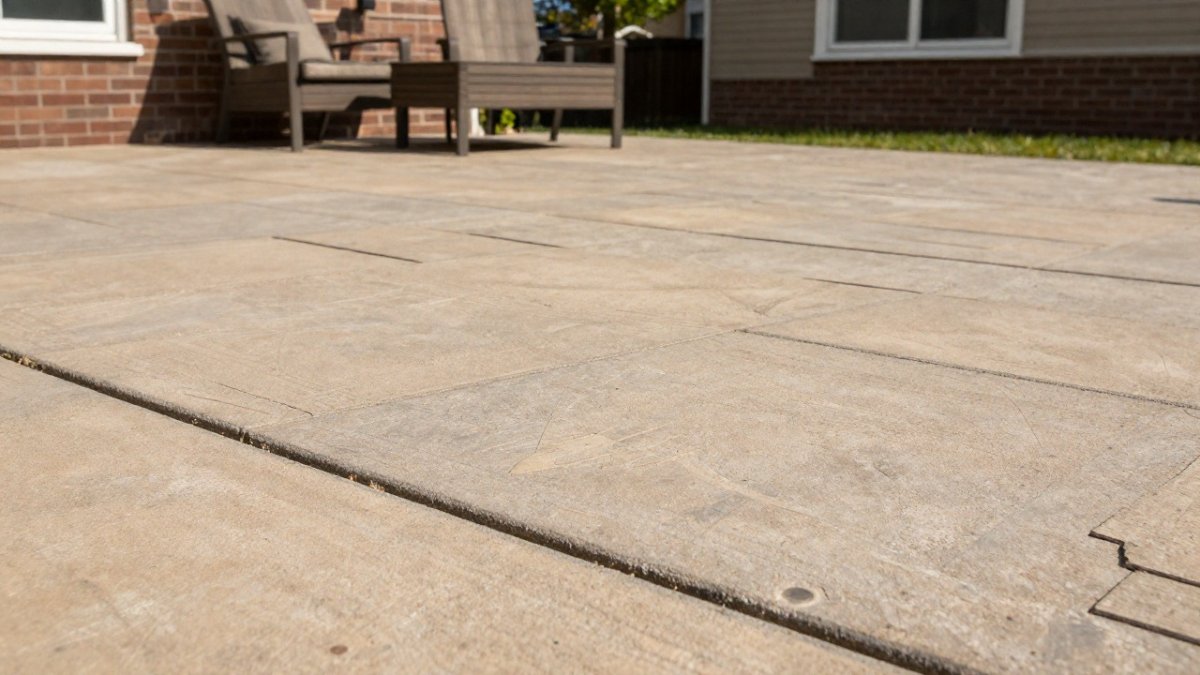
A freshly stamped patio with a slate-style pattern and warm earth-toned color can resemble natural stone. Keep in mind that the more complex the pattern, the more hours your crew needs to lay it out and stamp it cleanly.
Factors That Change the Total Cost of Your Project
Project size is the most obvious factor. Per-square-foot pricing often drops somewhat as the area grows, because mobilization, setup, and equipment costs get spread across more concrete. Very small jobs can cost more per square foot than their size suggests, since the crew still has to mobilize, form, and finish a small pour with the same setup.
Site conditions matter just as much, and they are where local quotes diverge most. Demolition of an existing surface, grading, base preparation, drainage correction, and access for trucks and equipment all add to the bill. A yard with poor drainage or a tight side access route may require extra prep that a flat, open site would not. In this region, clay-heavy soils and seasonal water tables are a common reason a base has to be over-excavated and replaced with compacted gravel before a slab can be poured, and that work shows up as a separate line item rather than in the per-square-foot rate.
How Site, Drainage, and Weather Show Up in a Quote
A transparent quote usually separates the work into stages: demolition and haul-off, excavation and grading, base preparation and compaction, formwork and reinforcement, concrete placement and finishing, color and stamping, control joints, sealing, and cleanup. Each stage has its own labor and material cost, and each can be expanded or reduced by site conditions.
Drainage is the factor homeowners most often overlook. A patio or walkway that slopes toward the house, or a driveway that ponds at the garage door, may need regarding, a channel drain, or a dry well before the decorative work begins. Those corrections are cheaper to build into the original pour than to retrofit after the slab is stamped and sealed.
Weather affects scheduling and sometimes cost. Concrete placed in high heat or direct sun can set too fast to stamp cleanly, so crews may schedule early-morning pours or add retarder to the mix. Cold weather can require blankets, accelerators, or a delay (Cold Weather Concrete Curing with Blankets, Additives & Heaters). A contractor who plans for the season will often build a small allowance into the schedule rather than the price, but a rushed pour in poor conditions is a common cause of later cracking and uneven color.
Permitting, Access, and Finish Choices
Permits and inspections vary by jurisdiction and by project type. A replacement driveway or a slab that changes lot coverage may require a permit and an inspection, while a small patio may not. Ask each contractor who is responsible for pulling the permit and whether the fee is included in the quote.
Access matters too. A backyard with no gate wide enough for a wheelbarrow or a skid steer means material has to be moved by hand, and that labor is real. Finish and sealer choices affect the final number as well: a premium sealer or a specialty finish adds material and labor, and a decorative border or saw-cut layout changes the forming and stamping time. Decorative overlays are also an option for resurfacing an existing slab, and our Decorative Overlays Raleigh NC | Concrete-Enhancements service covers the scope in the Raleigh and Durham area.
Watch out: a quote that lists a single lump sum with no site, drainage, or permit line items is the one most likely to grow through change orders once work begins. Ask for the assumptions in writing before you compare bids.
Stamped Concrete vs Pavers: A Cost Comparison
Many homeowners compare stamped concrete with pavers before deciding. Stamped concrete is typically poured as a continuous slab, while pavers are installed as individual units with a base, edge restraint, and sand bedding. Pavers, however, can be repaired more easily because a damaged unit can be lifted and replaced without redoing the whole surface.
Compare the full installed cost, not just the material price, and ask each contractor to include base preparation, sealing, and any drainage work. If you're weighing a cheaper option, you can check whether resurfacing an existing gravel driveway would give you the better value before committing to a new surface. The right answer depends on how much you value a seamless look against the ease of spot repairs over time.
For a deeper look at decorative surfaces, see our guide to Decorative Concrete Overlays for Patios: The Complete 2026 Guide, and for driveways, 5 Best Decorative Concrete Overlays for Driveways compares several finishes side by side.
How to Read and Compare Durham Contractor Quotes
A useful quote lists the square footage, the design tier, the color method, the base preparation, the sealer, and the warranty terms. A single lump-sum number with no breakdown makes it hard to know what you are actually paying for, or what might be left out later.
When comparing bids, check whether each one includes demolition, base work, drainage fixes, permits if required, and cleanup. Two quotes can look far apart simply because one assumes a basic finish and the other a premium one. Put every bid on the same specification before deciding.
Requesting an Itemized Estimate for Your Durham Project
The most reliable way to learn your real cost is a site-specific, itemized estimate. Measure the area, note the pattern and color you want, and describe the existing surface and drainage. Concrete-Enhancements is a CTi Certified Dealer with more than 20 years of experience, and can walk you through what a quote for your project would include.
Ask for the estimate to be broken down by square footage, prep, material, labor, and sealer so you can compare it fairly against other bids.
Frequently Asked Questions
How much does a 20x20 stamped concrete patio cost?
A 20x20 patio is 400 square feet. Stamped concrete pricing varies by project, so the most reliable way to learn your cost is to request a current price or quote. Multiply your square footage by the per-square-foot rate you receive, then add site preparation and any extras. Local quotes vary, so request an itemized estimate from each contractor.
Is stamped concrete more cost-effective than pavers?
The answer depends on pattern, thickness, site conditions and drainage needs. Compare quotes that cover the same square footage, base preparation and finish. Consider long-term maintenance, since sealing and occasional repair affect total ownership cost.
What is the downside of stamped concrete?
Stamped concrete can crack over time, especially if the base is poorly prepared or drainage is inadequate. Its appearance can fade without periodic resealing, and repairs can be harder to blend invisibly than replacing individual pavers. Pricing also varies widely, so a low bid may signal thinner material or less base preparation. Ask contractors how they handle subgrade, reinforcement and sealing before you commit.
What are the primary factors influencing stamped concrete pricing?
The biggest drivers are square footage, pattern complexity, color method, site preparation, access, and any demolition of existing surfaces. Design tier matters because intricate stamps take more labor. Thickness and reinforcement also affect cost. Pricing for a given project depends on its specific scope, so a single price rarely applies to every project.

Tags: stamped concrete cost, cost of decorative concrete stamping in durham, stamped concrete cost per square foot, stamped concrete vs pavers cost comparison
Frequently Asked Questions
A 20x20 patio is 400 square feet. Stamped concrete pricing varies by project, so the most reliable way to learn your cost is to request a current price or quote. Multiply your square footage by the per-square-foot rate you receive, then add site preparation and any extras. Local quotes vary, so request an itemized estimate from each contractor.
The answer depends on pattern, thickness, site conditions and drainage needs. Compare quotes that cover the same square footage, base preparation and finish. Consider long-term maintenance, since sealing and occasional repair affect total ownership cost.
Stamped concrete can crack over time, especially if the base is poorly prepared or drainage is inadequate. Its appearance can fade without periodic resealing, and repairs can be harder to blend invisibly than replacing individual pavers. Pricing also varies widely, so a low bid may signal thinner material or less base preparation. Ask contractors how they handle subgrade, reinforcement and sealing before you commit.
The biggest drivers are square footage, pattern complexity, color method, site preparation, access, and any demolition of existing surfaces. Design tier matters because intricate stamps take more labor. Thickness and reinforcement also affect cost. Pricing for a given project depends on its specific scope, so a single price rarely applies to every project.