ultimate-guide
Why Anti-Static Epoxy Flooring Protects Warehouse Operations
Last Updated: November 3, 2026
Quick Summary
Anti-static epoxy is a seamless resin floor coating with conductive additives that let static charge bleed safely to ground instead of building on the surface. It protects sensitive electronics, reduces shock and ignition risk for workers, and resists abrasion, chemicals, and oils under forklift traffic. The floor only performs if the conductive additive, grounding path, and concrete substrate are all correct.
- Standard epoxy insulates while anti-static epoxy conducts charge slowly and in a controlled way.
- Map racking, aisles, and packaging lines to decide which zones get full ESD treatment.
- Test the slab for moisture before ordering material, since a slab above the manufacturer's limit will blister the coating.
- Install copper grounding strips and test points before the conductive layer, not on top of a finished floor.
- Re-test resistance on a schedule because readings drift as coatings age, wear, and pick up contamination.
Table of Contents
- How Anti-Static Epoxy Flooring Stops Static Charge in Warehouses
- The Core Benefits of Anti-Static Epoxy for Warehouse Operations
- Anti Static Epoxy Flooring Price per Square Foot: What Drives the Cost
- ESD Flooring Installation Best Practices for Operating Warehouses
- How to Test ESD Floor Conductivity and Verify Performance
- Matching Anti-Static Epoxy to Warehouse Zones, Equipment, and Footwear
- Limitations and Maintenance of ESD Epoxy Floors in High-Traffic Areas
- Planning Your Anti-Static Epoxy Floor with Concrete-Enhancements
- Frequently Asked Questions
How Anti-Static Epoxy Flooring Stops Static Charge in Warehouses
Static electricity is a silent hazard in warehouses, and anti-static epoxy flooring is the control measure most facility managers overlook until something fails. This guide covers how the coating works and how to specify it correctly.
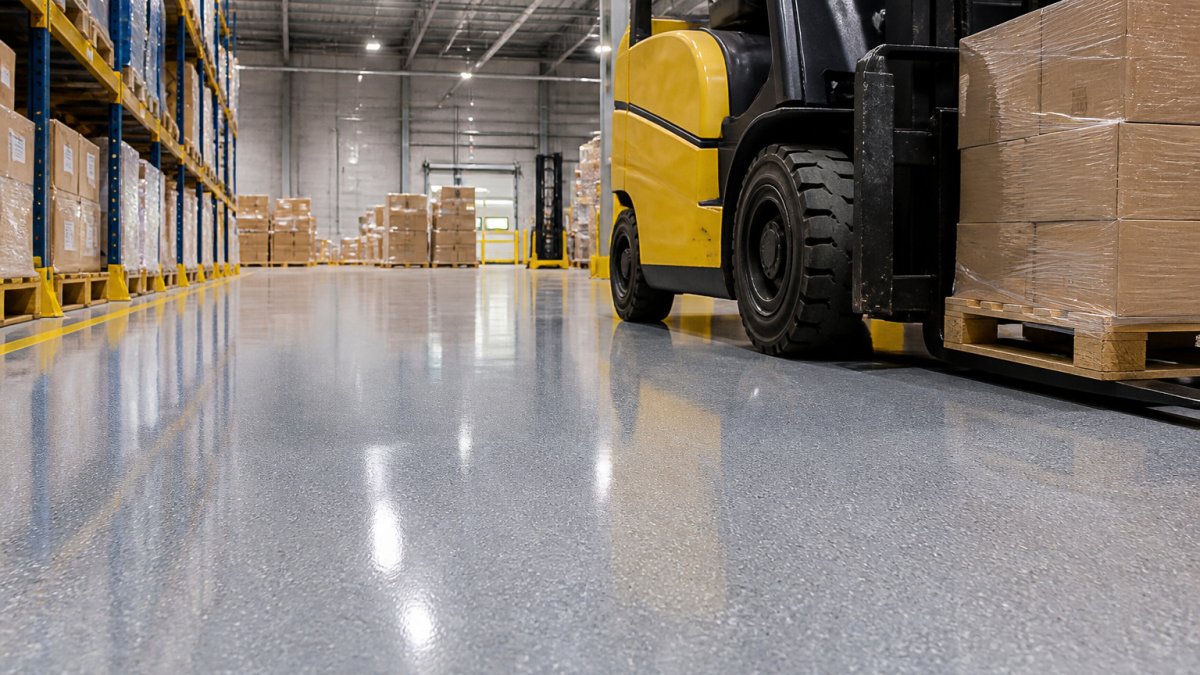
Anti-static epoxy flooring is a seamless resin floor coating formulated with conductive additives that let static charge bleed safely to ground instead of building on the surface. Standard epoxy insulates. Anti-static epoxy conducts, slowly and in a controlled way.
Here's the mechanism most guides gloss over. Static charge builds when two materials contact and separate: a shrink-wrapped pallet dragged across concrete, a forklift tire rolling over a dry floor, a worker's boots scuffing across a few hundred square feet.
The difference between a floor that works and one that just says "anti-static" on the spec sheet comes down to three things: the conductive additive, the grounding path, and the concrete substrate underneath. Get any of those wrong and you have an expensive gray floor that behaves like ordinary epoxy.
The Core Benefits of Anti-Static Epoxy for Warehouse Operations
The benefits stack in a specific order, and it helps to understand which ones are primary and which are downstream.
- Static charge control across high-traffic aisles, packaging lines, and electronics handling zones
- Protection of sensitive equipment, including electronic components, scanners, and control systems
- Worker safety from shocks and from ignition risk in areas handling flammable materials
- Abrasion and impact resistance that holds up under forklift traffic
- Chemical, oil, and water resistance with a seamless surface that wipes clean
- Reduced dusting compared with bare concrete, which keeps product quality consistent
Protecting Sensitive Equipment and Electronic Components
Electrostatic discharge damages electronic components in ways that don't always show up immediately. A discharge too small for a worker to feel can degrade a circuit board, and the failure surfaces weeks later in a customer's hands.
For warehouses that store, assemble, or ship electronics, an ESD floor is the layer of protection that covers the whole working area rather than one bench. It also protects the equipment doing the work: conveyors, automated storage systems, and scanning hardware all sit on the floor and all benefit when charge has a path to ground.
Worker Safety, Abrasion Resistance, and Chemical Resistance
Shocks from static are annoying in an office and genuinely dangerous in a warehouse handling solvents or dust. Beyond the shock itself, the coating has to survive the environment. Forklift tires, pallet drag, and dropped loads punish a floor daily.
A well-built epoxy system handles that wear while resisting oils, hydraulic fluid, and wash-down water. For facilities that also handle aggressive chemicals, the resin chemistry should be matched to the exposure. The seamless surface matters too: no seams means no place for oil, dust, or bacteria to collect, which simplifies cleaning and decontamination.
Anti Static Epoxy Flooring Price per Square Foot: What Drives the Cost
Pricing for anti-static epoxy flooring depends on several variables, including substrate condition, coating thickness, conductive additive type, and the grounding and testing work required. For a detailed commercial epoxy flooring cost per square foot breakdown, see the full pricing guide.
The substrate is the biggest swing factor. A sound, clean slab needs surface prep. A slab with spalling, oil contamination, or moisture problems needs repair and possibly a moisture barrier before any coating goes down.
Grounding and verification are part of the scope of a floor that has to perform, including copper grounding strips, test points, and post-install resistance testing. Each warehouse is quoted individually, so contact Concrete-Enhancements for a quote based on your facility.
ESD Flooring Installation Best Practices for Operating Warehouses
ESD flooring installation best practices start with one rule: protect the substrate, then protect the schedule.
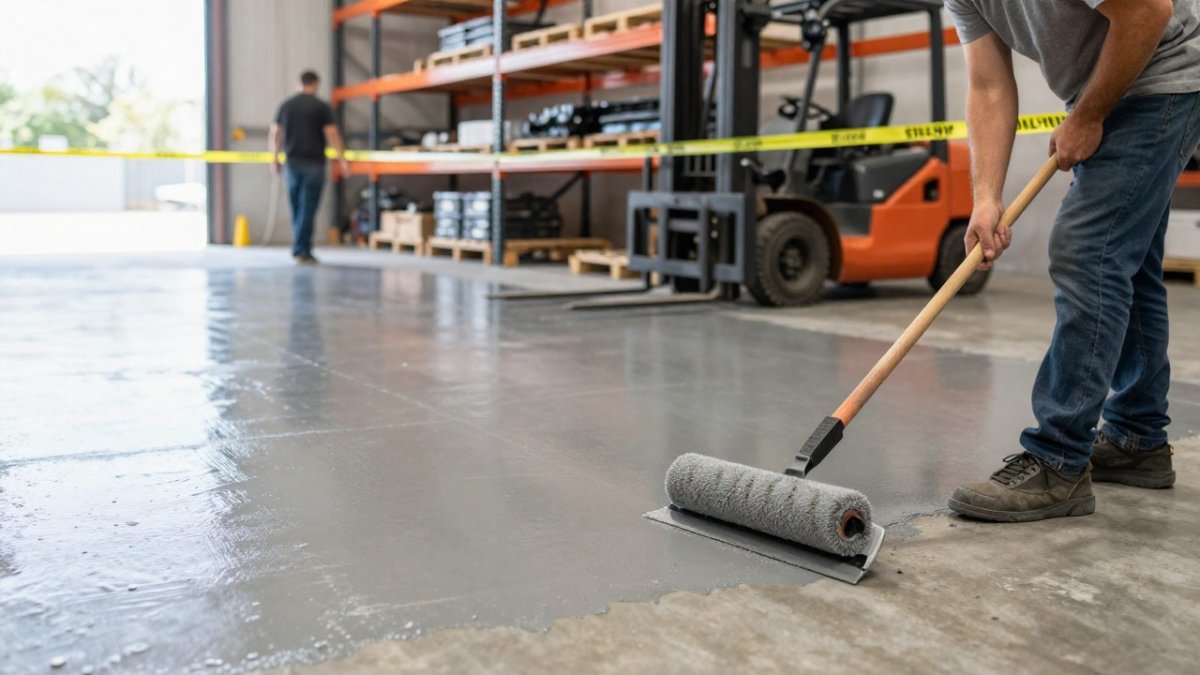
The sequence that works in an occupied building looks like this:
- Survey and zone the floor first. Map racking, aisles, dock doors, battery charging areas, and packaging lines, then decide which zones get full ESD treatment and which get standard coating. This is where the money is saved.
- Test the slab before ordering material. Moisture testing (ASTM F2170 in-situ relative humidity or ASTM F1869 calcium chloride) and a profile check determine whether a moisture barrier or repair is needed. A slab reading above the coating manufacturer's limit will blister a coating regardless of how good the conductive additive is.
- Grind or shot-blast to the specified concrete surface profile. Mechanical key is what holds the coating down under forklift traffic; acid etching is not adequate for a warehouse floor.
- Install grounding strips and test points before the conductive layer. Copper tape or grounding points go down on the prepared slab so the conductive coating can bond to them, not on top of a finished floor.
- Phase the work by zone and by shift. Coat one bay or aisle group at a time, keep adjacent aisles picking, and schedule the noisiest prep work for off-shift hours. Most warehouses can keep shipping with two or three zones out of service rather than the whole floor.
- Apply each zone in one continuous push. Cold joints between batches are where resistance readings go inconsistent, so plan batch sizes and crew size around the zone, not the other way around.
- Respect cure and return-to-service windows. Foot traffic, pallet jacks, and forklifts each have different minimum cure times, and the coating manufacturer's data sheet governs. Racking loads placed too early can imprint or crack a floor that has not fully cured.
- Test and document before racks go back. Resistance testing, test point marking, and a written record should be complete before the zone returns to service.
The concrete surface profile is where DIY jobs fail. Coatings that fail early are often traced to inadequate surface preparation or a missed moisture check.
Call (919) 824-5403 or email craigrfear@gmail.com for a free estimate →
Watch out: treating installation as a single continuous pour across the whole warehouse. That approach forces a full shutdown, and it also creates the cold joints and inconsistent resistance readings that show up months later during testing.
How to Test ESD Floor Conductivity and Verify Performance
Testing ESD floor conductivity means measuring resistance between the floor surface and ground at multiple points, then comparing results against the specification for that zone. It is a documented process, not a visual check.
Verification typically covers three measurements:
- Surface-to-ground resistance at marked test points, using a resistance meter with the specified test voltage and an electrode placed per the test method
- Point-to-point (surface-to-surface) resistance across the floor to confirm the coating is uniformly conductive rather than conductive in patches
- Continuity of the grounding path from the floor's conductive layer through copper strips or grounding points to the building ground
Test points should be marked on a floor plan, numbered, and re-tested on a maintenance schedule, because resistance drifts as coatings age, wear, and pick up contamination.
Watch out: testing only in the middle of a bay and calling it done.
Ask any installer for a written test record that includes the floor plan with test point locations, the instrument used, the test voltage, the measured values, and the date.
Matching Anti-Static Epoxy to Warehouse Zones, Equipment, and Footwear
Not every square foot of a warehouse needs the same floor. A zone-by-zone approach saves money and performs better than coating everything to the same spec.
| Zone | Static Risk | Recommended Approach |
|---|---|---|
| Electronics storage and assembly | High | Full ESD system with documented test points |
| Packaging and shrink-wrap lines | Moderate to high | Conductive coating plus grounded equipment |
| General pallet storage aisles | Low to moderate | Anti-static coating on high-traffic lanes |
| Loading docks and exterior transitions | Low | Standard epoxy with slip resistance |
Equipment and footwear matter as much as the floor. Forklift tires, pallet materials, and conveyor components all generate charge; the floor only controls what reaches it. Workers in ESD-sensitive zones should wear dissipative footwear, and grounded equipment should be bonded to the same grounding path as the floor. If you're still weighing floor types, our comparison of epoxy vs polished concrete for warehouses covers where each one fits.
Limitations and Maintenance of ESD Epoxy Floors in High-Traffic Areas
Anti-static epoxy is not a permanent fix, and anyone who tells you otherwise is selling. Conductive additives degrade with wear, resistance readings drift, and high-traffic lanes need attention first.
Watch out: skipping the re-test schedule is the mistake that quietly undoes the whole investment. A floor that was in spec at handover can drift out of range after years of forklift traffic, and nobody notices until a component failure triggers an investigation.
Maintenance is straightforward: sweep or dust-mop regularly, clean spills promptly, and avoid harsh strippers that attack the resin. Schedule resistance re-testing at intervals set by your ESD program, and plan for recoating high-wear lanes before the rest of the floor.
Planning Your Anti-Static Epoxy Floor with Concrete-Enhancements
A static-control floor is an electrical system as much as a coating, and it rewards planning over speed. Get the substrate right, ground it properly, test it, and document it.
At Concrete-Enhancements, we have more than 20 years of experience in decorative concrete overlays, epoxy floor coatings, and professional repair services, and we are a CTi Certified Dealer. Call (919) 824-5403 or email craigrfear@gmail.com for a free estimate and a walkthrough of your warehouse.
Frequently Asked Questions
Is anti-static flooring required for all warehouse environments?
No. Anti-static epoxy is required where static discharge can damage electronics, ignite flammable vapors, or disrupt equipment, such as electronics manufacturing, printing, packaging, and areas handling sensitive components. A standard storage warehouse without those risks may not need it. A zone-by-zone risk assessment by activity is the practical way to decide, since a single facility often needs ESD protection in one area and standard epoxy elsewhere.
What is the difference between standard epoxy and ESD epoxy?
Standard epoxy seals and protects concrete but does not control static charge. ESD epoxy adds conductive material so static charge dissipates in a controlled way instead of building up and discharging into equipment or people. The difference is measurable through floor resistance testing, not appearance. Anti-static epoxy flooring also needs compatible conductive primers, grounding connections, and footwear to function as a complete static control system.
How long does anti-static epoxy flooring last in high-traffic areas?
Service life depends on coating thickness, substrate condition, traffic type, and maintenance. A properly installed multi-coat ESD system with good abrasion and chemical resistance can hold up for years in forklift traffic, but wear points and damaged areas need repair to keep conductivity readings in range. Periodic testing catches drift early, and recoating worn zones is far cheaper than replacing the whole floor.
What maintenance is required to keep anti-static floors effective?
Keep the surface clean and free of insulating buildup. Dust, oil, and film can raise resistance readings, so routine sweeping and damp mopping with compatible cleaners matter. Avoid waxes and sealers that insulate the floor. Test conductivity on a set schedule and after any repair or heavy wear. Store records of readings so you can show compliance and spot trends before a floor falls out of specification.
Static problems rarely announce themselves. They show up as a failed component, a shock, or a batch of product that doesn't pass inspection. Concrete-Enhancements brings 20+ years of experience and CTi Certified Dealer credentials to every commercial floor, with decorative overlays, epoxy coatings, and professional concrete repair under one crew. Get started with Concrete-Enhancements and specify a floor that controls charge instead of storing it.

Tags: anti-static epoxy, benefits of anti-static epoxy for warehouses, anti static epoxy flooring price per square foot, esd flooring installation best practices, how to test esd floor conductivity
Frequently Asked Questions
No. Anti-static epoxy is required where static discharge can damage electronics, ignite flammable vapors, or disrupt equipment, such as electronics manufacturing, printing, packaging, and areas handling sensitive components. A standard storage warehouse without those risks may not need it. A zone-by-zone risk assessment by activity is the practical way to decide, since a single facility often needs ESD protection in one area and standard epoxy elsewhere.
Standard epoxy seals and protects concrete but does not control static charge. ESD epoxy adds conductive material so static charge dissipates in a controlled way instead of building up and discharging into equipment or people. The difference is measurable through floor resistance testing, not appearance. Anti-static epoxy flooring also needs compatible conductive primers, grounding connections, and footwear to function as a complete static control system.
Service life depends on coating thickness, substrate condition, traffic type, and maintenance. A properly installed multi-coat ESD system with good abrasion and chemical resistance can hold up for years in forklift traffic, but wear points and damaged areas need repair to keep conductivity readings in range. Periodic testing catches drift early, and recoating worn zones is far cheaper than replacing the whole floor.
Keep the surface clean and free of insulating buildup. Dust, oil, and film can raise resistance readings, so routine sweeping and damp mopping with compatible cleaners matter. Avoid waxes and sealers that insulate the floor. Test conductivity on a set schedule and after any repair or heavy wear. Store records of readings so you can show compliance and spot trends before a floor falls out of specification.