comparison
Decorative Concrete vs Epoxy Finishes: 2026 Comparison
Table of Contents
- Decorative Concrete vs Epoxy Finishes: Side-by-Side Comparison
- Decorative Concrete Overlay Pros and Cons
- How Long Does Epoxy Flooring Last in Real Conditions?
- Epoxy Floor Coating Cost Per Square Foot: What Drives the Number
- Durability, Repairability, and Climate: Where Each Finish Wins
- Indoor vs Outdoor Use: Matching the Finish to the Space
- Choosing a Decorative Concrete or Epoxy Contractor
- Frequently Asked Questions
Last Updated: September 30, 2026
Decorative Concrete vs Epoxy Finishes: Side-by-Side Comparison
Decorative concrete vs epoxy finishes is the decision that determines whether your floor still looks right in ten years, and the answer depends less on looks than on moisture, heat, and traffic. An epoxy finish is a resin coating applied over a prepared slab; a decorative concrete finish is either a cement-based overlay or a mechanically polished slab that changes the surface itself. At Concrete-Enhancements, we have resurfaced and coated concrete for more than 20 years as a CTi Certified Dealer, and the failures we get called to fix almost always trace back to a coating applied over a slab that was never tested for moisture. Below, we break down how each finish handles real conditions, what drives cost, and which one fits your space.
How Each Finish Handles Moisture, Heat, and Traffic
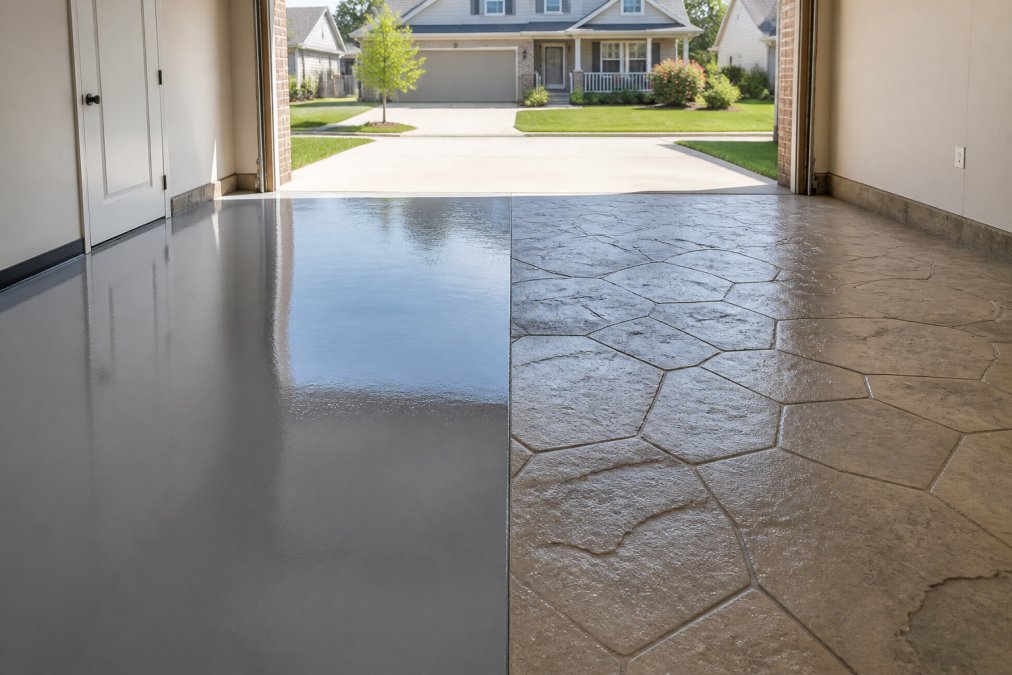
Moisture is the deciding factor. Epoxy is a thin film bonded to the surface, so any moisture vapor transmission through the slab pushes against that bond. Where vapor pressure is high, the coating blisters or delaminates, and no amount of surface cleaning fixes it. A decorative overlay is thicker and cement-based, so it tolerates more movement, though it still needs a sound, prepared substrate.
Heat separates the two just as sharply. Epoxy softens in sustained high temperatures, and hot tire pickup, where warm tires lift the coating, is the classic failure on garage floors. Polyurea and polyurethane topcoats resist that better because they stay flexible. Decorative concrete, by contrast, handles heat without softening, which is why it holds up on sun-exposed patios and pool decks.
Traffic wear differs too. Epoxy resists chemical spills and cleans easily, but it scratches and can wear thin in high-traffic lanes. Overlays take abrasion well and can be sealed for extra slip resistance.
Decorative Concrete Overlay Pros and Cons
A decorative concrete overlay is a cement-based layer, typically a few millimeters thick, troweled or sprayed over an existing slab to resurface it and add color, texture, or a stamped pattern. It bonds to the prepared concrete beneath, so it is a resurfacing method rather than a coating.
Pros:
- Resurfaces worn, spalled, or cracked concrete instead of just covering it
- Wide range of decorative finishes: stamped, stained, broom-textured, or spray-down
- Slip-resistant textures available for pool decks and walkways
- Handles sun exposure and heat without softening
- Repairable in sections; a damaged area can be patched and re-blended
Cons:
- Thicker profile means it may not suit tight door clearances without adjustment
- Curing time before heavy use is longer than a fast-cure coating
- Color matching on repairs takes skill; a poor patch shows
- Not the right call where the slab is actively moving or badly broken
When an Overlay Is the Better Choice
An overlay wins when the slab is sound but ugly. Cracked, stained, or spalled concrete that still has structural integrity is a resurfacing candidate, and an overlay restores both appearance and a wear surface in one step. It is also the better pick for exterior surfaces, pool decks, and any area that gets direct sun, because it does not soften or yellow the way a resin coating can.
Where an overlay falls short is a slab with serious structural problems or uncontrolled moisture. In those cases, the fix has to address the slab first. A common mistake is treating a decorative overlay as a cosmetic patch for a drainage or settlement problem. It will fail, and it will fail faster than the original surface did.
How Long Does Epoxy Flooring Last in Real Conditions?
A properly installed epoxy floor typically lasts 10 to 20 years in a residential garage and 5 to 10 years in a commercial setting with heavy traffic and chemical exposure. Those ranges assume correct substrate preparation and a moisture-tolerant slab. Get the prep wrong and the same floor can peel within a year or two.
The gap between the two numbers comes down to use.
Call (919) 824-5403 or email craigrfear@gmail.com for a free estimate →
What Shortens an Epoxy Floor's Lifespan
Four things cut an epoxy floor's life short, and most of them happen before the first coat goes down.
- Moisture vapor transmission: vapor pushing up through the slab blisters the coating from underneath.
- Poor substrate preparation: dust, oil, or a weak top layer means the epoxy bonds to contamination, not concrete.
- Hot tire pickup: warm tires lift a softened coating, common on unshaded garage floors.
- UV exposure: standard epoxy yellows and chalks in direct sunlight, so exterior use needs a UV-stable topcoat.
Epoxy Floor Coating Cost Per Square Foot: What Drives the Number
Epoxy floor coating cost per square foot depends on four variables: slab condition, square footage, coating system, and site access. There is no single number, and any quote that ignores condition is guessing.
| Cost Driver | What It Changes | Why It Matters |
|---|---|---|
| Slab condition | Prep labor | Cracks and old coatings add grinding and repair time |
| Square footage | Per-foot rate | Larger areas lower the rate per square foot |
| Coating system | Material cost | Primer, base, and topcoat cost more than a single coat |
| Site access | Mobilization | Tight or obstructed areas slow the crew |
| Finish complexity | Labor and material | Stamped and multi-color overlays cost more than solid finishes |
Durability, Repairability, and Climate: Where Each Finish Wins
Durability favors decorative concrete over the long haul; repairability favors epoxy in the short term. A polished or overlay surface can outlast a coating by years because there is no film to peel, but an epoxy floor can be recoated in a weekend when it wears.
Indoor vs Outdoor Use: Matching the Finish to the Space
Epoxy belongs indoors; decorative concrete works both indoors and out. That is the short answer, and it holds for most projects.
Choosing a Decorative Concrete or Epoxy Contractor
Installation quality decides whether either finish lasts, and it shows up in the prep, not the product. Ask every contractor the same three questions: how they test for moisture, how they prepare the substrate, and whether they will show you completed jobs from five or more years ago.
| Question to Ask | What a Good Answer Sounds Like | Red Flag |
|---|---|---|
| How do you test for moisture? | Plastic-sheet test or calcium chloride test before quoting | "We've never had a problem" |
| How do you prep the slab? | Mechanical grinding or shot blasting | Acid wash only |
| Can you show old jobs? | Completed projects 5+ years old | Only recent photos |
| What topcoat do you use outdoors? | UV-stable polyurea or polyurethane | Standard epoxy for exterior |
Frequently Asked Questions
Is epoxy or decorative concrete coating better?
It depends on where the floor is and how it gets used. Epoxy forms a bonded film that resists chemicals, oils, and abrasion, which suits garages, warehouses, and showrooms. Decorative concrete overlays are cement-based, so they handle UV exposure and moisture vapor transmission better and rarely delaminate in direct sun. For patios, pool decks, and driveways, an overlay usually holds up longer. For interior commercial floors with chemical spills, epoxy is the stronger pick.
How long does epoxy flooring last on a garage or commercial floor?
A professionally installed epoxy system typically lasts 10 to 20 years indoors, while a DIY kit applied over a poorly prepared slab often fails within one to three years. The variables that matter most are substrate preparation, moisture vapor transmission through the slab, and whether a UV-stable topcoat is used. Hot tire pickup and delamination are the two most common failure modes, and both trace back to prep work rather than the epoxy resin itself.
What are the drawbacks of using concrete epoxy?
Epoxy has three real weaknesses. It yellows under UV light unless a polyurethane or polyurea topcoat is applied, so it performs poorly on sun-exposed patios and pool decks. It is rigid, so it can crack if the slab moves or if moisture vapor pushes up from below. And once it delaminates, repair means grinding the affected area back to bare concrete. Interior floors with stable slabs avoid most of these problems.
How do decorative concrete overlays differ from standard epoxy finishes?
Overlays are cement-based coatings, usually 1/4 to 1/2 inch thick, that bond to the existing slab and can be stamped, stained, or textured. They breathe, which lets moisture vapor escape instead of trapping it under a film. Epoxy is a thin resin film, roughly 2 to 10 mils, that seals the surface completely. Overlays suit exterior surfaces and slip-resistant pool decks; epoxy suits interior floors that need chemical resistance and a seamless, easy-to-clean finish.
What affects epoxy floor coating cost per square foot?
Four factors drive the number: slab condition, square footage, coating system, and surface preparation. Cracked or contaminated concrete needs grinding, patching, or moisture testing before any coating goes down, and that prep often costs more than the epoxy itself. Larger jobs lower the per-square-foot rate because mobilization is spread across more area. Multi-coat systems with a polyurethane or polyurea topcoat cost more upfront but extend the floor's life.
Tags: decorative concrete vs epoxy, decorative concrete vs epoxy finishes, epoxy floor coating cost per square foot, how long does epoxy flooring last, decorative concrete overlay pros and cons
Frequently Asked Questions
It depends on where the floor is and how it gets used. Epoxy forms a bonded film that resists chemicals, oils, and abrasion, which suits garages, warehouses, and showrooms. Decorative concrete overlays are cement-based, so they handle UV exposure and moisture vapor transmission better and rarely delaminate in direct sun. For patios, pool decks, and driveways, an overlay usually holds up longer. For interior commercial floors with chemical spills, epoxy is the stronger pick.
A professionally installed epoxy system typically lasts 10 to 20 years indoors, while a DIY kit applied over a poorly prepared slab often fails within one to three years. The variables that matter most are substrate preparation, moisture vapor transmission through the slab, and whether a UV-stable topcoat is used. Hot tire pickup and delamination are the two most common failure modes, and both trace back to prep work rather than the epoxy resin itself.
Epoxy has three real weaknesses. It yellows under UV light unless a polyurethane or polyurea topcoat is applied, so it performs poorly on sun-exposed patios and pool decks. It is rigid, so it can crack if the slab moves or if moisture vapor pushes up from below. And once it delaminates, repair means grinding the affected area back to bare concrete. Interior floors with stable slabs avoid most of these problems.
Overlays are cement-based coatings, usually 1/4 to 1/2 inch thick, that bond to the existing slab and can be stamped, stained, or textured. They breathe, which lets moisture vapor escape instead of trapping it under a film. Epoxy is a thin resin film, roughly 2 to 10 mils, that seals the surface completely. Overlays suit exterior surfaces and slip-resistant pool decks; epoxy suits interior floors that need chemical resistance and a seamless, easy-to-clean finish.
Four factors drive the number: slab condition, square footage, coating system, and surface preparation. Cracked or contaminated concrete needs grinding, patching, or moisture testing before any coating goes down, and that prep often costs more than the epoxy itself. Larger jobs lower the per-square-foot rate because mobilization is spread across more area. Multi-coat systems with a polyurethane or polyurea topcoat cost more upfront but extend the floor's life.