listicle
9 Epoxy Flake Flooring Design Ideas That Transform Any Room
Last Updated: October 24, 2026
Quick Summary
Epoxy flake flooring design ideas start with the flake blend: neutral gray, greige, and off-white blends for clean modern rooms, or brown, tan, and black blends for warm and industrial spaces. Match flake size and coverage to the room, using 1/8-inch to 1/4-inch flake at full broadcast for garages and tighter micro blends at partial coverage for basements and living areas.
- Mid-tone blends with three or more colors hide dirt better than single flat colors.
- Micro flake runs 1/32 inch and macro flake runs 1/4 inch, with 1/16 inch the residential middle ground.
- Full broadcast coverage hides most and grips best, while partial scatter of roughly 30 to 70 percent shows more base color.
- Check a physical flake sample in the actual room, since warm and cool lighting shift flake color.
- Durability depends on surface prep and coating quality, not on the flakes themselves.
Table of Contents
- Why Epoxy Flake Flooring Beats Plain Concrete
- Epoxy Flake Floor Colors That Fit Every Palette
- Garage Floor Flake Color Combinations That Hide Dirt
- Epoxy Floor Flakes Size and Coverage: Getting the Ratio Right
- Design Ideas by Room: Basements, Patios, and Retail Spaces
- Matching Flake Blends to Lighting and Interior Style
- Epoxy Flake Flooring Installation: What Affects Durability and Cost
- Get a Free Estimate for Your Epoxy Flake Floor
- Frequently Asked Questions
Why Epoxy Flake Flooring Beats Plain Concrete
Epoxy flake flooring is a resin-based coating system that scatters decorative vinyl flakes into a wet epoxy base coat, then seals the whole surface under a clear topcoat (Resuflor® Deco Flake SB).
Plain concrete shows every oil drip, tire mark, and hairline crack. It also dusts.
The flake layer is where the design lives. Sherwin-Williams' flake flooring range notes that flake systems come in a wide array of colors, including macro and micro blends you can customize.
Below, we break down nine design directions, how flake size changes the look, and what drives durability and cost.
Epoxy Flake Floor Colors That Fit Every Palette
Color is the first decision most people fixate on, and rightly so. A flake blend sets the room's tone before furniture or lighting gets a say. The trick is choosing a palette that still works five years from now, not just on install day.
Neutral Blends for a Clean, Modern Look
Gray, greige, and off-white blends are the safest bet for a reason. They read clean, hide light dust, and pair with almost any wall color. A mid-tone gray with black and white flecks gives you a floor that looks intentional without shouting.
Bold and Earth-Tone Options
Brown, tan, and black blends bring warmth and suit rustic or industrial interiors. Metallic pigments go further, creating depth and movement under light. Garage Flooring Pros' overview of metallic epoxy design describes metallic finishes as a way to add dimension, which is why they photograph so well in showrooms and living spaces.
Garage Floor Flake Color Combinations That Hide Dirt
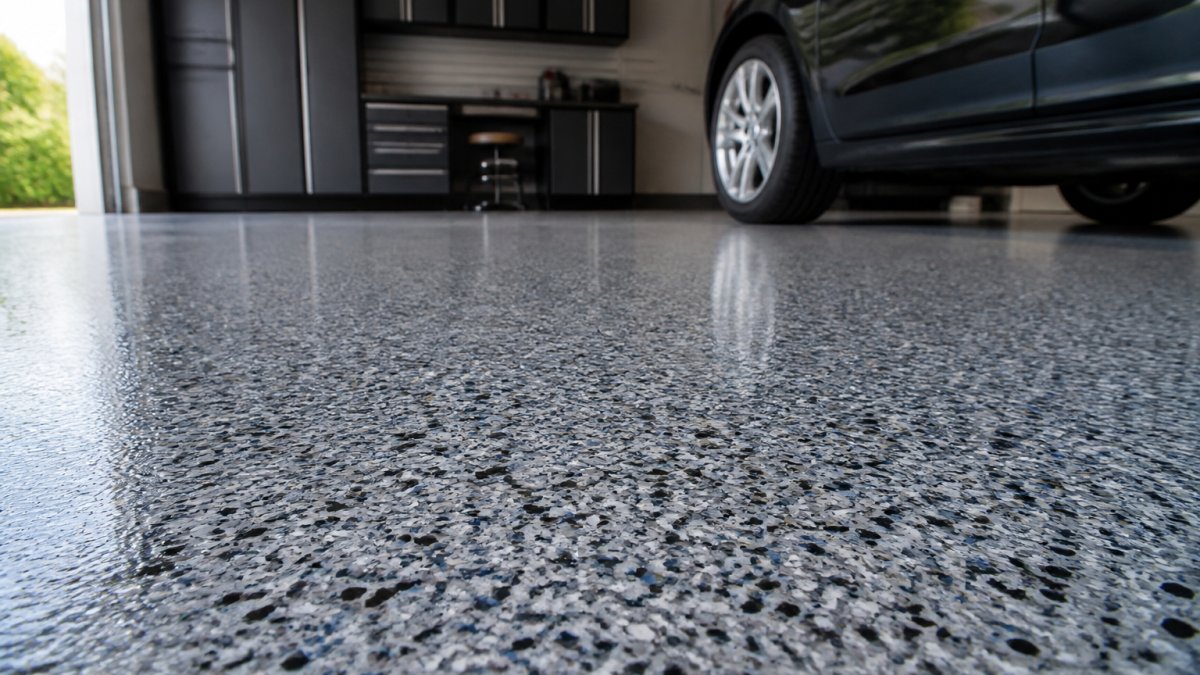
The best garage floor flake color combinations are mid-tone blends that use three or more colors, because busy patterns break up the visual line of dirt, leaves, and tire dust.
Two combinations work consistently well:
- Gray, black, and white: the classic camouflage blend. Neutral enough for resale, busy enough to hide road grime.
- Tan, brown, and black: warmer, forgiving of clay dust and yard debris, and a strong match for brick or wood-sided homes.
Lighter blends look brighter but show dark drips. Very dark blends hide oil but show pale dust. Mid-tones split the difference, which is why they dominate garage installations.
Epoxy Floor Flakes Size and Coverage: Getting the Ratio Right
Flake size and coverage decide whether the floor reads subtle or dramatic, and they are the two variables most people get wrong because they choose them from a photo instead of from the room. Here is the selection logic we use on installs.
Flake size: what the numbers mean
Vinyl flake is sold by nominal size, and the size range runs from fine to coarse:
- 1/32 inch (micro): a tight, speckled surface that reads like granite or terrazzo from standing height. Micro blends hide fine dust well but show larger debris and oil drips because the pattern is so even.
- 1/16 inch: the middle ground most residential floors use. Visible flecks, moderate texture, forgiving of both light dust and small stains.
- 1/8 inch: a bolder, chunkier look with strong contrast between flakes. Good for garages and utility spaces; can look busy in a small, quiet room.
A common pattern is to blend two sizes, a micro base with a scatter of 1/8-inch accent flakes, to get depth without a flat, single-size look.
Coverage: full broadcast vs. partial scatter
Coverage is measured as a percentage of the floor surface the flakes cover before the topcoat goes down:
- Full broadcast (near 100% coverage): flakes are thrown until the wet base coat refuses more, so the floor looks almost solid flake. Maximum hide, maximum texture, and the most forgiving surface for dirt and scuffs. This is the standard for garages, shops, and pool decks.
- Partial scatter (roughly 30-70% coverage): more base color shows through, giving a sparser, more contemporary look. It uses less flake and costs less in material, but it hides less and shows base-coat imperfections more readily.
- Light scatter (under about 30%): a decorative accent rather than a working surface. Best for low-traffic living areas where appearance outranks hide.
Matching size and coverage to the room
| Space | Typical flake size | Typical coverage | Why |
|---|---|---|---|
| Garage or shop | 1/8 in to 1/4 in | Full broadcast | Hides tire dust and oil; adds grip |
| Basement or living area | 1/32 in to 1/16 in | Partial to full | Reads like stone; less chunky underfoot |
| Patio or pool deck | 1/8 in to 1/4 in | Full broadcast | Wet-footing traction and UV exposure |
| Retail or commercial | 1/16 in to 1/8 in | Full broadcast | Brand-color blend plus traffic wear |
Coverage and size also change feel underfoot and slip resistance. Heavier texture grips better but is harder to mop and less comfortable to stand on barefoot; tighter blends feel smoother but can get slick when wet unless the topcoat carries a slip-resistant additive. We match the pair to the room rather than defaulting to the boldest look.
Design Ideas by Room: Basements, Patios, and Retail Spaces
Room use should drive the design, not the other way around. A blend that shines in a finished basement can be the wrong call on a sun-baked patio.
Call (919) 824-5403 or email craigrfear@gmail.com for a free estimate →
Garages and Workshops
Start with a mid-tone, three-color blend at full broadcast in 1/8-inch flake, gray/black/white or tan/brown/black. The busy pattern breaks up the visual line of tire dust and leaves, and the heavier texture grips wet shoes. Avoid very light blends (they show every dark drip) and very dark blends (they show pale dust).
Basements and Living Areas
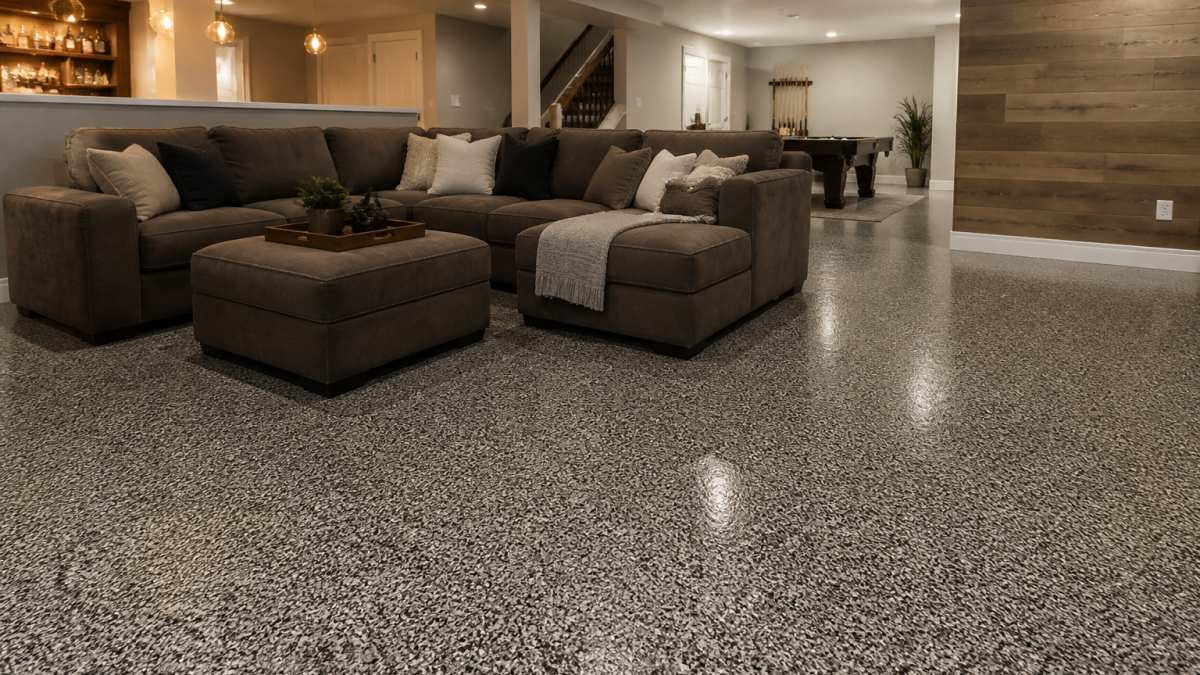
Basements benefit from warmer neutrals and tighter micro blends that feel closer to polished stone. A gray-and-taupe 1/32-inch blend with a satin topcoat keeps the space bright without glare. These floors handle moisture far better than carpet and clean up in minutes. In a finished living area, drop to partial coverage so the floor supports the furniture instead of competing with it.
Kitchens and Mudrooms
These are the spill-and-dirt rooms, so choose a mid-tone blend with enough contrast to hide crumbs and paw prints, in 1/16-inch flake at full broadcast. A slip-resistant topcoat matters here more than in a bedroom because the floor sees water regularly.
Laundry and Utility Rooms
Function beats style: a 1/8-inch full-broadcast blend in gray or tan hides lint, detergent drips, and lint-dryer dust, and the texture stands up to repeated mopping.
Patios, Pool Decks, and Outdoor Spaces
Outdoor surfaces need texture for wet footing and a finish that tolerates sun and temperature swings. Heavier 1/4-inch flake at full broadcast with a slip-resistant topcoat is the standard approach. If you are wondering whether flake epoxy works on patios and pool decks, read our answer on epoxy flooring for outdoor patios.
Commercial and Retail Floors
Retail and commercial spaces use flake floors to coordinate with branding. A custom 1/16-inch blend can echo a logo color or a fixture palette, and full broadcast stands up to carts, foot traffic, and constant cleaning. Our guide to epoxy flooring for retail spaces covers durability, safety, and maintenance in more detail.
Matching Flake Blends to Lighting and Interior Style
Lighting changes flake color more than most people expect. A blend that looks balanced in a showroom can turn muddy in a dim basement or washed out under bright warehouse LEDs.
Bring a physical sample into the actual room and check it at different times of day. For interior style, let the floor support rather than compete: neutral blends for minimalist rooms, earth tones for rustic spaces, metallic accents for modern ones.
Epoxy Flake Flooring Installation: What Affects Durability and Cost
Durability comes down to surface preparation and the quality of the coating system, not the flakes. A floor that peels early almost always traces back to poor prep: moisture, dust, or an unprepared slab.
Installation steps follow a set order: prep the concrete, apply the base coat, broadcast flakes, scrape and vacuum the excess, then seal with a topcoat. If you are weighing doing it yourself, our breakdown of professional epoxy floor installation costs explains what drives pricing.
Cost varies with square footage, slab condition, flake coverage, and topcoat type. We quote after an on-site measurement rather than guess from a photo.
| Design Factor | What It Changes | Practical Guidance |
|---|---|---|
| Flake size | Texture and visual contrast | Micro for living areas, macro for garages |
| Coverage level | Hide and slip resistance | Full broadcast for high-traffic and wet zones |
| Color blend | How well dirt is disguised | Three-plus mid-tone colors hide best |
| Topcoat finish | Sheen and grip | Slip-resistant for patios and pool decks |
| Surface prep | How long the floor lasts | Never cut corners here |
Get a Free Estimate for Your Epoxy Flake Floor
Choosing a flake blend is the fun part. Getting the prep and topcoat right is what makes it last, and that is where a professional install pays for itself.
We handle decorative overlays, epoxy coatings, and concrete repair across the Raleigh-Durham Triangle, NC Triad, and Coastal SC. Call (919) 824-5403 or email craigrfear@gmail.com to book a free estimate, and we will measure your space and match a flake blend to your room, your lighting, and your budget.
Frequently Asked Questions
How do you apply flakes to an epoxy floor?
Flakes are broadcast by hand or with a hopper gun onto wet epoxy while it is still tacky, typically within the working time listed on the product. The installer throws them upward so they fall evenly, covering the surface to the chosen density. After the epoxy cures, excess flakes are swept or vacuumed off, and a clear topcoat seals everything in. Full coverage takes more flakes and a heavier topcoat than a light scatter.
What colors and flake blends work best for an epoxy floor?
Mid-tone blends with three or more colors hide dust and tire marks better than solid light or dark floors. A gray, black, and white mix is a common choice for garages because it masks dirt without looking busy. Tan, brown, and black blends suit earth-tone interiors. For a cleaner look, a single-color flake in light gray or beige keeps the floor calm. Request a sample board and view it in the room's actual lighting before committing.
Can you customize the size and density of epoxy floor flakes?
Yes. Flake systems come in macro (larger) and micro (smaller) blends, and coverage can range from a light scatter to full broadcast. Larger flakes create a bolder, more textured look, while micro flakes give a finer, more uniform finish that is easier to sweep. Density affects both appearance and slip resistance. A full broadcast with a textured topcoat offers more grip than a sparse scatter, which matters for pool decks and garage entries.
Are epoxy flake floors suitable for spaces beyond garages?
They work well in basements, laundry rooms, workshops, retail showrooms, church fellowship halls, and covered patios. The flake layer adds visual texture and helps hide scuffs, and the topcoat provides wear resistance for high-traffic areas. For outdoor spaces exposed to sun and rain, confirm the coating is rated for exterior use and includes a UV-stable topcoat. Pool decks need a slip-resistant finish, so discuss texture options with your installer.
Your floor is the largest surface in the room, and it deserves a design decision, not a default. Concrete-Enhancements can help you choose a flake blend that fits your space and install it on a properly prepared slab that holds up for years. Get started with Concrete-Enhancements and turn plain concrete into a floor you actually want to show off.

Tags: epoxy flake flooring, epoxy flake flooring design ideas, epoxy flake floor colors, garage floor flake color combinations, epoxy floor flakes size and coverage, epoxy flake flooring installation
Frequently Asked Questions
Flakes are broadcast by hand or with a hopper gun onto wet epoxy while it is still tacky, typically within the working time listed on the product. The installer throws them upward so they fall evenly, covering the surface to the chosen density. After the epoxy cures, excess flakes are swept or vacuumed off, and a clear topcoat seals everything in. Full coverage takes more flakes and a heavier topcoat than a light scatter.
Mid-tone blends with three or more colors hide dust and tire marks better than solid light or dark floors. A gray, black, and white mix is a common choice for garages because it masks dirt without looking busy. Tan, brown, and black blends suit earth-tone interiors. For a cleaner look, a single-color flake in light gray or beige keeps the floor calm. Request a sample board and view it in the room's actual lighting before committing.
Yes. Flake systems come in macro (larger) and micro (smaller) blends, and coverage can range from a light scatter to full broadcast. Larger flakes create a bolder, more textured look, while micro flakes give a finer, more uniform finish that is easier to sweep. Density affects both appearance and slip resistance. A full broadcast with a textured topcoat offers more grip than a sparse scatter, which matters for pool decks and garage entries.
They work well in basements, laundry rooms, workshops, retail showrooms, church fellowship halls, and covered patios. The flake layer adds visual texture and helps hide scuffs, and the topcoat provides wear resistance for high-traffic areas. For outdoor spaces exposed to sun and rain, confirm the coating is rated for exterior use and includes a UV-stable topcoat. Pool decks need a slip-resistant finish, so discuss texture options with your installer.