comparison
Epoxy vs Polyurethane Coatings: Key Differences
Table of Contents
- Epoxy vs Polyurethane: What's the Difference?
- Epoxy vs Polyurethane Floor Durability Compared
- How Long Does Epoxy Flooring Last?
- Chemical Resistance and UV Stability
- Application Process and System Compatibility
- Best Concrete Floor Coating for Garages
- Making the Right Choice for Your Concrete Floor
- Frequently Asked Questions
Last Updated: September 6, 2026
Epoxy vs Polyurethane: What's the Difference?
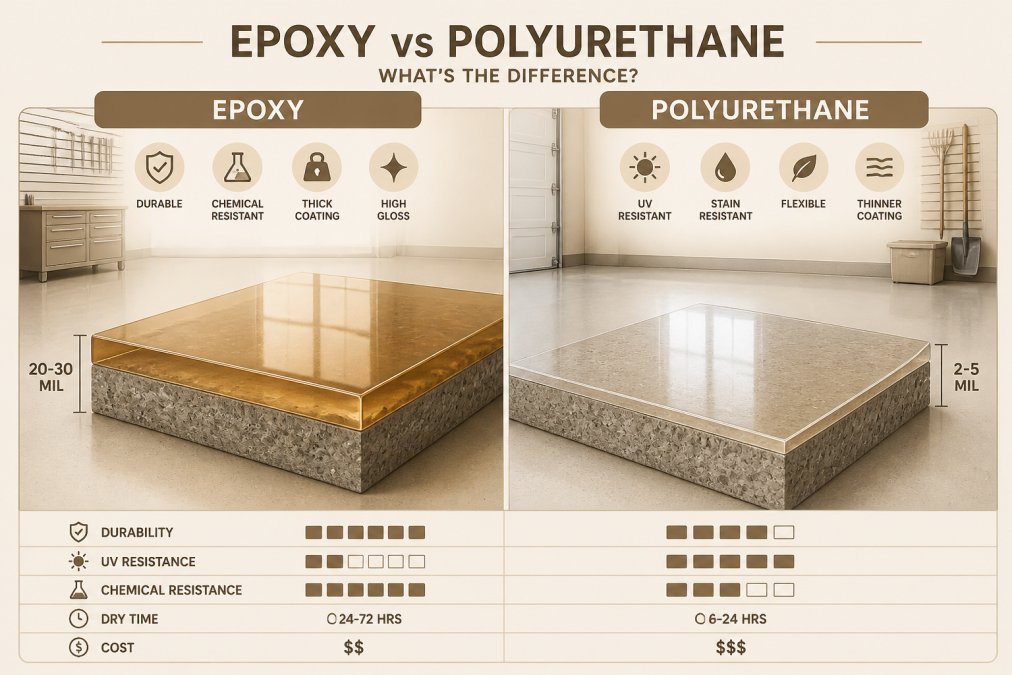
Choosing between epoxy and polyurethane coatings comes down to one core question: where will the floor live? Epoxy is a thermosetting resin that forms a thick, rigid, glass-like barrier, while polyurethane is a more flexible polymer that cures into a thinner, tougher film. At Concrete-Enhancements, we have applied both systems for over 20 years, and the right choice depends on your specific conditions, not which is "better" overall.
Epoxy coatings excel at adhesion and compressive strength, bonding aggressively to prepared concrete to create a hard, impact-resistant surface. Polyurethane coatings deliver superior elasticity and abrasion resistance, making them the standard for areas exposed to sunlight or frequent temperature swings. Many flooring professionals, including those at Protective Industrial Polymers, describe epoxy as the workhorse base layer and polyurethane as the protective shield. You rarely have to pick just one, which we will explore shortly.
Epoxy vs Polyurethane Floor Durability Compared
Epoxy vs polyurethane floor durability is a genuine trade-off between hardness and toughness. Epoxy measures higher on compressive strength, resisting heavy point loads and impacts without denting. Polyurethane flexes under stress, absorbing impacts that would crack a brittle epoxy film.
Where polyurethane pulls ahead is abrasion resistance and scratch resistance. Steel wheels, dragged tool boxes, and constant foot traffic slowly wear down epoxy's glossy surface over time. Polyurethane's elastic nature allows it to resist cutting and scuffing far better, which is why Copps Industries notes that polyurethane systems can last roughly twice as long as standard epoxy in high-traffic environments. The trade-off is that polyurethane is a thinner film, so it relies on the epoxy base beneath it for impact protection. This is why the two materials are so often paired together rather than pitted against each other.
How Long Does Epoxy Flooring Last?
How long does epoxy flooring last depends heavily on the environment and the system installed. A well-prepared slab with a quality epoxy coating in a climate-controlled garage can easily serve 10 to 15 years. The same coating on a sun-exposed driveway might begin chalking and fading within a few years because epoxy is not UV-stable.
The more accurate question is how long the system lasts. A common mistake is applying a single thick coat of epoxy and calling it done. Professional installations layer a primer, an epoxy body coat, and a polyurethane topcoat. The epoxy provides the structural build and adhesion, while the polyurethane topcoat protects the epoxy from UV light, chemicals, and abrasion. This hybrid approach extends the service life of the entire floor significantly. If you are weighing epoxy vs polyurethane for a long-term investment, remember that polyurethane's higher upfront material cost often pays off through a longer maintenance cycle. For a breakdown of how these systems perform on different substrates, see our epoxy flooring guide.
Chemical Resistance and UV Stability
Chemical resistance is where the two materials diverge most sharply. Epoxy offers excellent resistance to many chemicals, including many acids, alkalis, and solvents, making it a staple in industrial flooring and garage environments. However, epoxy will degrade with prolonged exposure to certain aggressive solvents and can yellow or chalk when exposed to direct sunlight.
Polyurethane is engineered to handle harsh cleaning chemicals and provides superior UV stability, resisting the yellowing that plagues epoxy in sunlit areas. Gulf Coast Paint highlights that polyurethane's resistance to chalking and fading makes it the clear choice for outdoor or sun-exposed applications. For a pool deck, patio, or a garage with large windows, a polyurethane topcoat is non-negotiable if you want the color to stay true. The resin chemistry is fundamentally different, and that difference dictates where each material belongs.
Application Process and System Compatibility
Applying these coatings is where the theoretical differences become practical realities, and it's also where most DIY projects go off the rails.
The DIY Reality Check
Most big-box store epoxy kits are water-based or low-solids products that are fundamentally different from the 100% solids epoxy systems used by professionals. A DIY kit might advertise a 200-400 sq ft coverage per gallon, but it typically cures to a film thickness of only 3-5 mils (0.003-0.005 inches). A professional 100% solids epoxy system is applied at 10-20 mils per coat. That difference in film build is why a DIY kit might last 2-3 years in a garage, while a professionally installed system can last 10-15 years.
Polyurethane is even less forgiving for the DIYer. It has a shorter pot life, often 20-30 minutes once mixed, compared to 45-60 minutes for epoxy, and is highly sensitive to ambient moisture. If the relative humidity is above 70% or the slab temperature is below 50°F, the coating can blush (turn milky) or fail to adhere properly. Most professional installers only apply polyurethane within a strict window, typically 60-80°F and below 60% relative humidity.
Surface Preparation: The Non-Negotiable Step
Both materials demand meticulous surface preparation, but the level of effort is often underestimated. A garage floor that looks clean may still have a thin layer of curing compound, oil residue, or a densifier that will prevent adhesion. Professionals use diamond grinding or shot blasting to create a mechanical profile, essentially opening the pores of the concrete so the coating can key in. A DIYer using a floor etcher or a rental floor buffer with sandpaper will rarely achieve the same profile depth.
The most common DIY failure is inadequate surface preparation. If you are considering a DIY application, you must be prepared to grind the concrete, not just clean it. A rental walk-behind grinder with diamond tooling costs roughly $100-150 per day. You also need to handle moisture testing, a simple plastic sheet taped to the slab for 24 hours will reveal if there is a vapor transmission problem. If moisture is present, no coating will bond long-term without a moisture barrier system.
System Compatibility: The Hybrid Advantage
System compatibility is the insider secret most guides miss. You can apply polyurethane directly over a cured epoxy base, which is the foundation of a high-performance hybrid system. This layering approach captures the best of both worlds: the epoxy's build and impact resistance, plus the polyurethane's UV stability and abrasion resistance.
A typical professional hybrid system looks like this:
- Primer: A low-viscosity epoxy primer that penetrates the concrete and seals the surface.
- Epoxy body coat: A 100% solids epoxy applied at 10-15 mils to build thickness and provide impact resistance.
- Polyurethane topcoat: A 2-3 mil clear or pigmented polyurethane layer that provides UV protection, chemical resistance, and a smooth, easy-to-clean finish.
This system is standard in commercial kitchens, auto dealerships, and aircraft hangars. For a homeowner, the takeaway is simple: if you want a garage floor that resists hot tire pickup, brake fluid, and UV yellowing, you need a polyurethane topcoat over an epoxy base. Most DIY kits skip the polyurethane layer entirely, which is why they fade and chalk within a year or two in sun-exposed areas.
Repairability and Recoating
Repairability also differs significantly. Epoxy is brittle and can chip if a heavy object is dropped, but those chips are often repairable with a patch kit, you clean the area, apply fresh epoxy, and it blends reasonably well. Polyurethane is more scratch-resistant but can be harder to touch up seamlessly. If a polyurethane topcoat is scratched or gouged, the repair often requires recoating the entire floor section because the material does not feather-edge as easily as epoxy. high-traffic retail coatings.
Recoating an aged system is another consideration. Epoxy floors that have worn or yellowed can often be recoated with a fresh polyurethane topcoat after light abrading and cleaning. This is a cost-effective way to extend the life of an existing floor without a full grind-and-replace. However, if the original epoxy is delaminating or the concrete has moisture issues, recoating will fail just as quickly as the original installation.
For a deeper look at how these systems perform on different substrates, see our [epoxy flooring(/articles/commercial-epoxy-flooring-cost-per-square-foot) guide | concrete-enhancements.com].
Call (919) 824-5403 or email craigrfear@gmail.com for a free estimate →
Best Concrete Floor Coating for Garages
The best concrete floor coating for garages is a hybrid system: an epoxy base coat for impact and chemical resistance, topped with a polyurethane topcoat for UV stability and scratch resistance. Garages are uniquely demanding, hot cars dripping fluids, cold winters causing thermal shock, and direct sunlight streaming through doors and windows. A single-material approach compromises somewhere. Pure epoxy will eventually yellow and chalk in sunlit areas. Pure polyurethane may lack the film build to hide surface imperfections. Combining them addresses every failure mode.
But the "best" system also depends on your budget, your tolerance for maintenance, and whether you plan to repair or recoat down the road.
The Cost Reality
The cost of a professional hybrid system, epoxy base plus polyurethane topcoat, depends on the condition of the concrete and the specific products used. A DIY epoxy kit from a home improvement store will not include a polyurethane topcoat, and it may not last as long in a garage environment.
The professional system costs more per year, but it also provides a thicker, more durable finish that resists hot tire pickup, chemical spills, and UV damage. The DIY kit will need to be stripped and reapplied, which adds labor costs and downtime.
The Repair and Recoat Decision
Garage floors take abuse, and eventually every coating will show wear. Epoxy chips and scratches can often be spot-repaired. If a dropped wrench chips the epoxy, you can clean the area, feather in fresh epoxy, and topcoat it. The repair will be visible up close but will not compromise the integrity of the floor. Polyurethane scratches are more difficult to touch up seamlessly. If a polyurethane topcoat is gouged, the repair often requires recoating the entire floor because the material does not blend well in patches.
However, a polyurethane topcoat is more resistant to scratching in the first place. Steel wheels, dragged tool boxes, and constant foot traffic will wear down an epoxy-only finish much faster. A hybrid system with a polyurethane topcoat will typically need a recoat every 8-10 years, while an epoxy-only system may need recoating every 4-5 years in a garage.
Recoating a hybrid system is straightforward: clean the floor, lightly abrade the surface to create a mechanical profile, and apply a fresh polyurethane topcoat. This is significantly less expensive than a full grind-and-replace, which is required if the epoxy base has delaminated or the concrete has moisture issues.
When to Skip the Hybrid and Go Single-Layer
There are scenarios where a single-material system makes sense:
- Epoxy-only for a climate-controlled, interior garage: If the garage is fully enclosed, has no windows, and is not exposed to direct sunlight, a thick epoxy system (15-20 mils) will provide excellent impact and chemical resistance. You lose UV stability, but you do not need it.
- Polyurethane-only for a carport or open-air garage: If the space is covered but open to the elements, polyurethane's flexibility and UV stability make it the better choice. However, polyurethane is a thinner film, so it will not hide cracks or surface imperfections as well as epoxy.
The Professional Advantage
This is where professional experience separates a floor that lasts from one that peels within a year. The most common DIY failure is inadequate surface preparation. Epoxy and polyurethane are only as good as their bond to the substrate, and a smooth, sealed, or contaminated concrete slab will reject the coating. Professionals grind the surface to open the pores, repair cracks, and manage moisture issues before a single drop of resin is applied. If you have tried a DIY kit that peeled, the problem was almost certainly preparation, not the material.
For a garage that needs to handle everything from hot tire pickup to dropped tools, investing in a properly installed multi-layer system is the most cost-effective decision you can make. The upfront cost is higher, but the repair and recoat cycle is longer, and the floor will look better for longer.
Making the Right Choice for Your Concrete Floor
Choosing between these two coatings means matching the material to your specific environment, not picking a "winner." For interior spaces with heavy impacts and chemical exposure, a thick epoxy system delivers unbeatable hardness. For exterior slabs, pool decks, or any area with significant sun exposure, a polyurethane topcoat is essential for color retention and longevity. For the vast majority of high-performance floors, the smartest solution is a layered system combining both.
| Consideration | Epoxy | Polyurethane |
|---|---|---|
| Impact Resistance | Excellent | Good |
| Abrasion Resistance | Good | Excellent |
| UV Stability | Poor (chalks/yellows) | Excellent |
| Chemical Resistance | Excellent | Superior |
| Flexibility | Rigid, brittle | Elastic, tough |
| Typical Role | Base coat / build | Topcoat / protection |
The cost difference between the materials is often less important than the cost of failure. A floor that fails in two years costs far more than a premium system that lasts 15. With over 20 years of experience as a CTi Certified Dealer, Concrete-Enhancements has seen firsthand how proper surface preparation and system selection determine a floor's lifespan. Whether you need a decorative overlay for a showroom or a heavy-duty coating for a warehouse, the right system starts with an honest assessment of your concrete and your usage.
Choosing the wrong coating is an expensive mistake, but it is entirely avoidable with expert guidance. At Concrete-Enhancements, we specialize in professional epoxy and polyurethane systems designed for the specific demands of residential and commercial spaces across the Raleigh-Durham Triangle, NC Triad, and Coastal SC. Our 20-plus years of experience and CTi certification mean your floor is installed right the first time, with proper surface preparation and a system built to last. Call (919) 824-5403 or email craigrfear@gmail.com for a free estimate and get a floor that stands up to real life.
Frequently Asked Questions
Which is more durable: epoxy or polyurethane?
Both coatings are durable, but each excels differently. Epoxy provides superior hardness, impact resistance, and compressive strength, making it ideal for heavy loads. Polyurethane offers better flexibility, scratch resistance, and abrasion resistance. For high-traffic industrial floors, polyurethane often lasts about twice as long as standard epoxy. Many professional systems combine both: an epoxy base for hardness and a polyurethane topcoat for UV stability and flexibility.
What is the main difference between epoxy and polyurethane coatings?
The main difference comes down to their molecular structure and resulting performance. Epoxy is a rigid, hard material that bonds aggressively to concrete, offering excellent impact resistance. Polyurethane is more flexible and elastic, which gives it superior scratch resistance and UV stability. Epoxy will chalk and yellow when exposed to sunlight, while polyurethane resists fading. Epoxy typically costs less upfront, but polyurethane often provides a longer service life in demanding conditions.
Can you apply polyurethane over epoxy flooring?
Yes, applying a polyurethane topcoat over an epoxy base is a standard professional practice called a hybrid system. This layering combines the hardness and adhesion of epoxy with the UV resistance and flexibility of polyurethane. The epoxy layer provides impact strength, while the polyurethane topcoat protects against yellowing, scratching, and chemical exposure. This system is ideal for garages, showrooms, and other spaces where appearance and long-term durability matter.
Is polyurethane more UV resistant than epoxy?
Yes, polyurethane is significantly more UV resistant than epoxy. Epoxy contains aromatic amines that react to sunlight, causing chalking and amber yellowing over time. This makes epoxy a poor choice for sun-exposed areas like pool decks or driveways. Polyurethane uses aliphatic isocyanates, which resist UV degradation and maintain gloss retention. If your floor receives direct sunlight, a polyurethane topcoat or a full polyurethane system will keep its color and clarity far longer than epoxy alone.
How long does epoxy flooring last?
A professionally installed epoxy floor typically lasts 10 to 20 years, depending on traffic levels, maintenance, and whether it has a protective topcoat. In residential garages with light use, epoxy can last 15 to 20 years when properly maintained. In industrial settings with heavy traffic and chemical exposure, standard epoxy may need recoating sooner, often around 5 to 10 years. Adding a polyurethane topcoat extends the service life by protecting the epoxy from UV damage and scratching.
Frequently Asked Questions
Both coatings are durable, but each excels differently. Epoxy provides superior hardness, impact resistance, and compressive strength, making it ideal for heavy loads. Polyurethane offers better flexibility, scratch resistance, and abrasion resistance. For high-traffic industrial floors, polyurethane often lasts about twice as long as standard epoxy. Many professional systems combine both: an epoxy base for hardness and a polyurethane topcoat for UV stability and flexibility.
The main difference comes down to their molecular structure and resulting performance. Epoxy is a rigid, hard material that bonds aggressively to concrete, offering excellent impact resistance. Polyurethane is more flexible and elastic, which gives it superior scratch resistance and UV stability. Epoxy will chalk and yellow when exposed to sunlight, while polyurethane resists fading. Epoxy typically costs less upfront, but polyurethane often provides a longer service life in demanding conditions.
Yes, applying a polyurethane topcoat over an epoxy base is a standard professional practice called a hybrid system. This layering combines the hardness and adhesion of epoxy with the UV resistance and flexibility of polyurethane. The epoxy layer provides impact strength, while the polyurethane topcoat protects against yellowing, scratching, and chemical exposure. This system is ideal for garages, showrooms, and other spaces where appearance and long-term durability matter.
Yes, polyurethane is significantly more UV resistant than epoxy. Epoxy contains aromatic amines that react to sunlight, causing chalking and amber yellowing over time. This makes epoxy a poor choice for sun-exposed areas like pool decks or driveways. Polyurethane uses aliphatic isocyanates, which resist UV degradation and maintain gloss retention. If your floor receives direct sunlight, a polyurethane topcoat or a full polyurethane system will keep its color and clarity far longer than epoxy alone.
A professionally installed epoxy floor typically lasts 10 to 20 years, depending on traffic levels, maintenance, and whether it has a protective topcoat. In residential garages with light use, epoxy can last 15 to 20 years when properly maintained. In industrial settings with heavy traffic and chemical exposure, standard epoxy may need recoating sooner, often around 5 to 10 years. Adding a polyurethane topcoat extends the service life by protecting the epoxy from UV damage and scratching.