listicle
How to Use Antimicrobial Epoxy in Healthcare Facilities
Last Updated: November 8, 2026
Quick Summary
Antimicrobial epoxy is a seamless, non-porous resin flooring with an antimicrobial agent built into the coating that reduces microbial growth on the surface between cleanings. Its benefits for healthcare facilities come from being seamless, non-porous, and easy to clean, not from the additive replacing your disinfection protocol.
- The additive, usually silver-ion, is mixed into the resin and interferes with microbial reproduction at the surface.
- Operating rooms, patient rooms, corridors, laboratories, and pharmacies are the strongest fits for antimicrobial epoxy flooring.
- Higher upfront cost than vinyl composition tile or sealed concrete is a key disadvantage.
- Antimicrobial performance fades as the surface additive depletes through abrasion and scrubbing.
- The CDC states routine cleaning and disinfection remain the foundation of infection control.
Table of Contents
- What Antimicrobial Epoxy Actually Delivers in Healthcare Settings
- Antimicrobial Epoxy Flooring for Hospitals: Where It Fits Best
- Epoxy Flooring Advantages and Disadvantages for Healthcare Facilities
- Epoxy Flooring Hygiene and Maintenance: What Staff Should Expect
- Healthcare Flooring Installation and Downtime Planning
- Durability, Chemical Resistance, and Long-Term Performance
- Request a Free Estimate for Your Facility Floor
- Frequently Asked Questions
What Antimicrobial Epoxy Actually Delivers in Healthcare Settings
Antimicrobial epoxy is a seamless resin flooring system with an antimicrobial agent built into the coating, designed to reduce microbial growth on the surface between cleanings. It is a surface, not a sterilizer, and that distinction matters more than any marketing claim you will read this year.
Here is the honest version: the benefits of antimicrobial epoxy for healthcare facilities are real but narrow. They come from the floor being seamless, non-porous, and easy to clean, not from the additive doing the work of your disinfection protocol. Facility managers often buy the wrong thing for the right reason.
How the Antimicrobial Action Works
The additive, usually silver-ion or a similar agent, is mixed into the resin before it cures. It leaches slowly at the surface and interferes with microbial reproduction.
That mechanism has been measured in the lab. According to a 2025 Scientific Reports study on antimicrobial epoxy resin, surfaces painted with chlorhexidine resin showed significant, reproducible antimicrobial efficacy against E. coli, S. aureus, and C. albicans. Note what that study tested: an experimental resin, not a commercial healthcare flooring product. The gap between "a lab surface killed these organisms" and "this floor reduces infections in your hospital" is where most sales pitches quietly fall apart.
Antimicrobial Epoxy Flooring for Hospitals: Where It Fits Best
Antimicrobial epoxy flooring for hospitals earns its cost in specific areas, not everywhere. Operating rooms, patient rooms, laboratories, and pharmaceutical facilities are the strongest fits because they combine strict hygiene requirements with heavy wheeled traffic and constant chemical exposure.
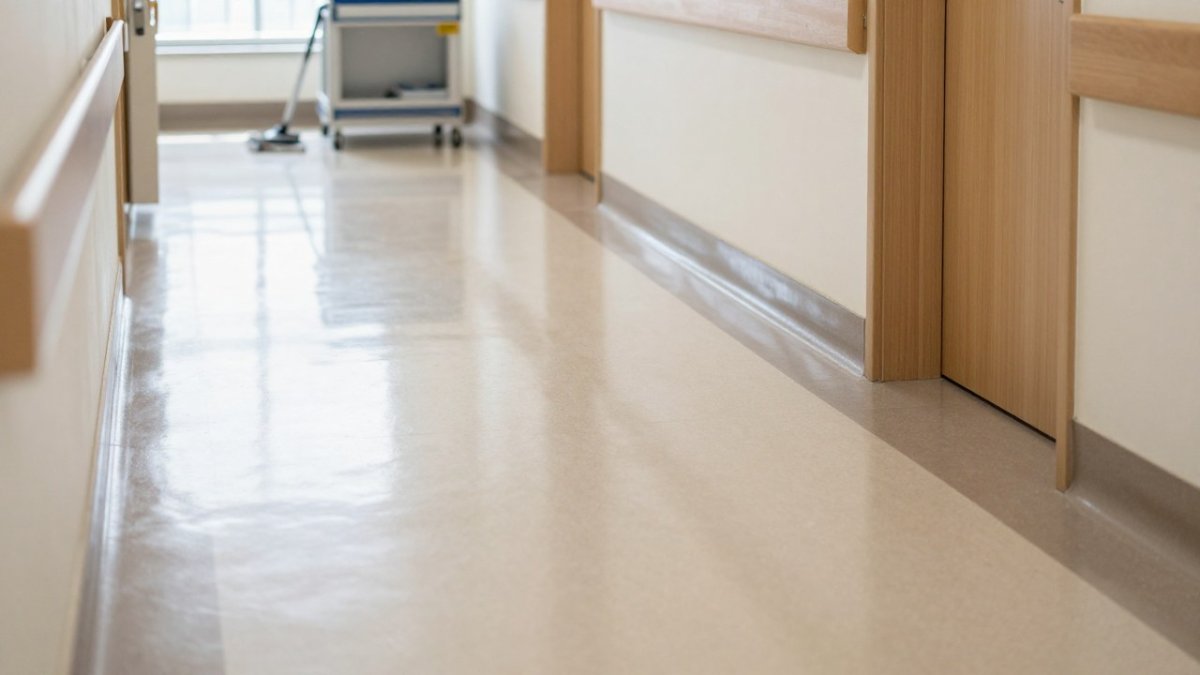
Published work on antimicrobial coatings in operating rooms ties the value of these systems to maintaining sterility and reducing infection risk, which is exactly the argument for a seamless, non-porous surface. Where it fits poorly: storage rooms, administrative offices, and mechanical spaces. You would pay a premium for a property those rooms do not need.
Epoxy Flooring Advantages and Disadvantages for Healthcare Facilities
The epoxy flooring advantages and disadvantages break down along two axes: what the surface physically does, and what the evidence and lifecycle actually support. Competitors tend to stop at the first axis. The second is where specification decisions get made.
Advantages:
- Seamless surface with no grout lines for bacteria to colonize
- Non-porous finish that resists spills, stains, and surface degradation
- Easy to clean with standard hospital disinfectants
- Withstands heavy foot traffic and wheeled equipment
- Chemical resistance to cleaners, disinfectants, and pharmaceuticals
- Available in a range of colors, gloss levels, and slip-resistant finishes
Disadvantages:
- Higher upfront cost than vinyl composition tile or sealed concrete
- Requires full cure time before the space reopens
- Antimicrobial performance fades as the additive at the surface depletes
- No independent clinical evidence that it lowers infection rates
- Moisture-sensitive substrate requirements; slab testing is mandatory
- Repair of a damaged area is a coating job, not a tile swap
Area-by-Area Specification Guidance
Specifying one system for the whole building is a common mistake. A decision matrix can keep the premium where it earns a return:
| Area | Fit | Why |
|---|---|---|
| Operating rooms | Strong | Seamless, non-porous, chemical-resistant; supports sterility protocols |
| Patient rooms | Strong | Cleanable, durable under wheeled traffic |
| Corridors | Strong | Abrasion resistance under heavy foot traffic |
| Laboratories | Strong | Chemical resistance to spills and reagents |
| Pharmacies | Strong | Non-porous, cleanable, chemical-resistant |
| Wet areas and decontamination | Conditional | Requires slip-resistant finish and proper slope; verify coefficient of friction |
| Storage, admin, mechanical | Poor | Premium property those rooms do not need; VCT or sealed concrete is more cost-effective |
Total Cost of Ownership Versus Alternatives
Upfront price is the least useful number in a flooring decision. Epoxy pricing depends on area size, surface condition, and project scope, so lifecycle cost should be evaluated against a specific quote from Concrete-Enhancements. The trade-off is downtime: epoxy requires a cure window that tile does not, and that window has a real operational cost in a facility that cannot close a wing.
Compare systems on several factors, not one, including installed cost, maintenance labor, service life, and operational downtime.
The Limits of the Evidence
This is the part most guides skip. The CDC guidance on chemical disinfectants is unambiguous that routine cleaning and disinfection remain the foundation of infection control. No antimicrobial coating replaces that, and no reputable manufacturer claims it does.
The market is growing, which explains the noise. Coherent Market Insights forecasts a 15.0% CAGR for antimicrobial coatings and a market size of USD 16.5 billion in 2026, per its antimicrobial coatings market forecast. That is a global figure for all antimicrobial coatings, not proof that your operating room floor will perform.
What most guides miss: the additive is a supplement to your cleaning protocol, never a substitute. Treat any vendor who implies otherwise as a warning sign.
Epoxy Flooring Hygiene and Maintenance: What Staff Should Expect
Epoxy flooring hygiene and maintenance is simpler than tile, but it is not maintenance-free. Staff should expect regular damp mopping with a pH-neutral cleaner and prompt spill response.
| Task | Frequency | What to Watch |
|---|---|---|
| Damp mop with neutral cleaner | Daily | Buildup dulls the finish |
| Disinfect high-touch floor zones | Per protocol | Match product to coating chemistry |
| Deep scrub | Monthly | Removes film from disinfectant residue |
| Inspect seams and edges | Quarterly | Early wear signals re-coat timing |
Our guidance on maintenance tips for epoxy floors covers stain removal and preventative care in more detail for staff training.
Healthcare Flooring Installation and Downtime Planning
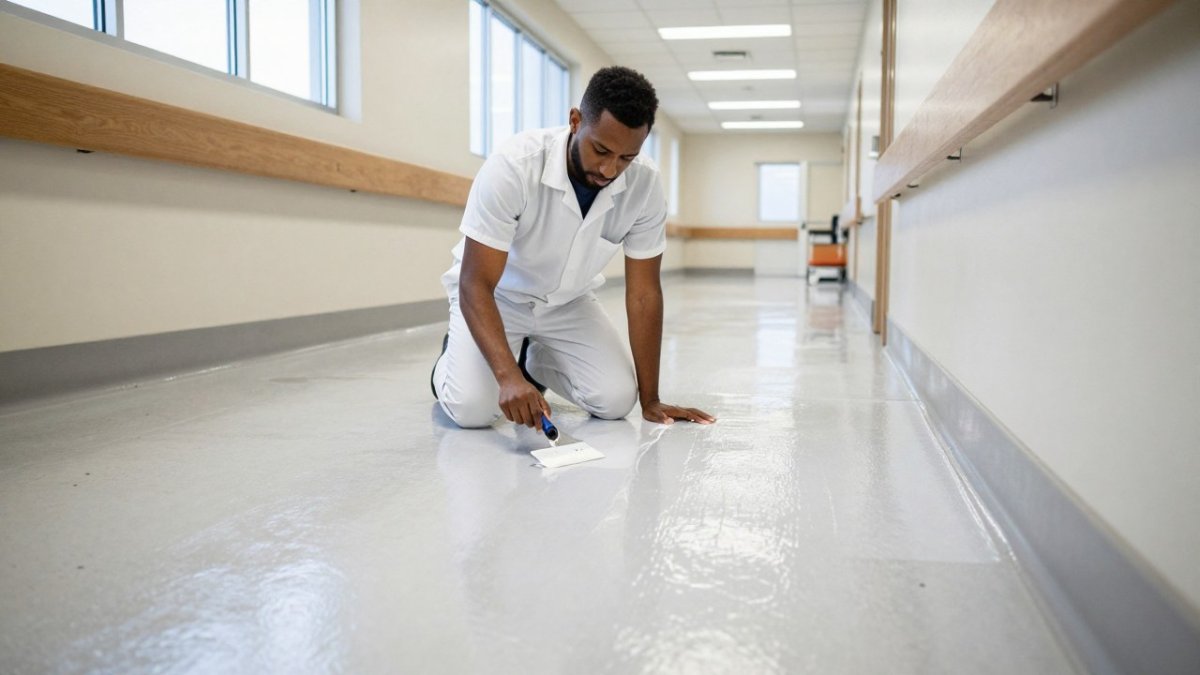
Healthcare flooring installation and downtime planning decides whether the project succeeds as much as the product does. Because cure time and access constraints shape the installation plan, comparing hygienic flooring options can help teams choose a surface that fits both clinical needs and operational schedules.
Sequence it right and you can phase work area by area. Sequence it wrong and you shut down a wing for a week. You can see how we stage the work in our concrete overlay installation process, which matters when a clinic cannot afford a dark day.
Watch out: applying epoxy over a slab with moisture issues traps vapor and causes bubbling within months. Test the slab first.
Durability, Chemical Resistance, and Long-Term Performance
Durability and chemical resistance are where epoxy earns its keep. A properly installed epoxy system can handle foot traffic and routine cleaning in many settings. But durability of the coating and durability of the antimicrobial claim are two different questions, and most guides conflate them.
How Antimicrobial Efficacy Changes Over Time
The antimicrobial agent, typically silver-ion or a similar additive, is dispersed through the resin and acts at the surface. As the floor wears, the top layer abrades and the agent at the surface depletes. Recoating restores the surface, but whether it restores the antimicrobial property depends on whether the recoat product contains the additive and whether the manufacturer's system is designed for renewal.
A common pattern is that efficacy is highest when the floor is new and declines with abrasion, aggressive scrubbing, and repeated exposure to strong cleaning chemicals. That is not a reason to avoid the product; it is a reason to ask the manufacturer three questions before you buy: what test method supports the antimicrobial claim, how is efficacy measured after wear, and what maintenance or recoating schedule preserves it.
Test Methods and Compliance Considerations
Ask for the specific method and the reported log reduction, and ask whether the test was run on the finished flooring system or on a raw resin sample. The two are not the same.
Beyond antimicrobial claims, healthcare flooring specifications commonly address volatile organic compound content and indoor-air quality, slip resistance (coefficient of friction), and chemical resistance to the facility's actual disinfectant list. A system that passes an antimicrobial lab test but fails the facility's slip-resistance or VOC requirements is not a specification win.
Chemical Resistance in Practice
That resistance is not unlimited. Strong solvents, prolonged chemical pooling, and abrasive scrubbing wear the coating over time. Resistance also varies by resin chemistry: novolac epoxies generally outperform standard epoxies against aggressive chemicals, and polyurethane or polyaspartic topcoats offer different trade-offs in abrasion and UV stability. Our chemical resistant epoxy coatings guide includes resistance charts comparing novolac and polyurethane options, which is worth reading before you specify a system for a lab or pharmacy floor.
Watch out: a resistance chart tells you what a cured coating tolerates in controlled exposure, not what happens when a disinfectant puddles overnight against a seam or a drain collar. Detail work at penetrations and edges is where chemical attack usually starts.
Practical Maintenance and Testing
A workable long-term program has three parts. First, baseline the floor when it is new: record gloss, note the recoat product and its antimicrobial status, and file the manufacturer's test documentation. Second, inspect high-wear zones quarterly for abrasion, bubbling, or seam failure, since early wear is the signal that recoating is due. Third, match cleaning products to the coating chemistry; a disinfectant that is compatible with the resin is part of preserving both the finish and any surface antimicrobial property.
None of this makes antimicrobial epoxy a sterilizer. It makes it a durable, cleanable surface whose performance depends on installation quality, substrate condition, and a maintenance program that treats the coating as an asset with a service life rather than a one-time purchase.
Request a Free Estimate for Your Facility Floor
The benefits of antimicrobial epoxy for healthcare facilities are genuine but specific: a seamless, non-porous, chemical-resistant surface that supports hygiene and sanitation without replacing your cleaning protocol.
Concrete-Enhancements is a CTi Certified Dealer with more than 20 years of experience installing epoxy coatings and decorative overlays. You can review our concrete coating warranty information or check what professional epoxy floor installation costs before you commit.
Get started with Concrete-Enhancements and specify a floor that holds up to your cleaning protocol.
Your facility deserves a floor that supports hygiene instead of fighting it. Concrete-Enhancements brings CTi-certified materials, two decades of installation experience, and a documented warranty to every healthcare project. Call (919) 824-5403 or email craigrfear@gmail.com for a free estimate.
Frequently Asked Questions
Does antimicrobial epoxy flooring kill germs?
It can reduce microbial growth on the surface, but it does not sterilize a room. Laboratory research on experimental antimicrobial resins has shown activity against some microorganisms, but that is not the same as a commercial flooring product. The CDC still recommends routine cleaning and disinfection with chemical disinfectants in healthcare facilities. Treat antimicrobial epoxy as one layer of infection control, not a replacement for cleaning protocols.
What are the advantages and disadvantages of epoxy for a healthcare facility?
Advantages include a seamless, non-porous surface that leaves fewer places for bacteria to collect, resistance to cleaners and disinfectants, and durability under heavy foot traffic and wheeled equipment. Disadvantages include a higher upfront cost than some alternatives, the need for proper surface preparation, and the fact that antimicrobial additives may lose effectiveness over the life of the floor. Installation also requires curing time, which affects scheduling in occupied buildings.
How long does epoxy flooring last in a healthcare facility?
Service life depends on the coating system, prep work, and traffic load. A properly installed epoxy floor in a hospital or clinic can hold up for years under heavy foot traffic and routine chemical cleaning, but high-traffic areas like corridors and operating room entries may need recoating sooner. Antimicrobial additives are not guaranteed to perform at the same level for the entire life of the floor, so plan periodic inspections and budget for maintenance.
How much downtime should we plan for healthcare flooring installation?
Downtime depends on the square footage, the coating system, and cure times. Most epoxy systems need the area closed during application and curing, which can range from one day to several depending on the product and number of coats. Phasing work by zone, scheduling overnight or weekend installs, and confirming cure windows with your contractor before work begins keeps patient areas open and protects the new surface from damage.

Tags: antimicrobial epoxy, benefits of antimicrobial epoxy for healthcare facilities, antimicrobial epoxy flooring for hospitals, epoxy flooring advantages and disadvantages
Frequently Asked Questions
It can reduce microbial growth on the surface, but it does not sterilize a room. Laboratory research on experimental antimicrobial resins has shown activity against some microorganisms, but that is not the same as a commercial flooring product. The CDC still recommends routine cleaning and disinfection with chemical disinfectants in healthcare facilities. Treat antimicrobial epoxy as one layer of infection control, not a replacement for cleaning protocols.
Advantages include a seamless, non-porous surface that leaves fewer places for bacteria to collect, resistance to cleaners and disinfectants, and durability under heavy foot traffic and wheeled equipment. Disadvantages include a higher upfront cost than some alternatives, the need for proper surface preparation, and the fact that antimicrobial additives may lose effectiveness over the life of the floor. Installation also requires curing time, which affects scheduling in occupied buildings.
Service life depends on the coating system, prep work, and traffic load. A properly installed epoxy floor in a hospital or clinic can hold up for years under heavy foot traffic and routine chemical cleaning, but high-traffic areas like corridors and operating room entries may need recoating sooner. Antimicrobial additives are not guaranteed to perform at the same level for the entire life of the floor, so plan periodic inspections and budget for maintenance.
Downtime depends on the square footage, the coating system, and cure times. Most epoxy systems need the area closed during application and curing, which can range from one day to several depending on the product and number of coats. Phasing work by zone, scheduling overnight or weekend installs, and confirming cure windows with your contractor before work begins keeps patient areas open and protects the new surface from damage.