listicle
7 Best Concrete Sealers for High Traffic Retail Stores
Last Updated: November 4, 2026
Quick Summary
The best concrete sealers for high traffic retail stores balance abrasion resistance, slip safety, and return-to-service time, with epoxy and urethane systems in high-traffic indoor areas lasting seven to ten years or more. We weight abrasion resistance highest for receiving zones and appearance retention highest for customer-facing sales floors, since the failure modes differ.
- Acrylic sealers held 27.83% of the concrete sealer market by chemistry in 2026, per Mordor Intelligence data.
- Foundation Armor AR350 is best for retail environments that want a decorative, wet-look aesthetic.
- Ghostshield Siloxa-Tek 8500 is the best penetrating concrete sealer for entryways and exterior concrete.
- Match the finish to the zone, not the whole store, and test slip resistance before full application.
- A lower-priced sealer that needs recoating every few years can cost more over a decade.
Table of Contents
- Quick Comparison: Best Concrete Sealers for High Traffic Retail Stores
- How We Evaluated These Commercial Concrete Floor Sealers
- 1. Foundation Armor AR350: Best Overall Wet-Look Acrylic
- 2. Ghostshield Siloxa-Tek 8500: The Best Penetrating Concrete Sealer for Entryways
- 3. Bone Dry Concrete Sealer: Moisture Control Before New Flooring
- 4. Super Seal-M Water Repellent: Stain Defense for Spill-Prone Sales Floors
- 5. PROSOCO Consolideck LS: Densifier for Warehouse-Style Retail
- Choosing a Slip-Resistant Concrete Floor Sealer for Customer Safety
- Frequently Asked Questions
Quick Comparison: Best Concrete Sealers for High Traffic Retail Stores
The best concrete sealers for high traffic retail stores balance abrasion resistance, slip safety, and return-to-service time. North America's concrete sealer market is growing at a 14.4% CAGR through 2033, according to LinkedIn Pulse market analysis, and retail floors are a major driver. At Concrete-Enhancements, we specify commercial concrete floor sealer systems for showrooms and sales floors where downtime costs money.
Here is a shortlist of commonly considered options for retail floors:
| Product | Type | Best For | Standout Trait |
|---|---|---|---|
| Foundation Armor AR350 | Acrylic (solvent) | Best overall wet-look finish | Breathable, UV-stable film |
| Ghostshield Siloxa-Tek 8500 | Penetrating silane/siloxane | Entryways | Invisible, no peeling |
| Bone Dry Concrete Sealer | Penetrating waterproof | Pre-flooring moisture control | Permanent chemical bond |
| Super Seal-M | Water repellent | Spill-prone sales floors | Stain defense |
| PROSOCO Consolideck LS | Lithium densifier | Warehouse-style retail | Dust-proofing, abrasion resistance |
Below, we break down each pick, what it costs in maintenance terms, and where it falls short.
How We Evaluated These Commercial Concrete Floor Sealers
We scored each commercial concrete floor sealer on five criteria: abrasion and wear resistance, chemical and stain resistance, slip resistance, cure and return-to-service time, and compatibility with existing slabs. Durability carried the most weight. Concrete Sealer Review's 2026 durability benchmarks show epoxy and urethane systems in high-traffic indoor areas lasting seven to ten years or more, so we weighted service life heavily.
What separates a retail evaluation from a generic high-traffic one is the traffic itself. A shopping cart's polyurethane wheels, a rolling garment rack, and a pallet jack's steel forks abrade concrete in different ways. Pallet jacks concentrate load on small contact points and can gouge soft or undercured films; carts and racks produce broad, repeated scuffing that polishes gloss off main aisles first. We weighted abrasion resistance highest for receiving and back-of-house zones and appearance retention highest for customer-facing sales floors, because the failure modes differ.
Penetrating sealers generally tolerate a wider range of cleaners without film damage; acrylic films can haze or wear under aggressive stripping. A common pattern is to confirm the store's actual cleaning chemical list against the sealer manufacturer's resistance guidance before specifying.
Solvent-based acrylics require ventilation and a longer cure before foot traffic; water-based and penetrating products often allow faster reopening. We noted where a product supports staged application without visible lap lines between phases.
A lower-priced sealer that needs recoating every few years can cost more over a decade than a densifier or penetrating system with a longer service interval. We also weighed compatibility with existing sealers, polished concrete, stains, and moisture conditions, since adhesion failure is the most expensive outcome, it forces removal and reinstallation, not just a recoat.
If you would rather have a crew handle surface prep and application, professional commercial floor coatings remove the guesswork on adhesion and coat thickness.
1. Foundation Armor AR350: Best Overall Wet-Look Acrylic
Acrylic sealers held 27.83% of the concrete sealer market by chemistry in 2026, per Mordor Intelligence's market data, and AR350 shows why. The breathable film lets moisture vapor escape, resists UV yellowing, and applies easily by sprayer or roller.
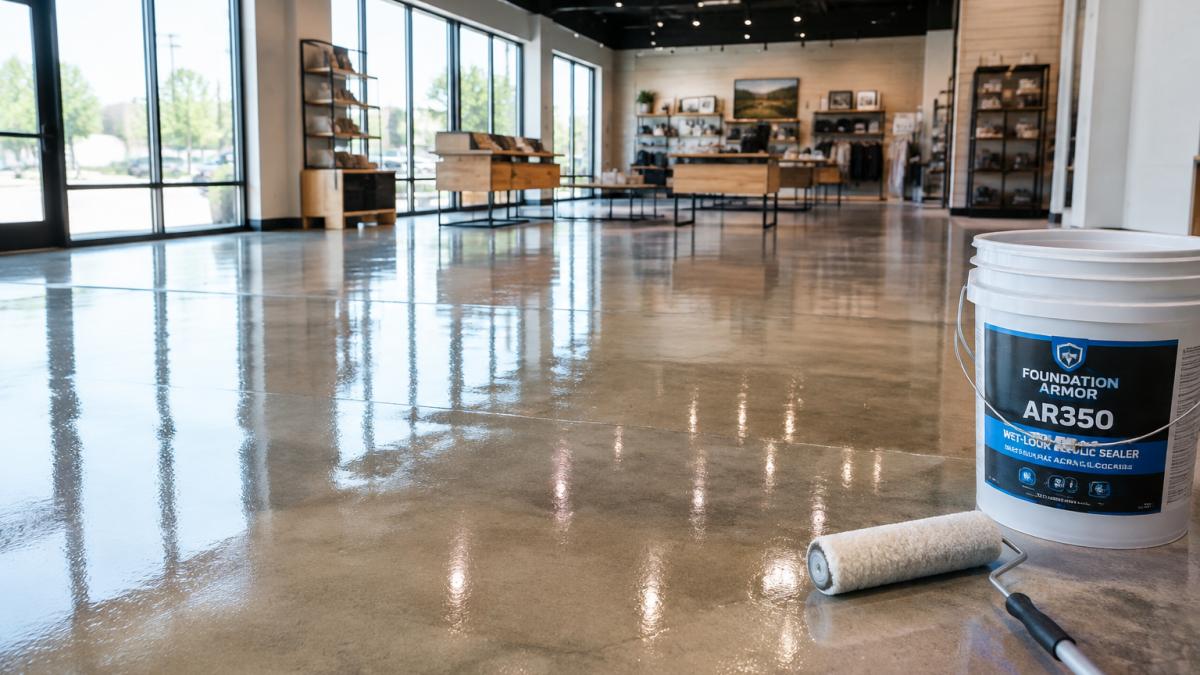
Best for: Retail environments that want a decorative, wet-look aesthetic. Skip if: You need an invisible finish that preserves the raw concrete look.
2. Ghostshield Siloxa-Tek 8500: The Best Penetrating Concrete Sealer for Entryways
Best for: Entryways and exterior concrete prone to moisture damage. Skip if: You want a satin or gloss finish for visual appeal.
3. Bone Dry Concrete Sealer: Moisture Control Before New Flooring
Best for: Stores preparing concrete for finished flooring. Skip if: You need a visible protective coating.
Call (919) 824-5403 or email craigrfear@gmail.com for a free estimate →
4. Super Seal-M Water Repellent: Stain Defense for Spill-Prone Sales Floors
Best for: High-traffic retail floors requiring stain resistance. Skip if: You want a set-and-forget permanent system.
5. PROSOCO Consolideck LS: Densifier for Warehouse-Style Retail
Best for: Warehouse-style stores with heavy foot traffic. Skip if: You need a quick decorative topcoat.
Choosing a Slip-Resistant Concrete Floor Sealer for Customer Safety
Slip resistance is the factor most sealer guides skip, and it is the one that can shut a store down. A gloss or wet-look finish can become slick when wet, so specify a slip-resistant concrete floor sealer and test it before full application. Retail floors face a specific mix of hazards, tracked-in rain and snow at entrances, beverage and produce spills in grocery and convenience formats, fryer and mop-water films in food service areas, and cart or pallet-jack traffic that polishes smooth spots over time, and each calls for a different traction strategy.
Match the finish to the zone, not the whole store. A single sheen across an entire sales floor is a common mistake. Entrances and vestibules see the most wet traffic and benefit from a matte or low-sheen penetrating sealer, or a film-forming coating with a traction additive. General sales floors can carry a satin or wet-look film if the surface profile is adequate. Food preparation, sampling, and beverage areas should default to the highest practical traction, even at the cost of gloss. Back-of-house and receiving areas where pallet jacks and rolling racks operate need abrasion resistance first and appearance second.
Traction additives and texture. Manufacturers offer silica, polymer, or aluminum-oxide traction additives that can be mixed into a topcoat or broadcast between coats. The trade-off is real: heavier texture improves wet traction but traps soil, complicates daily mopping, and can dull the finish. Some penetrating sealers leave the concrete's original profile intact, which often provides better natural traction than a smooth film, one reason entryways frequently use penetrating silane/siloxane products rather than acrylic films.
Test before you commit. The most reliable approach is a slip test on a cured sample or a small mock-up area under both dry and wet conditions. The American Society of Concrete Contractors' application guidance stresses proper surface prep, including removing at least 75% of release agents on stamped concrete before sealing, because poor adhesion creates uneven film thickness and unpredictable traction.
Accessibility and cleaning interactions. Slip resistance and accessibility pull in the same direction more often than store operators expect. Excessively rough textures can be difficult for wheelchairs, carts, and strollers, and they resist routine cleaning, which lets soil and spills accumulate and actually increases slip risk over time. The practical balance is a moderate profile that passes wet testing, cleans easily with the store's standard equipment, and stays consistent as the coating wears. Re-test traction after any recoat or deep cleaning, because aggressive stripping or high-pH cleaners can change the surface.
Once the floor is sealed, commercial polished concrete floor maintenance keeps it safe and clean. If your slab is worn or failing, concrete restoration for retail spaces addresses ADA compliance before sealing. Weighing epoxy as an alternative? See our epoxy flooring guide for retail spaces.
Frequently Asked Questions
What type of concrete sealer is best for high traffic areas?
Epoxy and urethane coatings are generally considered durable options for indoor retail floors with constant foot traffic. Penetrating formulas suit entryways and exterior walks where an invisible finish matters more than gloss. For product-specific guidance, contact us for a free estimate.
Is a penetrating or topical sealer better for a retail store?
It depends on what the floor has to do. A penetrating sealer soaks into the slab, blocks water and salt, and never peels, which makes it a strong pick for entryways and back-of-house concrete. Topical sealers sit on the surface and add gloss, color depth, and abrasion resistance, which most sales floors want. Many stores combine both: a penetrating base for moisture control, then a topical coat for looks and wear.
How long does concrete sealer take to cure before a store can reopen?
Cure times vary by product, coat count, and temperature, so ask for a schedule tailored to your store when you request a free estimate.
Can a concrete sealer make a retail floor slippery?
Yes, gloss films and wet conditions can raise slip risk, which matters under the Americans with Disabilities Act access rules. Testing a patch before full application is a sensible step for any sealer on a retail floor. Keep spill response supplies nearby regardless of which product you pick.
How often should a retail concrete floor be resealed?
Recoat timing depends on the system used, traffic levels, and cleaning practices. Watch for dulling in entry zones, worn paths near checkout, and water no longer beading as signals that a refresh may be due.
The right sealer protects your floor, your customers, and your maintenance budget. If you would rather skip the trial-and-error, Concrete-Enhancements brings 20+ years of experience and CTi Certified Dealer credentials to every job, with decorative overlays, epoxy coatings, and professional repair done right. Get started with Concrete-Enhancements and get a free estimate: call (919) 824-5403 or email craigrfear@gmail.com.

Tags: concrete sealers, best concrete sealers for high traffic retail stores, commercial concrete floor sealer, best penetrating concrete sealer, concrete sealer cure time
Frequently Asked Questions
Epoxy and urethane coatings are generally considered durable options for indoor retail floors with constant foot traffic. Penetrating formulas suit entryways and exterior walks where an invisible finish matters more than gloss. For product-specific guidance, contact us for a free estimate.
It depends on what the floor has to do. A penetrating sealer soaks into the slab, blocks water and salt, and never peels, which makes it a strong pick for entryways and back-of-house concrete. Topical sealers sit on the surface and add gloss, color depth, and abrasion resistance, which most sales floors want. Many stores combine both: a penetrating base for moisture control, then a topical coat for looks and wear.
Cure times vary by product, coat count, and temperature, so ask for a schedule tailored to your store when you request a free estimate.
Yes, gloss films and wet conditions can raise slip risk, which matters under the Americans with Disabilities Act access rules. Testing a patch before full application is a sensible step for any sealer on a retail floor. Keep spill response supplies nearby regardless of which product you pick.
Recoat timing depends on the system used, traffic levels, and cleaning practices. Watch for dulling in entry zones, worn paths near checkout, and water no longer beading as signals that a refresh may be due.