comparison
Polyaspartic vs Epoxy Durability: A 2026 Comparison
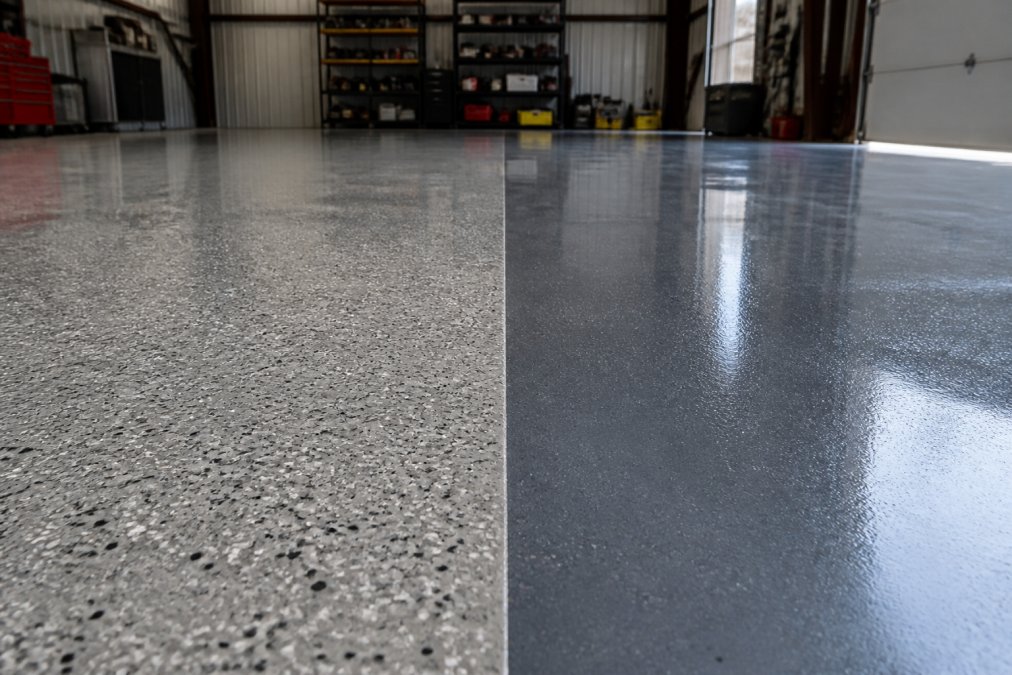
Table of Contents
- Polyaspartic vs Epoxy Durability: Key Differences at a Glance
- How Each Coating Handles Real-World Wear
- Polyaspartic Cure Time and What It Means for Your Project
- Polyaspartic Floor Coating Pros and Cons
- Cost Difference Between Epoxy and Polyaspartic
- Which Coating Lasts Longer in Practice?
- Frequently Asked Questions
Last Updated: September 13, 2026
Polyaspartic vs Epoxy Durability: Key Differences at a Glance
The polyaspartic vs epoxy durability comparison comes down to one structural fact: epoxy bonds harder, polyaspartic flexes and resists UV light. Epoxy is a rigid thermoset that grips concrete tenaciously but yellows in sunlight and turns brittle as it ages. Polyaspartic is a polyurea-based coating that stays flexible, cures in hours instead of days, and holds its color outdoors.
At Concrete-Enhancements, we've installed and repaired both systems across the Raleigh-Durham Triangle and NC Triad for more than 20 years, and the failure patterns are consistent. Epoxy fails from the top down: chalking, ambering, hot tire pickup. Polyaspartic fails from the bottom up, and almost always because of moisture or poor surface prep underneath it.
That distinction matters more than any single spec sheet. Here's how the two compare on the factors that actually determine lifespan:
| Factor | Epoxy | Polyaspartic |
|---|---|---|
| UV stability | Yellows and ambers in sun | Color-stable |
| Cure time | 12-24 hours between coats | Returns to service in hours |
| Flexibility | Rigid, can crack with movement | Flexes with slab movement |
| Hot tire resistance | Moderate | High |
| Moisture tolerance | Sensitive during cure | More forgiving |
| Relative cost | Lower material cost | Higher material cost |
The rest of this comparison explains where each advantage shows up in practice, and where the marketing claims fall apart.
How Each Coating Handles Real-World Wear
Real-world wear tests a coating in three ways: heat and sunlight, physical impact, and moisture. Epoxy and polyaspartic respond to each differently, and the gap widens the longer the floor stays in service.
A common mistake is judging a coating by its first month. Both look identical then. The differences surface in year two and year three, when epoxy has begun to amber under a garage door and polyaspartic hasn't moved.
Hot Tires, Sunlight, and Chemical Spills
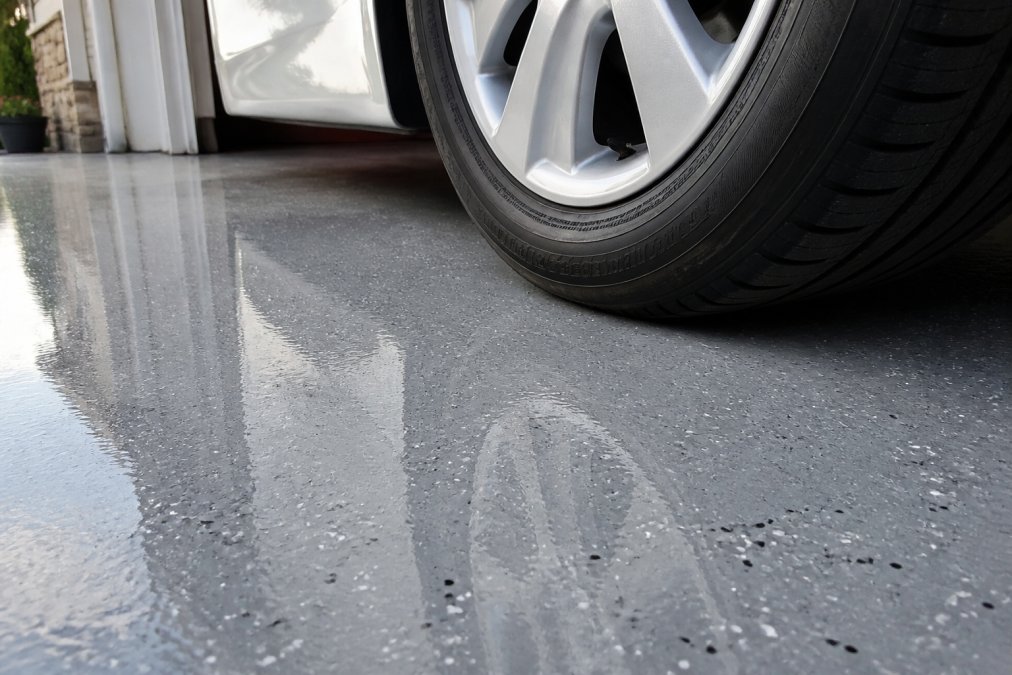
Hot tire pickup is the single most common complaint we hear about epoxy garage floors. A tire that's been running on summer asphalt can soften a rigid epoxy film enough that it lifts and peels when the car pulls away. Polyaspartic's flexibility and higher heat tolerance make it far more resistant to this.
Sunlight is the other differentiator. Standard epoxy contains aromatic amines that oxidize and yellow when exposed to UV (PubMed). A garage floor that gets afternoon sun through an open door will show it. Polyaspartic is UV-stable by formulation, which is why it's the default choice for pool decks and any slab that sees direct sun.
Chemical resistance is closer than most people expect. Both handle typical garage spills like oil, antifreeze, and road salt. For concentrated solvents or industrial chemicals, a hybrid system with an epoxy base and polyaspartic topcoat often outperforms either coating alone.
Impact, Abrasion, and Moisture
Drop a wrench on a fully cured epoxy floor and you may get a chip with a sharp edge. Drop it on polyaspartic and the film tends to absorb the impact and recover. That flexibility is why polyaspartic holds up better in shops where tools get dropped and equipment gets dragged.
Moisture is where epoxy gets a bad reputation it partly deserves. Concrete slabs wick water vapor from below. If that vapor rises through a curing epoxy film, it causes bubbles, blisters, and eventually delamination. Polyaspartic cures fast enough that it's less vulnerable to this window, but it is not immune. No coating fixes a slab with active moisture problems, and a contractor who skips a moisture test is setting you up for a callback.
Polyaspartic Cure Time and What It Means for Your Project
Polyaspartic cure time is measured in hours, not days, and that changes the entire project timeline. A typical polyaspartic system allows a return to foot traffic in a few hours and vehicle traffic the next day. Epoxy usually needs overnight curing between coats and several days before it can take vehicle weight (PubMed).
That speed is the reason polyaspartic dominates commercial work where downtime costs money. A warehouse aisle or retail showroom that can't close for three days is a different business problem than a homeowner's garage that can sit empty for a week.
Fast cure also has a downside. Polyaspartic leaves the installer a short working window. Once it's mixed, you have minutes to spread it, and a crew that isn't experienced with the material will leave lap marks and uneven texture. The material forgives a lot, but not a slow hand.
For a residential project, the practical difference is convenience. For a commercial facility, it's revenue. That's the honest way to weigh it.
Call (919) 824-5403 or email craigrfear@gmail.com for a free estimate →
Polyaspartic Floor Coating Pros and Cons
Polyaspartic floor coating pros and cons usually get reduced to "it costs more but lasts longer." That's true but incomplete. The real trade-offs are about installation conditions and appearance over time.
Pros:
- UV-stable, so it won't yellow on sun-exposed slabs
- Flexible enough to resist cracking from minor slab movement
- Fast cure means minimal downtime
- Strong resistance to hot tire pickup and abrasion
- Holds gloss and color longer than standard epoxy
Cons:
- Higher material cost, and premium systems cost more per square foot
- Short working time demands an experienced installer
- Less forgiving of a poorly prepped or damp substrate
- Can look "plastic" if over-applied without a proper base coat
Cost Difference Between Epoxy and Polyaspartic
The cost difference between epoxy and polyaspartic is real, and it's the main reason homeowners hesitate. Epoxy materials cost less per square foot. Polyaspartic costs more, and a full polyaspartic system can run meaningfully higher than a basic epoxy job.
But comparing sticker price alone is misleading. A cheap epoxy floor that yellows and peels in two years costs more over a decade than a polyaspartic floor that's still intact. For a commercial facility, the downtime saved during installation often outweighs the material premium entirely.
Pricing for any specific project depends on square footage, slab condition, moisture readings, and the system spec, so we quote each job individually rather than publishing a flat rate. That's not evasiveness; a 400-square-foot garage and a 20,000-square-foot warehouse have almost nothing in common beyond the word "floor." You can request a free estimate from Concrete-Enhancements for a number that reflects your actual slab.
Which Coating Lasts Longer in Practice?
Polyaspartic lasts longer than epoxy in most real-world conditions, particularly where UV exposure, hot tires, or temperature swings are involved. Epoxy can still be the right call for interior slabs with no sunlight, light traffic, and a tight budget.
The honest answer depends on four variables:
- Sun exposure: Polyaspartic wins outright. Epoxy will amber.
- Traffic type: Polyaspartic handles hot tires and dropped tools better.
- Moisture: Neither coating fixes a wet slab. Prep and testing decide the outcome.
- Budget and timeline: Epoxy costs less; polyaspartic installs faster.
The thing nobody tells you about durability claims is that installation quality matters more than the product name on the bucket. We've seen a well-prepped epoxy floor outlast a poorly installed polyaspartic floor, and vice versa. Diamond grinding, crack repair, and moisture testing are what separate a floor that lasts 15 years from one that fails in 18 months.
If you're weighing a polyaspartic vs epoxy durability comparison for a garage, pool deck, or commercial space, the material choice is only half the decision. The crew applying it is the other half.
Choosing between polyaspartic and epoxy is really a question about your slab, your sunlight exposure, and how much downtime you can afford. Concrete-Enhancements has spent over 20 years installing decorative overlays, epoxy floor coatings, and professional repair systems, and as a CTi Certified Dealer we test every slab for moisture before we quote a single square foot. Our team handles diamond grinding, crack repair, and hybrid epoxy-polyaspartic systems built for garages, pool decks, warehouses, and high-traffic commercial floors. Get started with Concrete-Enhancements and get a free estimate built around your actual concrete, not a generic price sheet. Call (919) 824-5403 or email craigrfear@gmail.com.
Frequently Asked Questions
Is polyaspartic stronger than epoxy?
Polyaspartic coatings typically outperform standard epoxy in flexibility and UV resistance, which helps them resist cracking and yellowing over time. Epoxy forms a harder, more rigid bond and can be more prone to chipping under impact. For high-traffic areas exposed to sunlight or temperature swings, polyaspartic generally holds up better. However, a hybrid system using an epoxy base with a polyaspartic top coat often delivers the best of both materials.
How long does a polyaspartic floor last compared to epoxy?
Polyaspartic floor coatings often last longer than standard epoxy. Surface preparation and proper application are the biggest factors in either case, which is why professional installation matters.
Does polyaspartic yellow in sunlight?
Polyaspartic coatings are formulated with UV-stable chemistry that resists yellowing and fading, unlike standard epoxy which can amber when exposed to direct sunlight. This makes polyaspartic a better choice for garage aprons, pool decks, patios, and any surface that gets consistent sun exposure. If your concrete gets full sun for most of the day, polyaspartic will hold its color far longer than a basic epoxy top coat.
Can you apply polyaspartic over existing epoxy?
Yes, polyaspartic can be applied over existing epoxy if the surface is properly prepared. The old epoxy must be clean, dry, and free of peeling or delamination. A professional installer will typically grind or sand the surface to create a mechanical bond before applying the polyaspartic top coat. This approach is common for refreshing a worn epoxy floor without a full tear-out, but it only works when the existing epoxy is still firmly bonded to the concrete.
Tags: polyaspartic vs epoxy durability, polyaspartic vs epoxy durability comparison, polyaspartic cure time, polyaspartic floor coating pros and cons, cost difference between epoxy and polyaspartic
Frequently Asked Questions
Polyaspartic coatings typically outperform standard epoxy in flexibility and UV resistance, which helps them resist cracking and yellowing over time. Epoxy forms a harder, more rigid bond and can be more prone to chipping under impact. For high-traffic areas exposed to sunlight or temperature swings, polyaspartic generally holds up better. However, a hybrid system using an epoxy base with a polyaspartic top coat often delivers the best of both materials.
Polyaspartic floor coatings often last longer than standard epoxy. Surface preparation and proper application are the biggest factors in either case, which is why professional installation matters.
Polyaspartic coatings are formulated with UV-stable chemistry that resists yellowing and fading, unlike standard epoxy which can amber when exposed to direct sunlight. This makes polyaspartic a better choice for garage aprons, pool decks, patios, and any surface that gets consistent sun exposure. If your concrete gets full sun for most of the day, polyaspartic will hold its color far longer than a basic epoxy top coat.
Yes, polyaspartic can be applied over existing epoxy if the surface is properly prepared. The old epoxy must be clean, dry, and free of peeling or delamination. A professional installer will typically grind or sand the surface to create a mechanical bond before applying the polyaspartic top coat. This approach is common for refreshing a worn epoxy floor without a full tear-out, but it only works when the existing epoxy is still firmly bonded to the concrete.