ultimate-guide
Common Causes of Concrete Structural Failure
Last Updated: November 9, 2026
Quick Summary
Concrete structural failure is the loss of a structure's ability to safely carry its intended loads, and it almost never traces back to a single cause. Insufficient durability of materials and construction elements is the dominant driver, with water ingress and steel corrosion quietly shrinking the load-carrying section.
- Most workmanship defects trace to shortcuts taken before the concrete truck ever arrives.
- Plastic shrinkage cracking appears within hours of a pour when surface moisture evaporates too fast.
- Freeze-thaw cycling is the dominant weathering mechanism in cold climates, expanding water roughly 9 percent.
- Crack width is the fastest severity filter: hairline cracks under about 0.01 inch are usually cosmetic.
- Call a structural engineer when you see displacement, not just cracking.
Table of Contents
- How Concrete Structural Failure Actually Happens
- Defects in Concrete Due to Poor Workmanship
- Concrete Defects After Pouring: Curing, Shrinkage, and Early-Age Problems
- Reinforced Concrete Failure Mechanisms: Corrosion, Spalling, and Loss of Section
- Concrete Deterioration Causes and Prevention
- A Cause-to-Symptom Diagnostic Framework for Concrete Structural Failure
- When to Call a Structural Engineer or Evacuate
- Getting a Professional Assessment Before Small Defects Become Structural Failure
- Frequently Asked Questions
How Concrete Structural Failure Actually Happens
Concrete structural failure is the loss of a structure's ability to safely carry its intended loads, and it almost never traces back to a single cause. Research from a peer-reviewed assessment of degradation factors in concrete structures identifies insufficient durability of materials and construction elements as the dominant driver of deterioration. At Concrete-Enhancements, we have spent more than 20 years watching small defects turn into expensive problems, and the pattern is consistent: water gets in, steel corrodes, and the section that carries load quietly shrinks.
The useful mental model is a chain, not a list. A defect appears, exposure accelerates it, and load redistribution finishes the job. Break any link early and the structure survives.
Defects in Concrete Due to Poor Workmanship
Most workmanship defects trace to shortcuts taken before the truck ever arrives. Improper consolidation leaves honeycombing and voids. Misplaced reinforcement bars sit too shallow or too deep, so the steel cannot do its job. Cold joints form when a second pour meets concrete that has already set, creating a plane that never bonds.
A common mistake is judging a slab by its surface. A smooth finish tells you nothing about whether the mix was placed correctly underneath. In practice, the defects that matter most are the ones you cannot see: voids under rebar, segregation from over-vibration, and formwork that shifted during the pour.
Concrete Defects After Pouring: Curing, Shrinkage, and Early-Age Problems
Early-age defects are where timelines matter most. Concrete gains strength through curing, and skipping or rushing that step leaves the surface weak and permeable. Plastic shrinkage cracking appears within hours of a pour when surface moisture evaporates faster than bleed water rises. Drying shrinkage follows over months as excess mix water leaves the slab.
Watch out: curing compound sprayed over a wet surface, or a slab left uncovered in wind and sun, produces surface cracks that later become water ingress paths. If you are already dealing with a cracked slab, our guide on how to fix a cracked concrete slab foundation walks through severity assessment and repair options.
Reinforced Concrete Failure Mechanisms: Corrosion, Spalling, and Loss of Section
Reinforcement bars fail in a predictable sequence. Chlorides or carbonation reach the steel, bar corrosion begins, and the expanding rust pushes the cover concrete outward. That pressure produces delamination and eventually spalling, where chunks of cover break away and expose the rebar directly.
The structural consequence is loss of section. Every bar that corrodes loses load-bearing capacity, and the beam or slab must redistribute stress to what remains. Spalling on a driveway often signals the same mechanism at work in a parking structure. Our breakdown of what causes concrete spalling on driveways covers the exposure side in more detail.
Concrete Deterioration Causes and Prevention
Deterioration is the slow loss of material integrity and load capacity before a structure ever reaches its design life. Most practitioners group the drivers into four interacting families: material quality, design detailing, construction practice, and environment. The mistake is treating them as isolated, in real structures they compound, which is why a single repair rarely fixes a deteriorating slab.
Material quality. A high water-cement ratio is the most common material defect. Extra water buys workability but raises permeability, and permeability is the doorway every other deterioration mechanism walks through. Poor aggregate grading, dirty aggregates, and inadequate cement content weaken the matrix further.
Design detailing. Inadequate cover over reinforcement, expansion joints spaced too far apart, missing control joints, and insufficient drainage slope all pre-load a structure for failure. Cover is the single most consequential detail: thin cover shortens the time for carbonation or chlorides to reach the steel from decades to a few years.
Construction practice. Improper consolidation, cold joints, misplaced rebar, and rushed curing each create a defect that exposure later exploits. Because early workmanship defects can be difficult to distinguish from later deterioration, Construction Services can help frame what to watch for before exposure turns a small flaw into a structural concern.
Environmental exposure. Freeze-thaw cycling is the dominant weathering mechanism in cold climates. Water saturates the pore structure, freezes, expands roughly 9 percent, and cracks the matrix from the inside; repeated cycles produce scaling and surface loss. Air entrainment, deliberately introduced microscopic air voids, gives freezing water room to expand and is the standard defense.
Settlement and loss of support. Soil erosion, inadequate compaction of fill, and poor drainage under a slab remove the support the concrete was designed to bear on. The slab does not fail from load, it fails from losing its bed, which is why settlement cracks often appear alongside displacement rather than as isolated hairline cracks.
Overloading and stress redistribution. Structures designed for one occupancy get used for another: a residential slab carrying commercial equipment, a parking deck carrying heavier vehicles than specified. Overloading rarely causes immediate collapse; it accelerates fatigue and widens existing cracks until the section can no longer redistribute stress.
Prevention is cheaper than repair at every stage. Control joint spacing, proper air entrainment in cold climates, adequate cover over reinforcement, positive drainage away from the slab, and verified mix design all extend service life. When a slab is already deteriorated, alternatives to concrete slab replacement can restore serviceability without a full tear-out.
| Deterioration Cause | Mechanism | Typical Symptom | Prevention Lever |
|---|---|---|---|
| High water-cement ratio | Permeability opens path to steel | Surface dusting, map cracking | Stricter mix design, lower w/c |
| Shallow rebar cover | Carbonation/chlorides reach steel early | Rust staining, spalling | Verify cover before pour |
| Poor drainage | Water ponds, soil erodes under slab | Settlement, efflorescence | Grade away from slab |
| Missing control joints | Restrained shrinkage concentrates stress | Random cracking | Planned joint layout |
| Freeze-thaw exposure | Water expands in pores, cracks matrix | Scaling, surface loss | Air entrainment, sealers |
| Chloride/sulfate attack | Corrosion and paste softening | Delamination, discoloration | Low-permeability mix, membranes |
| Overloading | Fatigue and stress redistribution | Widening cracks, deflection | Verify design loads before reuse |
A Cause-to-Symptom Diagnostic Framework for Concrete Structural Failure
Diagnosis starts with the symptom, not the cause. Use this framework to narrow the possibilities, assign a severity tier, and decide whether the next step is monitoring, repair, or urgent assessment.
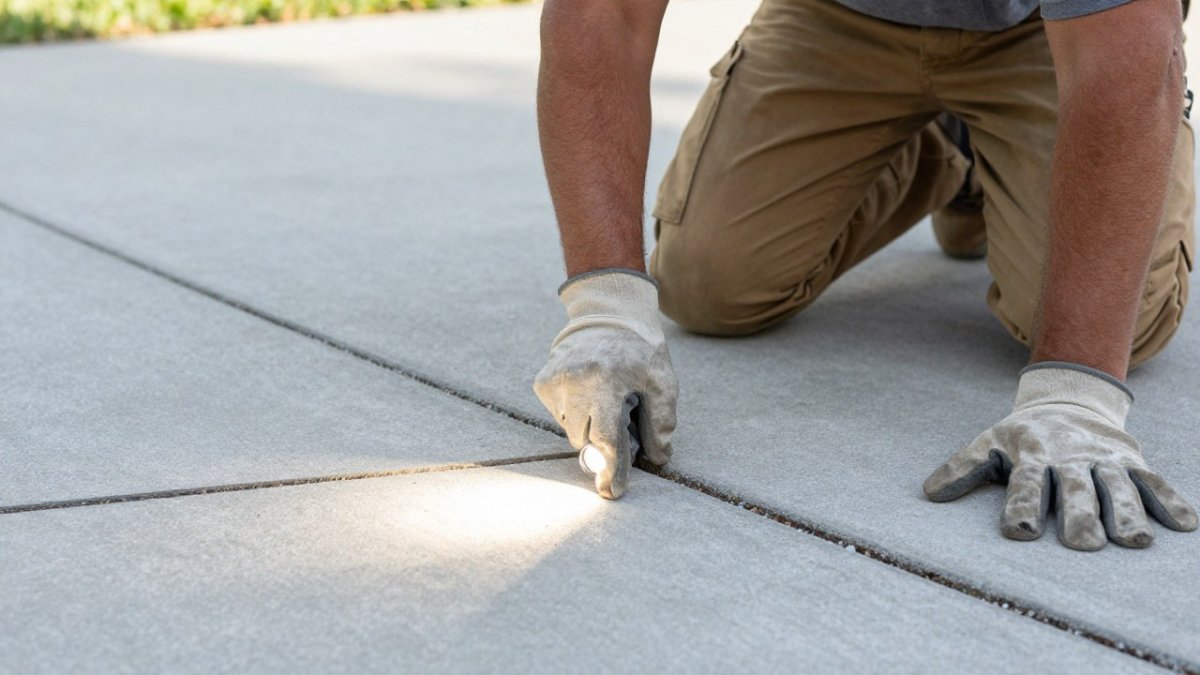
Step 1, Classify the symptom. Map the crack pattern before anything else. Vertical cracks in a wall suggest settlement or lateral pressure. Diagonal cracks at openings point to differential movement. Map cracking across a surface suggests shrinkage or freeze-thaw.
Step 2, Measure width and movement. Crack width is the fastest severity filter. Hairline cracks under about 0.01 inch are usually cosmetic. Cracks between roughly 0.01 and 0.04 inch warrant monitoring.
Step 3, Check for displacement. Vertical offset across a crack means loss of support, not just cracking. Displacement is the dividing line between a serviceability issue and a structural concern, because it means the load path has already shifted.
Step 4, Look for corrosion staining. Rust bleed on the surface means the reinforcement is already affected. Paired with delamination, it signals loss of section at the steel.
Step 5, Sound the surface. A hollow tone under tapping indicates delamination, cover concrete that has separated from the body of the slab. Delamination on a horizontal surface is a precursor to spalling.
Step 6, Review the history. Original mix, pour date, joint layout, drainage, and any change in use all narrow the cause list.
Assign a severity tier. This is the step most guides skip. A cosmetic defect affects appearance only and can be monitored. A serviceability problem affects function, drainage, ride quality, weather tightness, and needs targeted repair. Structural failure affects load capacity and safety and requires engineering assessment.
Understand failure progression. Deterioration follows a recognizable sequence: a defect appears, exposure accelerates it, reinforcement corrodes and loses section, the load path narrows, and the section fails.
Verification methods. Suspected causes are confirmed, not guessed. Crack monitors track movement over time. Cover meters and ground-penetrating radar locate reinforcement and measure cover depth. Half-cell potential testing maps corrosion activity. Core sampling and petrographic examination identify mix problems and chemical attack.
Interactions matter. Causes rarely act alone. A design detail that leaves cover thin, combined with a construction shortcut in curing, plus a drainage problem that keeps the slab wet, produces corrosion far faster than any one factor would.
When to Call a Structural Engineer or Evacuate
Call a structural engineer when you see displacement, not just cracking. Sagging slabs, tilting walls, widening cracks that move, or deflection you can feel underfoot all warrant an assessment. Evacuate immediately if a section has dropped suddenly, if you hear ongoing cracking or popping, or if a beam or column shows visible spalling with exposed, corroded rebar.
Concrete structural failure rarely announces itself. The San José State University case-study guidance on failure case studies of concrete structures makes the point clearly: multiple factors usually contribute, so attributing a failure to one cause without examining the circumstances leads to the wrong repair.
Getting a Professional Assessment Before Small Defects Become Structural Failure
An assessment is cheaper than a failure. A qualified inspector documents crack widths, checks cover and drainage, sounds for delamination, and separates cosmetic wear from genuine structural concern. That report tells you whether you need monitoring, targeted repair, or a resurfacing system.
If you are ready to bring someone in, our guide on finding concrete contractors in Durham covers what to ask, how to verify licensing, and what to expect from the process. For readers in the Triangle and Triad, the local warning-sign checklist on concrete deterioration in Durham, NC is a useful starting point.
Small defects become structural failures through the same sequence every time: water enters, steel corrodes, and the load path narrows until something gives. Concrete-Enhancements offers decorative overlays, epoxy floor coatings, and professional repair services for residential and commercial properties in the Raleigh-Durham Triangle, NC Triad, and Coastal SC. Contact us for a free estimate to discuss your concrete.
Frequently Asked Questions
What is the most common cause of concrete structural failure?
Insufficient durability of materials and construction elements is the dominant factor, according to research led by JR Krentowski (2021). That covers weak mixes, poor aggregate, and thin reinforcement cover. But the San José State University failure case studies (2022) caution that failures usually involve several interacting factors, not one isolated cause, so a single crack or spall should be read alongside the mix design, workmanship, water exposure, and loading history before anyone assigns blame.
How can poor workmanship lead to concrete structural failure?
Workmanship problems show up as defects in concrete due to poor workmanship: reinforcement placed too close to the surface, honeycombing from inadequate vibration, cold joints between pours, and mix water added on site to make placement easier. Each one weakens the cover that protects reinforcement bars from moisture. Once bar corrosion starts, the steel expands and pushes off the surrounding concrete, which is how a cosmetic surface issue turns into a load-bearing problem over time.
What are the warning signs of a failing concrete structure?
Watch for cracks wider than a hairline that keep growing, spalling where chunks of surface break away, delamination that sounds hollow when tapped, rust staining along crack lines, and slabs that feel uneven or deflect underfoot. Warning signs matter most in combination. A crack near a column plus rust staining plus a hollow sound points to reinforced concrete failure mechanisms at work, and that combination warrants an inspection rather than a patch.
How do cracks differ from serious structural damage?
Hairline shrinkage cracks in a driveway or patio are usually cosmetic and do not affect load-bearing capacity. Structural damage looks different: wide or widening cracks, cracks that follow reinforcement lines, displaced slabs, and spalling that exposes rebar. The distinction matters because repair methods diverge sharply. Cosmetic defects can often be resurfaced, while serviceability and structural problems need assessment and targeted repair before any overlay goes down.

Tags: concrete structural failure, common causes of concrete structural failure, defects in concrete due to poor workmanship, concrete defects after pouring, reinforced concrete failure mechanisms
Frequently Asked Questions
Insufficient durability of materials and construction elements is the dominant factor, according to research led by JR Krentowski (2021). That covers weak mixes, poor aggregate, and thin reinforcement cover. But the San José State University failure case studies (2022) caution that failures usually involve several interacting factors, not one isolated cause, so a single crack or spall should be read alongside the mix design, workmanship, water exposure, and loading history before anyone assigns blame.
Workmanship problems show up as defects in concrete due to poor workmanship: reinforcement placed too close to the surface, honeycombing from inadequate vibration, cold joints between pours, and mix water added on site to make placement easier. Each one weakens the cover that protects reinforcement bars from moisture. Once bar corrosion starts, the steel expands and pushes off the surrounding concrete, which is how a cosmetic surface issue turns into a load-bearing problem over time.
Watch for cracks wider than a hairline that keep growing, spalling where chunks of surface break away, delamination that sounds hollow when tapped, rust staining along crack lines, and slabs that feel uneven or deflect underfoot. Warning signs matter most in combination. A crack near a column plus rust staining plus a hollow sound points to reinforced concrete failure mechanisms at work, and that combination warrants an inspection rather than a patch.
Hairline shrinkage cracks in a driveway or patio are usually cosmetic and do not affect load-bearing capacity. Structural damage looks different: wide or widening cracks, cracks that follow reinforcement lines, displaced slabs, and spalling that exposes rebar. The distinction matters because repair methods diverge sharply. Cosmetic defects can often be resurfaced, while serviceability and structural problems need assessment and targeted repair before any overlay goes down.