blog
Sustainable Concrete Flooring Options for Retail Design
Table of Contents
- Why Sustainable Concrete Flooring Fits Retail Design
- Polished Concrete Floors for Retail Stores
- Stained Concrete Floors for Retail: Design Versatility and Color Options
- Concrete Floor Overlays for Commercial Spaces
- Low-VOC Concrete Floor Coatings and Indoor Air Quality
- Comparing Sustainability: Lifecycle, Embodied Carbon, and Material Content
- Retail-Specific Selection Criteria and Installation Planning
- Frequently Asked Questions
Last Updated: October 20, 2026
Why Sustainable Concrete Flooring Fits Retail Design
Sustainable concrete flooring is a retail floor system that reduces environmental impact across its service life while standing up to heavy foot traffic, cart wheels, and constant cleaning. At Concrete-Enhancements, we have spent more than 20 years resurfacing and restoring concrete across the Raleigh-Durham Triangle, NC Triad, and Coastal SC.
The logic is hard to argue with. An existing concrete slab is already poured, already cured, and already sitting under your fixtures. Polishing, staining, or coating it avoids the demolition waste, the new material hauling, and the downtime that comes with laying vinyl tile or carpet over a sound floor. The U.S. Environmental Protection Agency's guidance on construction and demolition debris notes that building-related debris makes up a substantial share of the national waste stream, and keeping a slab in service is one of the simplest ways a retail project avoids adding to it.
Below, we break down the main sustainable concrete flooring options for retail design, compare how each performs on lifecycle and indoor air quality, and explain how to choose based on your store format.
Polished Concrete Floors for Retail Stores
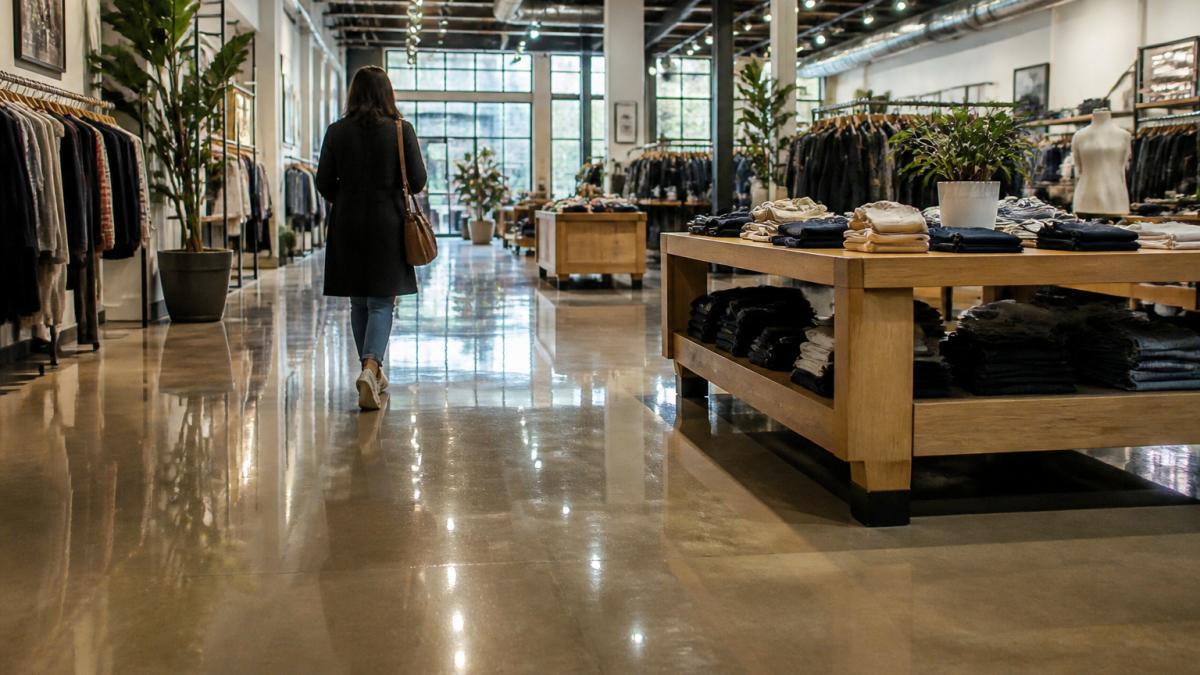
Polished concrete floors for retail stores are the workhorse option: the slab is ground, honed, and polished in place, with no topical film to peel or wear through. Because the finish is mechanical rather than chemical, there is no coating to reapply every few years, which extends service life and cuts long-term maintenance material.
Retailers like the look for good reason. The surface reflects overhead lighting, which makes a showroom feel brighter without adding fixtures, and the industrial aesthetic reads as deliberate rather than unfinished.
A common mistake is assuming polished concrete is sealed against everything. In practice, it needs densifier and a stain guard in food or beverage retail, and it will show etching from acidic spills if left unmanaged. Plan for that up front.
Stained Concrete Floors for Retail: Design Versatility and Color Options
Stained concrete floors for retail deliver the color and branding flexibility that plain gray slabs cannot. Acid stains react with the minerals in the concrete to produce mottled, earth-toned results, while concrete dyes offer a wider, more predictable color range and can be applied in patterns, borders, and wayfinding zones.
Design versatility is the real selling point. A boutique can use a warm stain to soften an industrial shell. A big-box showroom can dye traffic lanes a contrasting tone to guide customers. Both approaches work on the existing slab, so the color comes from a thin surface treatment rather than a new floor.
What most guides miss is that acid stain results are never fully repeatable. The slab's age, porosity, and prior patches all affect the outcome. If brand consistency across multiple stores matters, dye is the more controllable choice.
Concrete Floor Overlays for Commercial Spaces
Concrete floor overlays for commercial spaces are thin resurfacing systems, typically cementitious or polymer-modified, troweled or sprayed over a prepared slab. They are the right answer when the existing concrete is too damaged, too uneven, or too plain for polishing alone.
Overlays earn their place in retail for three reasons:
- They restore worn slabs instead of replacing them, keeping the original material in service
- They accept decorative finishes, including stains, dyes, saw-cut patterns, and stamped textures
- They can correct minor surface defects that would otherwise show through a polished finish
The catch is preparation. An overlay bonds only as well as the slab beneath it is clean, profiled, and sound. Skipping proper surface prep is a common cause of delamination on failed DIY and low-bid jobs.
Low-VOC Concrete Floor Coatings and Indoor Air Quality
Low-VOC concrete floor coatings are film-forming systems, such as epoxy and urethane, formulated to release fewer volatile organic compounds as they cure. Indoor air quality matters in retail because customers and staff breathe that air for hours, and a floor that off-gasses after installation is a real liability.
Call (919) 824-5403 or email craigrfear@gmail.com for a free estimate →
The practical guidance here is straightforward. Ask for the product's VOC content and cure schedule in writing, and confirm the space can be ventilated during application. Water-based systems generally cure faster and smell less than solvent-based alternatives, which shortens the window when a store has to close or isolate a department.
Coating systems also bring benefits polishing cannot match: a seamless, cleanable surface with strong chemical resistance for back-of-house areas, stockrooms, and food prep zones.
Comparing Sustainability: Lifecycle, Embodied Carbon, and Material Content
Here is the comparison most eco-flooring roundups skip. Sustainability is not one attribute; it is the sum of material content, embodied carbon, service life, maintenance burden, and end-of-life. On those measures, the concrete systems differ meaningfully, and the differences matter more in retail than in residential work because the floor covers a large share of the conditioned envelope and takes constant abuse.
| Floor System | Material Inputs | Expected Service Life | Maintenance Burden | Indoor Air Quality Notes |
|---|---|---|---|---|
| Polished concrete | Existing slab, lithium or sodium densifier, stain guard | 20+ years with proper care | Low; no recoat, damp mop and neutral cleaner | No film-forming chemistry; low emissions after cure |
| Stained concrete | Existing slab, acid stain or dye, sealer | 10-15 years before reseal cycles | Moderate; reseal every 2-5 years depending on traffic | Water-based sealers lower VOC load; solvent sealers require longer ventilation |
| Cementitious overlay | Existing slab plus thin topping (often 1/8-1/2 inch) | 15-25 years | Low to moderate; may need resealer | Moderate during cure; dust control critical during grinding |
| Low-VOC epoxy or urethane coating | Existing slab plus resin system | 7-15 years depending on film build and traffic | Low; easy to clean, but recoat when worn | Low with certified low-VOC product; cure schedule matters |
Embodied carbon is dominated by the concrete slab itself, not the finish. The cement in a new slab is the single largest contributor to a floor's upfront carbon footprint, so reusing an existing slab avoids the most carbon-intensive step regardless of which finish you choose.
Recycled content varies by product and by supplier. The U.S. Green Building Council's materials and resources guidance explains how material disclosure and recycled content factor into green building decisions, and the U.S. Environmental Protection Agency's guidance on construction and demolition debris is a useful reference for why keeping the existing slab in service avoids waste-stream impacts.
Lifecycle cost is where the sustainability case and the business case converge. A polished concrete floor carries a higher upfront cost than a coating but typically avoids recoat cycles for decades, so the total cost of ownership over a 15- to 20-year horizon is often lower. A low-VOC epoxy coating costs less to install but will need recoating or replacement within roughly 7-15 years depending on traffic and film build.
Retail-Specific Selection Criteria and Installation Planning
Choosing well comes down to matching the finish to the store format, the traffic profile, and the operating schedule, not to a generic ranking. The checklist below is organized around the decisions that actually change the outcome on a retail project.
- Traffic profile: cart traffic, pallet jacks, and footfall volume push you toward harder finishes. Polished concrete and cementitious overlays handle pallet jack wheels better than thin-film coatings, which can gouge under point loads.
- Slab condition and moisture: test for moisture vapor emission and check for cracks, spalls, and prior coatings before selecting any overlay or coating. An overlay applied over a slab with moisture issues will blister and lift, often within the first year.
- Cleaning chemicals: confirm the finish resists what your crew actually uses. Acidic cleaners etch polished concrete that lacks a stain guard, and aggressive degreasers can dull a sealer.
- Downtime tolerance: polishing generates dust and noise; coatings need cure time. A phased schedule, overnight work, and department-by-department isolation keep a store trading while the floor goes down.
- Slip resistance: check the coefficient of friction for wet areas, entrances, and food service zones. A polished surface can be treated with an anti-slip additive or a honed rather than high-gloss finish.
- Brand consistency: dye over acid stain if multiple stores must match. Acid stain results vary with slab age, porosity, and prior patches, so chain-wide consistency is hard to guarantee.
- VOC and cure schedule: confirm ventilation and closure windows in advance. Water-based systems generally cure faster and smell less than solvent-based alternatives.
- Embodied carbon and material disclosure: ask the supplier for product data sheets and recycled-content statements, and favor finishes that reuse the existing slab rather than adding a new topping where the slab is sound.
Installation disruption is the gap topic that sinks otherwise good projects. A retail floor replacement can mean closing a store, isolating a department, or working overnight for several nights. The planning questions to settle before signing a contract are: How many nights will the work take? What dust-control method will the crew use? For projects involving grinding or cutting, the Occupational Safety and Health Administration's silica exposure guidance is worth reviewing, since dust control protects both the crew and the merchandise.
Reusing the existing slab is the single biggest sustainability and schedule win available on a retail renovation. Before specifying a new floor, have the slab assessed for soundness, flatness, and moisture. If it passes, polishing, staining, or a thin overlay keeps the original material in service and avoids the demolition, hauling, and new-material production that a tear-out would require. If it fails, a cementitious overlay can often restore it without a full replacement, provided the substrate is properly prepared.
This is where working with an experienced installer pays off. Concrete-Enhancements is a CTi Certified Dealer with more than two decades of decorative overlay and coating work.
Frequently Asked Questions
Is concrete flooring a sustainable choice for retail stores?
Concrete flooring can be a sustainable option because it uses an existing concrete slab, avoiding the waste and new material production of a full floor replacement. It has a long service life and needs minimal maintenance, which reduces replacement frequency. Recycled content can be added through materials like recycled glass in some finishes. Sustainability depends on the specific finish chosen, so retailers should compare polished, stained, overlay, and low-VOC coating options against their durability and indoor air quality needs.
Are polished concrete floors suitable for high-traffic retail spaces?
Polished concrete floors for retail stores handle high-traffic areas well because the mechanical polishing process hardens the surface and improves wear resistance. The finish resists scuffs and is easy to clean, which suits retail stores, showrooms, and commercial facilities with constant foot traffic. Regular maintenance is simple: dust mopping and occasional burnishing keep the surface looking professional. The long service life and reduced replacement needs make polished concrete a practical, long-lasting choice for busy retail environments.
Can an existing retail floor be resurfaced instead of replaced?
Yes. Concrete floor overlays for commercial spaces let retailers resurface an existing concrete slab rather than tear it out and pour new concrete. This reduces waste, shortens installation disruption, and lowers the environmental impact of a renovation. Overlays can also correct minor surface damage and change the appearance with decorative finishes. Before choosing an overlay, a contractor should assess the slab's condition to confirm it can support the new surface and meet the store's performance requirements.
How do polished and stained concrete floors compare?
Polished concrete floors rely on mechanical grinding and densifying to create a hard, reflective surface with strong wear resistance, making them a fit for high-traffic retail. Stained concrete floors for retail add color through dyes and stains, offering more design versatility and a terrazzo-like or industrial aesthetic. Polished floors emphasize durability and easy cleaning; stained floors emphasize color options and a modern look. Both can be combined, and the right pick depends on whether appearance or maximum wear resistance matters more for the space.
Tags: sustainable concrete flooring, sustainable concrete flooring options for retail design, polished concrete floors for retail stores, stained concrete floors for retail
Frequently Asked Questions
Concrete flooring can be a sustainable option because it uses an existing concrete slab, avoiding the waste and new material production of a full floor replacement. It has a long service life and needs minimal maintenance, which reduces replacement frequency. Recycled content can be added through materials like recycled glass in some finishes. Sustainability depends on the specific finish chosen, so retailers should compare polished, stained, overlay, and low-VOC coating options against their durability and indoor air quality needs.
Polished concrete floors for retail stores handle high-traffic areas well because the mechanical polishing process hardens the surface and improves wear resistance. The finish resists scuffs and is easy to clean, which suits retail stores, showrooms, and commercial facilities with constant foot traffic. Regular maintenance is simple: dust mopping and occasional burnishing keep the surface looking professional. The long service life and reduced replacement needs make polished concrete a practical, long-lasting choice for busy retail environments.
Yes. Concrete floor overlays for commercial spaces let retailers resurface an existing concrete slab rather than tear it out and pour new concrete. This reduces waste, shortens installation disruption, and lowers the environmental impact of a renovation. Overlays can also correct minor surface damage and change the appearance with decorative finishes. Before choosing an overlay, a contractor should assess the slab's condition to confirm it can support the new surface and meet the store's performance requirements.
Polished concrete floors rely on mechanical grinding and densifying to create a hard, reflective surface with strong wear resistance, making them a fit for high-traffic retail. Stained concrete floors for retail add color through dyes and stains, offering more design versatility and a terrazzo-like or industrial aesthetic. Polished floors emphasize durability and easy cleaning; stained floors emphasize color options and a modern look. Both can be combined, and the right pick depends on whether appearance or maximum wear resistance matters more for the space.